

UNAIR NEWS – A team of lecturers and students from the Faculty of Advanced Technology and Multidisciplinary Studies (FTMM) Universitas Airlangga (UNAIR) carried out a community service initiative titled “Implementation of Solar Shelters to Support a Sustainable Renewable Energy System on Gili Iyang Island, Sumenep.”
The program took place from Wednesday to Sunday (October 23–26, 2025) at Ropet Beach as part of the Airlangga Community Development Hub (ACDH) initiative. This collaborative project focused on three main areas, technology dissemination, socio-cultural development, and clean water and microplastic management. ACDH is a multidisciplinary platform that integrates UNAIR’s research innovations into practical solutions for underdeveloped regions.
High oxygen, limited electricity
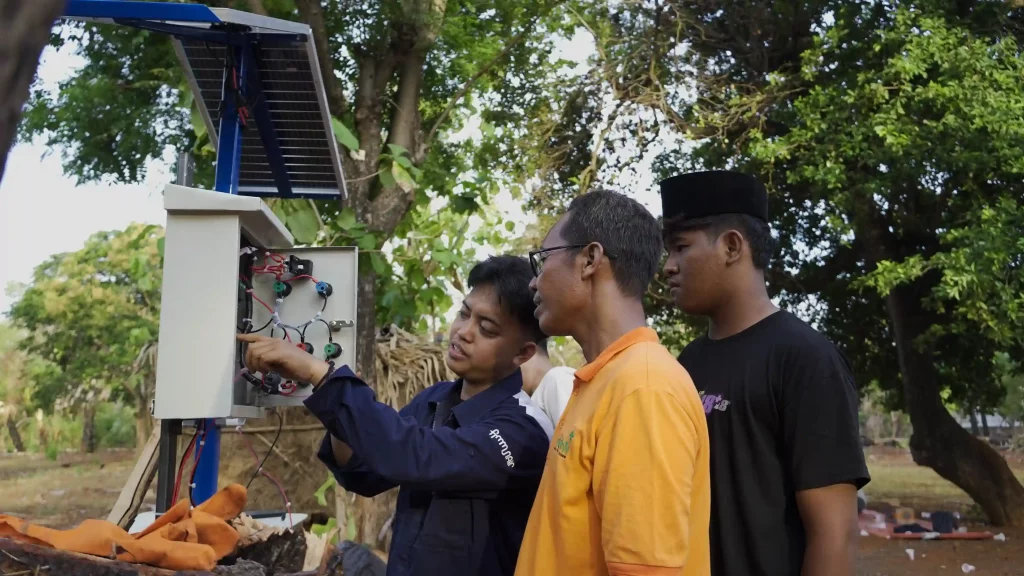
Gili Iyang Island is renowned for having the highest oxygen concentration in Indonesia, making it a popular health and wellness tourism destination. However, the local community continues to face challenges in accessing stable electricity. To address this, the FTMM team introduced a solar-powered renewable energy solution. The installation of solar shelters now enables residents to charge electric bicycles and electronic devices using eco-friendly solar energy.
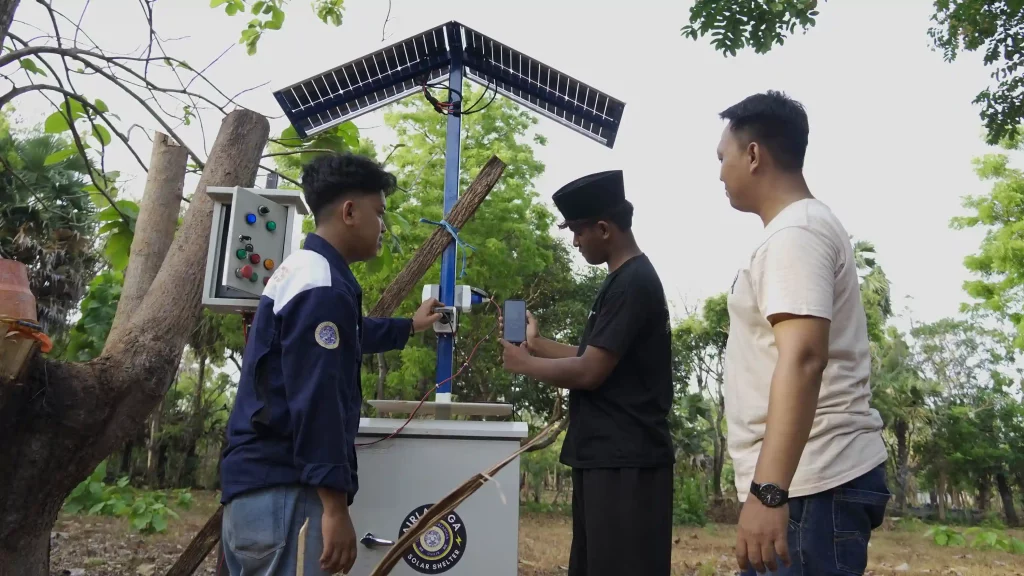
Throughout the program, the team conducted training sessions on the operation and maintenance of the solar system. Local residents and youth from Karang Taruna actively participated in the installation, reflecting strong collaboration between academics and the community. The team also worked closely with the Gili Iyang Tourism Awareness Group (Pokdarwis), which plays a central role in managing local tourism. The addition of these solar shelters improves visitor convenience while reinforcing Gili Iyang’s reputation as a clean-energy-based ecotourism site.
Stable and efficient energy supply
FTMM Solar Shelter System utilizes 50 Wp solar panels, a VRLA 12V 50Ah battery, and a 1000 W inverter, providing a stable and efficient power source for remote areas. The system is designed to be low-maintenance and easily operated, making it well-suited for rural communities. Beyond supplying electricity, the initiative also serves as a public education platform, promoting awareness of renewable energy adoption and environmental sustainability.
Through this project, FTMM reaffirms its commitment to advancing the United Nations Sustainable Development Goals (SDGs), specifically Goal 7 (Affordable and Clean Energy) and Goal 13 (Climate Action), by developing innovative and sustainable technologies that address energy challenges in underdeveloped regions (3T areas) and foster energy self-sufficiency across Indonesia.
Innovative water filtration project
At the same time, the Industrial Engineering Department of FTMM conducted another community service program focused on water filtration innovation. On Saturday (October 25, 2025), Gunawan Setia Prihandana, MEng, PhD, a lecturer in Industrial Engineering, led the installation of a new water filtration system at a local water depot on Gili Iyang Island, assisted by students from the same department.
According to Prihandana, the filtration system incorporates four active materials, activated sand, manganese sand, activated carbon, and zeolite, to enhance water purity through microfiltration. Although the depot already uses a reverse osmosis (RO) system, the team added an extra filtration layer before the RO process to reduce high calcium content in the island’s water.
Author: Yutika Amelia, Andri Hariyanto
Editor: Yulia Rohmawati