

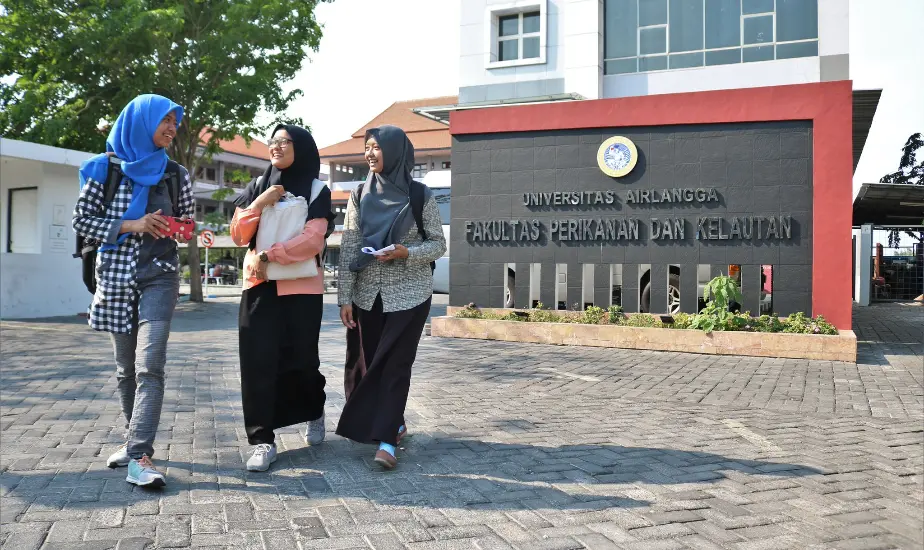
UNAIR NEWS – Aquaculture is one of the undergraduate study programs in the Faculty of Fisheries and Marine Sciences (FPK) at Universitas Airlangga (UNAIR). The campus is located at the MERR-C Campus, UNAIR.
Putri Desi Wulan Sari Spi MSi, the Coordinator of the Aquaculture Study Program, highlighted that UNAIR’s Aquaculture program is uniquely focused on fish and environmental health. In her statement on Wednesday, January 17, 2024, Desi underscored this specialization as a key strength of the program.
“Our Aquaculture program at UNAIR stands out for its focus on fish and environmental health. The curriculum is specifically designed to cover these areas, incorporating subjects related to parasites, viruses, and bacteria affecting fish,” she detailed.
Accreditation and contribution
The strength of UNAIR’s Aquaculture study program is evident through its national and international accreditations. Desi mentioned that these accreditations open up broader opportunities for academic activities, both nationally and internationally, within the Aquaculture study program.
“The program has achieved Excellent National accreditation and ASIIN international accreditation. This undoubtedly expands the scope of academic activities at both national and international levels,” expressed Desi.

UNAIR’s Aquaculture study program, bolstered by its accreditations, remains committed to contributing significantly to the nation. Desi highlights Indonesia’s immense marine potential and emphasizes the crucial role of skilled human resources developed by the program in this sector.
“The advancement of these activities needs to be aligned with the presence of skilled human resources ready to tackle future challenges. Our Aquaculture program graduates possess the necessary capabilities to meet the challenges in the evolving realm of fish farming,” she further stated.
National and international programs
During the 3.5 to 4-year study period, the Aquaculture study program actively supports a range of national and international initiatives. This includes the Credit Transfer Program (MBKM), which allows students in designated semesters to earn recognized or convertible semester credits.
The program similarly embraces international opportunities like internships, joint research projects, competitions, and international seminars. These experiences are translated into course credits, with full backing from the faculty.
“To support these activities, the study program and the faculty will provide financial aid for students’ achievements at the international level,” she explained.
Career prospects
In terms of career prospects, graduates with the “S.Pi” degree have a bright future ahead. Desi highlighted that the Aquaculture study program opens up a wide range of career opportunities. Graduates can find employment in government agencies and the private sector. They also have substantial entrepreneurial opportunities.
“Graduates of the Aquaculture study program are highly sought after for A-level positions in fish farming, taking roles such as consultants and supervisors. Opportunities also exist in state-owned enterprises (BUMN), as well as in national and international educational and research institutions. Graduates can serve as civil servants in the Ministry of Fisheries and Marine Affairs or pursue careers as independent fish farming entrepreneurs,” she concluded.
Author: Muhammad Badrul Anwar
Editor: Nuri Hermawan