


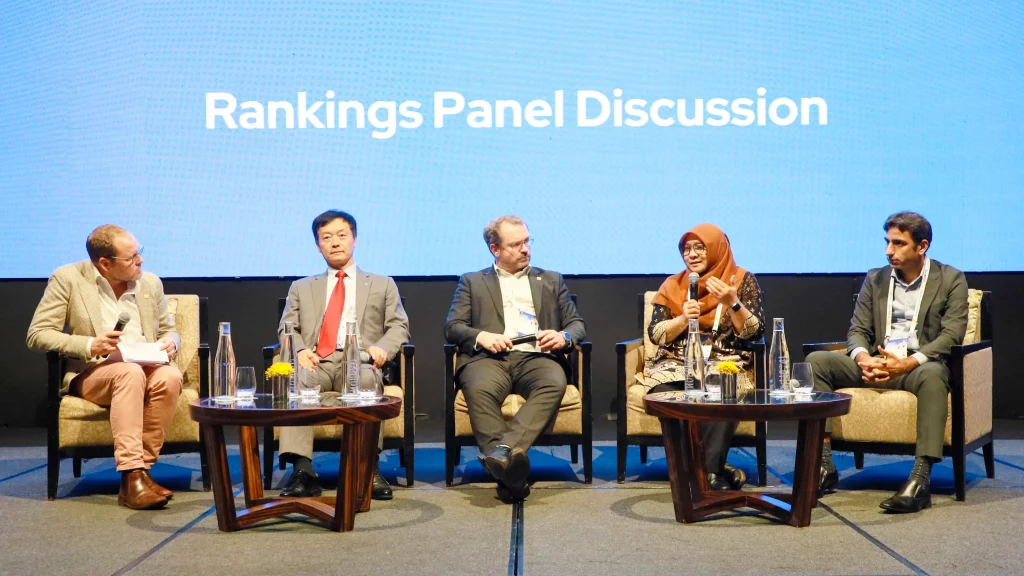
UNAIR NEWS – The QS held a Rankings Panel Discussion on the last night of the QS Higher Ed Summit Asia Pacific 2023 on November 9th, 2023. The agenda was wrapped in the QS World University Rankings 20th Anniversary Dinner. Head of the Planning & Development Board of Universitas Airlangga, Dr. Dian Ekowati Ph.D. was invited as one of the experts to share her insights on ranking. The other three panel members include Prof S. Joe Qin, President of Lingnan University; Ben Sowter, QS Senior Vice President; and Kavit Yagnik, Regional Solution Sales Manager and Research Intelligence from Elsevier. Leigh Kamolins, QS Director of Analytics and Evaluation, moderated the panel discussion which was held at the Grand Ballroom of Grand Hyatt Kuala Lumpur.
Kamolins stated that the agenda was conducted to commemorate the anniversary of QS World University Rankings and to reflect the changes in rankings in the past 20 years. He narrated a brief history of QS, and how the founder Nunzio Quacquarelli established the company 33 years ago by creating guidebooks containing information about universities. He organized career fairs to connect prospective students with various universities.
“Thirteen years later, the internet was invented. The QS World University Ranking was created to fulfill the information needs of prospective students,” he said.
At times, there has always been criticism about rankings and their current relevance. Kamolins stated that around 15 million people visit the QS website every year.
“This year, we launched the QS World University Rankings. In the first three days, almost ten million people see our rankings,” he claimed.
Prof S. Joe Qin, President of Lingnan University believed that rankings have a greater influence in Asia. It was evident when he moved to the Chinese University of Hong Kong and initiated a new campus in Shenzhen ten years ago.
“At that time, rankings were crucial in Asia, possibly even more so in China. Students and their parents wanted their money to be worth it when sending their children to university. So, I think rankings were very important,” said Prof Qin.
Engaging in the field of bibliometrics, Kavit Yagnik believed that ranking is a by-product of every good practice in the university. Ben Sowter, on the other hand, sees a revolution, in that university has used the data to report to the QS.
“Rankings will always face criticism for their inability to fully encapsulate a university. One aspect that is heavily capitalized on and requires significant energy is ensuring a wide variety of equipment and making the institution better. I see this now more than in 2004,” he said.
According to Dr. Dian Ekowati Ph.D., while rankings will always become the key topics, it also serves as a guide in assessing the strategic performance of universities. In Indonesia, many universities are assigned to achieve specific rankings.
“As you perhaps know, there are 5,000 universities in Indonesia. It’s a huge number,” she said.
One more thing about ranking is that it concerns an institution’s data management. In the context of ranking, data may pose another challenge.

“We need to show our work in research, teaching, and community development. At the same time, we are urged to demonstrate to the world what we can do about it,” she said.
From the perspective of Planning and Development, participating in the rankings is like having a medical check-up, where a performance report is given, revealing both the strengths and weaknesses of an institution.
“That’s where we see what’s good [in our work] and what to improve. From that perspective, rankings become one of the tools to assess performance. However, they’re not the goal but it’s what we need,” said the Faculty of Economics and Business lecturer.
She believed that rankings encourage universities to achieve far beyond. Universitas Airlangga has achieved remarkable milestones through its improved performance in rankings.
“A few years ago in 2015-2016, our research performance was barely published 150 papers. Now, we can publish at least 2,500 papers per year. It changes the strategy on how we reach the number, and how to improve the research culture and strength. I’d like to see those perspectives. Therefore, rankings are a tool to improve our performance,” she said.
The University of York alumna added that rankings could attract interest from other institutions for collaboration.
“Over the past three years, with our ranking, Alhamdulillah, we’ve been in a favorable position due to all our efforts. In 2020, our data indicated that we partnered with around 260 institutions from 40 countries around the world. By 2023, we’ve collaborated with about 350 partners. So, there’s been a 40 percent increase compared to three years ago. They come from 63 countries,” said the Organizational Change Management lecturer.
The data indicates increases in the number of partners and diversity of origin countries. It is highly beneficial in the context of international research networks. Drawing from her experience as the former Director of AGE, rankings are one of the first frequently asked questions when seeking collaboration with potential partners.
“Even in the past 6 years, rankings are showcased in the backdrop of exhibitions like this event. People have become more aware of rankings. At some point, rankings pique interest as a way to measure the resources or strengths of a university,” she said.
Author: Andi Pramono
Editor: Martha Kurnia Kusumawardani.