


UNAIR NEWS – Microplastics have emerged as a growing global concern in both environmental and public health sectors. These tiny particles not only pollute water and soil but can also enter the human body through food, beverages, air, and everyday consumer products.
To address this issue, the Sustainable Community Service Institute (LPMB) Universitas Airlangga organized an educational forum titled Invisible Threat of Microplastics. The event took place at the Dewa Suci Hall, Airlangga Convention Center, UNAIR MERR-C Campus, on Friday (Nov. 28, 2025).
The dangers of microplastics
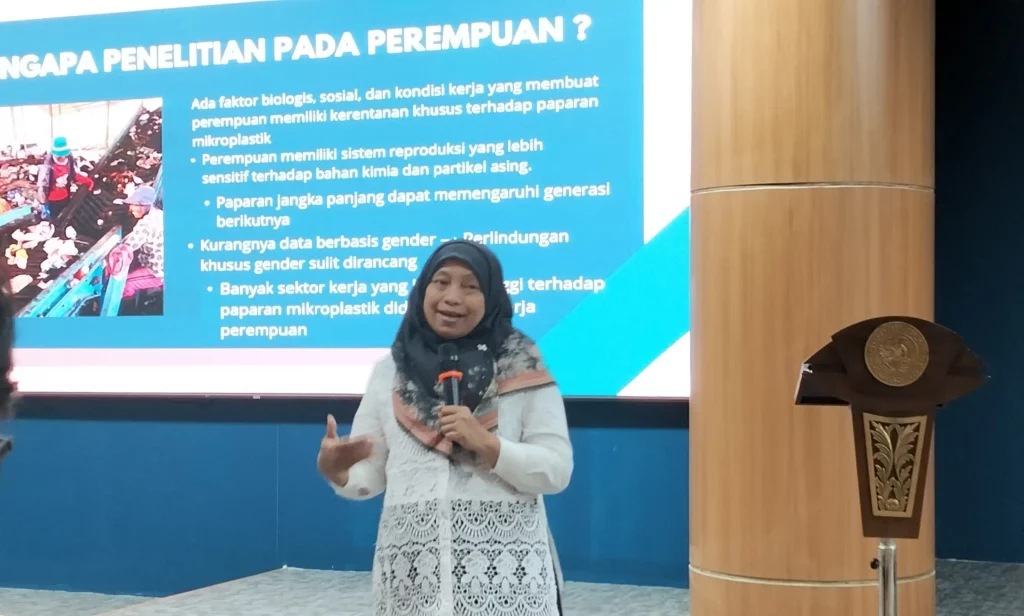
The program brought together health professionals to examine the impacts of microplastics more closely. One of the speakers, Dr. Lestari Sudaryanti, dr., M.Kes., shared insights drawn from her research.
She referenced a study showing that combustion by-products can generate microplastics capable of entering the human bloodstream. These particles were even found in the placenta. “All of these elements enter our bodies and circulate through various organs without us realizing it,” she explained.
She further noted that microplastics can infiltrate bodily tissues and transport hazardous chemicals, creating long-term health threats for both mothers and developing fetuses.
Vulnerable groups
Dr. Sudaryanti also emphasized that women face higher biological susceptibility to chemical exposure. Monthly hormonal shifts, social factors, and certain occupations significantly increase women’s likelihood of encountering microplastics. “All of my studies indicate just how vulnerable women are to chemical exposure, including microplastics,” she said.
She added that gender-specific data on microplastic exposure remains limited, even though the risks faced by women and workers in certain sectors are substantial. Exposure can begin as early as pregnancy, as microplastics in amniotic fluid may disrupt early development of vital organs such as the brain, liver, and lungs.
“If amniotic fluid contains microplastics, the first organs affected are the brain and lungs. This is deeply concerning,” she added.
Author: Adinda Octavia Setiowati
Editor: Yulia Rohmawati