

UNAIR NEWS – Environmental change has drawn global attention as its impacts are increasingly felt in everyday human life. Responding to this challenge, the Universitas Airlangga’s Institute of Sustainable Community Service (LPMB) has reaffirmed its commitment to collective environmental stewardship. The initiative took the form of planting 200 tree saplings of rain trees, mahogany, and stone apple trees, at Pakal Grand Forest Park in Surabaya on Sunday (Dec 14, 2025).
The program was carried out in collaboration with a range of youth and community organizations, including Natura Amerta, East Java Environmental Ambassadors, Cak and Ning Surabaya, the Pakal subdistrict administration, the Benowo Military District Command (Danramil), officers from the Municipal Police (Satpol PP), and the Surabaya Office of Food Security and Agriculture (DKPP).
The strong involvement of youth communities underscores a shared awareness and commitment to environmental conservation. Organizers expressed hope that this spirit of collaboration will be sustained over the long term. The activity also aligns with the Sustainable Development Goals (SDGs), particularly Goal 13 on Climate Action and Goal 15 on Life on Land.
Restoring forest functions
In his address, Prof. Drs. Hery Purnobasuki, MSi, PhD, emphasized LPMB’s full support for the initiative. He encouraged that the message of environmental action be further disseminated among young people through environmental ambassadors and Cak and Ning Surabaya. “Planting seeds or tree saplings can start as an individual effort in one’s immediate surroundings and eventually become a daily habit,” said the Head of LPMB UNAIR.
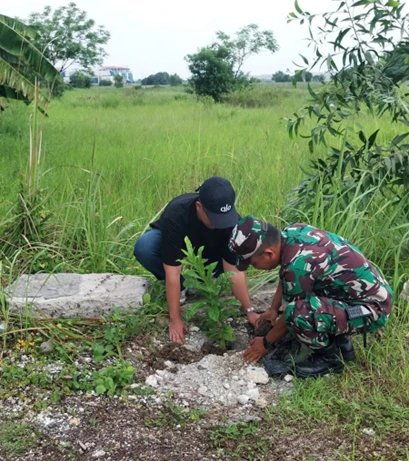
When trees are properly planted and maintained, they can perform their functions effectively, producing oxygen, absorbing carbon dioxide (CO₂), retaining water, stabilizing soil against runoff, lowering ambient temperatures, and providing habitats for various organisms. These benefits extend to all living beings in the surrounding ecosystem.
Expanding green areas
The initiative also reflects a broader vision for Surabaya to expand and better manage green spaces throughout the city. A sustainable Surabaya is envisioned as a city that prioritizes green open spaces (RTH), integrating nature into urban planning to foster a healthy, efficient, and equitable environment.
“Surabaya prioritizes green open spaces, public transportation, waste management, and renewable energy, while integrating nature into urban development to meet climate targets. The city aims to allocate at least 30 percent of its area to green open spaces and connect them with green infrastructure to reduce pollution, manage water resources, and enhance residents’ quality of life,” he said.
The participation of local stakeholders also highlights strong regional government support for implementing the pentahelix approach, a strategic collaboration model that brings together five key sectors: government, academia, business, community, and the media.
Author: Rizma Elyza
Editor: Yulia Rohmawati