

UNAIR NEWS – The Sustainable Development Goals (SDGs) represent a global agenda that calls for active involvement from higher education institutions. Universitas Airlangga (UNAIR), committed to advancing that mission, continues to embed the SDGs across its three core pillars of higher education: teaching, research, and community services.
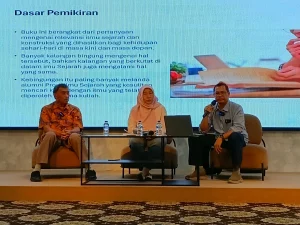
One example of this effort is a Training of Trainers (ToT) program for field supervisors of the Kuliah Kerja Nyata Belajar Bersama Komunitas (KKN-BBK), a community-based service-learning initiative. The event, organized by UNAIR’s Institute for Sustainable Community Services (LPMB), took place for two days from Friday, Sept. 25, to Saturday, Sept. 26, 2025, at the Garuda Mukti Hall, Management Office Building, MERR-C Campus.
Advancing SDG Goals
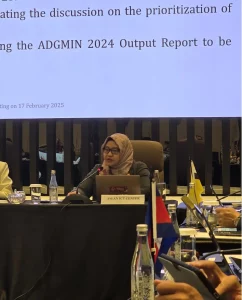
LPMB Secretary Dr. Nurina Fitriani, ST, opened the program with an introduction to SDG-oriented service projects. She explained that the SDGs were launched by the United Nations in 2015 to succeed the Millennium Development Goals (MDGs), with the aim of improving global quality of life. The framework includes 17 goals grouped into four main pillars: education, health, environment, and community empowerment.
Dr. Fitriani underscored UNAIR’s contributions to tackling complex social issues, pointing to the university’s strong performance in the Times Higher Education Impact Rankings, where it placed ninth worldwide. UNAIR achieved first place globally in SDG 6 (Clean Water and Sanitation), third in SDG 1 (No Poverty), fourth in SDG 5 (Gender Equality), and 29th in SDG 9 (Industry, Innovation, and Infrastructures).
With the 2030 deadline for the SDGs approaching, Dr. Fitriani said UNAIR would increase its efforts in areas where it has yet to secure stronger global positions, including SDG 9, SDG 4 (Quality Education), SDG 10 (Reduced Inequalities), and SDG 8 (Decent Work and Economic Growth).
“There is a ranking system that classifies UNAIR’s SDG performance globally,” she said. “Blue means top 30, yellow ranks between 30 and 70, while red indicates positions in the hundreds. We hope to move those in red up to yellow through their integration into BBK programs.”
Integrating SDGs into service projects
UNAIR’s community service programs, especially KKN-BBK, have long reflected SDG principles, even if not labeled explicitly. Still, Dr. Fitriani stressed the importance of openly identifying SDG contributions in project outputs to align with international standards. These outputs include media articles, photo and report documentation, audiovisual content, videos, and book chapters.
She concluded by presenting examples from UNAIR’s SDGs Center as references for KKN-BBK initiatives, such as building bore wells to provide clean water for communities and water conservation projects in the upper Brantas River. “These activities could be replicated or further developed by faculty members when guiding BBK students in the future,” she remarked.
Author: Selly Imeldha
Editor: Khefti Al Mawalia