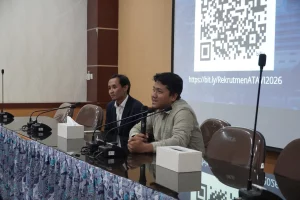



UNAIR NEWS – Dozens of students and community members crowded into the Bima Suci Theater at the Airlangga Convention Center (ACC) on UNAIR’s MERR-C Campus on Friday (Nov 28, 2025). They gathered for the “Invisible Threat of Microplastics” exhibition and talk show, a joint effort by UNAIR’s Institute for Sustainable Community Service (LPMB), the SDGs Center, the Ecoton Foundation, and Greenpeace Indonesia. The event underscored the growing risks microplastics pose to human health.
Microplastics enter a critical stage
Head of LPMB Prof. Hery Purnobasuki, Drs., M.Si., Ph.D., warned that microplastics have reached a crisis level. As an opening example, he pointed to the shift in bottled water labeling, noting that what was once called “mineral water” is now simply “bottled drinking water,” raising questions about what it actually contains. “Most of the water we consume comes in plastic bottles. It used to be marketed for its minerals. Now it’s just bottled drinking water, which makes its contents worth examining,” he said.

Prof. Hery added that microplastics accumulating in the body may contribute to various health problems. He encouraged attendees to begin with simple habits such as carrying reusable tumblers and personal cutlery to reduce plastic use. “As an institution committed to sustainable community research, we aim to take an active role in raising awareness and helping address the dangers microplastics pose,” he stated.
New findings on microplastic presence
Ecoton Foundation founder Prigi Arisandi also shared alarming findings. “Microplastics are no longer limited to water and soil; they are now found in the air and even in rainfall, including in Surabaya, which is linked to the burning of plastic waste,” said the UNAIR science alumnus.
He explained that microplastics appear in forms such as fibers, fragments, pellets, films, and foam. “More concerning are microbeads, which are found in everyday products like soaps, scrubs, and toothpaste,” Arisandi added. Ecoton’s research has even detected microplastics in the urine of female waste workers, along with BPA, commonly found in plastic bottles and canned foods.
Associated with cognitive decline
In line with those concerns, Afifah Rahmi Andini, a researcher with Greenpeace Indonesia, presented results from a study conducted with several medical faculties. Among 67 participants from the Greater Jakarta area, microplastics were detected in blood, urine, and feces, with PET being the most common polymer found. “Participants with high exposure had a 36-times higher likelihood of experiencing cognitive impairment,” she reported. She noted that microplastics can enter the human body through ingestion, skin contact, and even the bloodstream.
Andini also issued strong recommendations. She called for accelerating the ban on single-use plastics, transitioning to reusable packaging, and establishing standardized testing for microplastics. “As a tropical country, our plastic breaks down into microplastics more quickly, yet our mitigation efforts still lag,” she said.
She added that producers must take responsibility by reducing single-use plastics, being transparent about product materials, and investing in filtration technologies. “The public must also reduce plastic use, sort their waste, and increase their awareness of the risks,” Andini concluded.
Author: Panca Ezza Aisal Saputra
Editor: Yulia Rohmawati