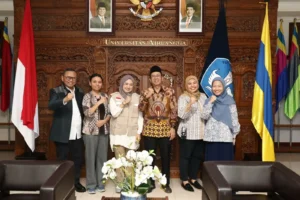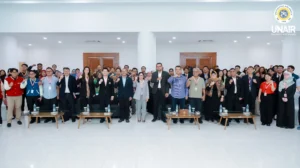


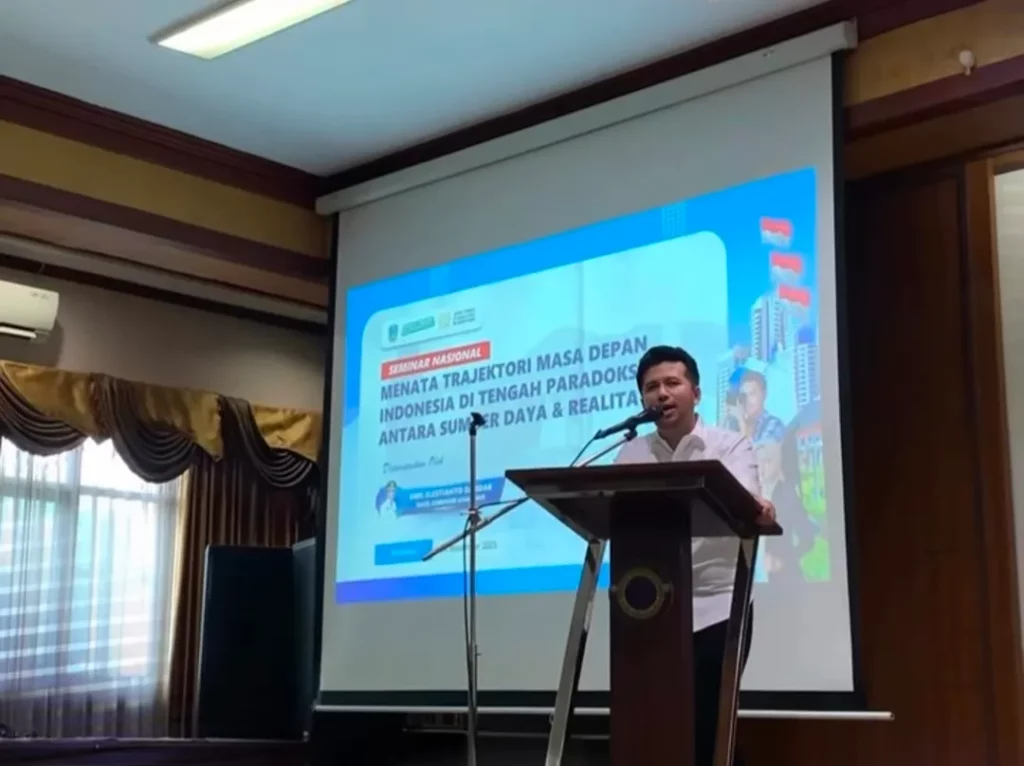
UNAIR NEWS – The Student Executive Body (BEM) of the Faculty of Social and Political Sciences (FISIP) Universitas Airlangga (UNAIR) successfully hosted Dr Emil Elestianto Dardak BBus MSc PhD as the keynote speaker of its national seminar. Speaking on the theme “Charting Indonesia’s Future Trajectory Amid the Paradox Between Resources and Reality,” Dardak offered his perspective on the country’s current state.
Trajectory as foundation of national sovereignty
Dardak began by describing a trajectory as a roadmap that guides a nation’s direction while also functioning as a strategic tool to achieve its aspirations. He explained that trajectories often present two approaches: projecting forward or learning from the past. Reflecting on Indonesia, he noted that although the nation is rich in resources, its people still question why prosperity remains elusive.
“Indonesia is an agrarian country. Others should be the ones intimidated by us. So why are we the ones worried about imports? We should be leading the global food market. That’s the paradox,” he said on Monday (24/11/2025).
To him, food independence is essential. Without it, a country cannot fully capitalize on its natural resources. “When we talk about resilience, the priority is maintaining safe stock, even if it comes from abroad. But food sovereignty means being self-sufficient. It means producing our own supply and not depending on other countries,” he explained.
Learning from Singapore
The East Java Deputy Governor continued by noting that the gap between Indonesia’s resources and its reality takes many forms. He expressed concern that Indonesia’s comparative advantage may be falling behind, making decisive action necessary. Drawing on Tony Blair’s reflections, he highlighted three strategic decisions made by Singapore’s founding Prime Minister, Lee Kuan Yew.
First, after Singapore separated from the Federation of Malaya, Lee Kuan Yew made English the national working language, believing it would connect Singapore to the global community. Second, the government committed to a strict, zero-tolerance stance on corruption, with the belief that investing heavily in professional salaries would prevent unethical behavior.
Third, as Blair recounted, Lee Kuan Yew insisted that Singapore remain open to talent from anywhere, without restrictions. Anyone could contribute to the nation’s progress. This openness shows in the rise of the National University of Singapore, once overlooked and now ranked among the world’s top ten universities.
Dardak stressed that Indonesia does not need to copy Singapore exactly but can still draw lessons from its example. “Singapore seeks the best talent without regard to nationality, students included. What does that tell us? Their mindset isn’t ‘I’m wealthy so I should spend it.’ Instead, it’s ‘We must strive to be the best to survive.’ Their mentality is that without struggle, you cannot succeed,” he concluded.
Author: Uswatun Khasanah
Editor: Yulia Rohmawati