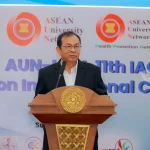

UNAIR NEWS – An international webinar titled Invisible Exposures: How EDCs and Toxic Chemicals Impact Women Waste Workers was convened on Tuesday (Nov. 25, 2025) via Zoom. The event was jointly organized by Universitas Airlangga (UNAIR), the Wonjin Institute for Occupational and Environmental Health (WIOEH), the International Pollutants Elimination Network (IPEN), Ecological Observation and Wetland Conservation (ECOTON), and Ecological Alert and Recovery Thailand (EARTH). The program offered a thorough examination of the health risks faced by women in the waste-management sector due to exposure to hazardous chemicals from plastic waste.
Dr. Lestari Sudaryanti, dr., M.Kes., a researcher and lecturer at UNAIR’s Faculty of Medicine, presented findings from a collaborative study titled Phthalate Exposure, Estrogen Dysregulation, and Its Implications for Insulin and Leptin Function in Relation to Weight Gain among Female Waste-Sorting Workers. During her presentation, she warned of the significant dangers posed by phthalates, plastic-derived chemical compounds classified as endocrine-disrupting chemicals (EDCs), which can interfere with the body’s hormonal regulation and metabolic systems.
Health irregularities among female waste sorters
According to Dr. Sudaryanti, waste-sorting workers experience some of the highest levels of chemical exposure. “Women who sort waste are in direct contact with plastic debris every day,” she said. She also explained that phthalates enter the body through multiple routes, including inhalation and skin absorption.
Her team’s findings revealed several striking abnormalities. “Most of our respondents were overweight or obese, even though they come from low-income communities and perform physically demanding work. That signals an underlying issue,” she noted.
The descriptive data further showed that 37 percent of participants had hypertension and 8 percent exhibited early signs of diabetes. These results strengthened concerns that exposure to toxic plastic chemicals may be contributing to widespread metabolic disorders among workers.
Disruptions to estrogen, insulin, and leptin
Drawing from scientific evidence, Dr. Sudaryanti explained that phthalates act as estrogen mimics, throwing off the body’s hormonal balance. “Phthalates imitate estrogen, interfere with estrogen receptor activity, and disturb the reproductive hormone system in women,” she said.
She added that such exposure can lead to insulin resistance, which elevates blood sugar levels and increases the likelihood of developing type 2 diabetes. Her presentation also showed that these imbalances drive the body to convert excess glucose into fat, resulting in the buildup of visceral fat.
She emphasized that the impact is not limited to those directly exposed. “Exposure to phthalates during critical developmental stages can trigger epigenetic changes that heighten obesity risk in both current and future generations,” she explained.
Urgent need for better worker protection
In her concluding remarks, Dr. Sudaryanti called for stronger safeguards to protect women working in waste-processing environments. “We need to improve the health protections for female workers because the consequences are far more severe than they appear,” she said. She also stressed the value of international collaboration in advancing research.
“Research must continue so we can find effective solutions to eliminate plastic contaminants from the human body and the environment,” she concluded.
Author: Tsabita Nuha Zahidah
Editor: Khefti Al Mawalia