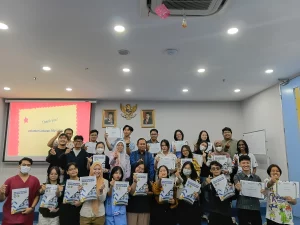




UNAIR NEWS – On Monday (May 5, 2025), the Faculty of Economics and Business (FEB) Universitas Airlangga (UNAIR) hosted a guest lecture featuring Dr. Dwitya Amry, Assistant Professor of Innovation and Technology Management at the University of Warwick. The session highlighted the critical importance of adopting technology in accelerating digital transformation.
Dr. Amry emphasized that a company’s technology strategy forms the foundation upon which all other functional strategies are built. This includes strategies in operations, human resources, and eventually sales and marketing.
Product development models
Within the field of product development, two primary innovation approaches are commonly applied: market pull and technology push. Speaking about the market pull model, Dr. Amry explained that this approach begins with a thorough understanding of consumer needs or identifiable gaps in the market.
“In this model, the process is initiated by market demand, which then guides research and development, production, and marketing efforts to meet that demand. Essentially, the market pulls the innovation process,” she said.
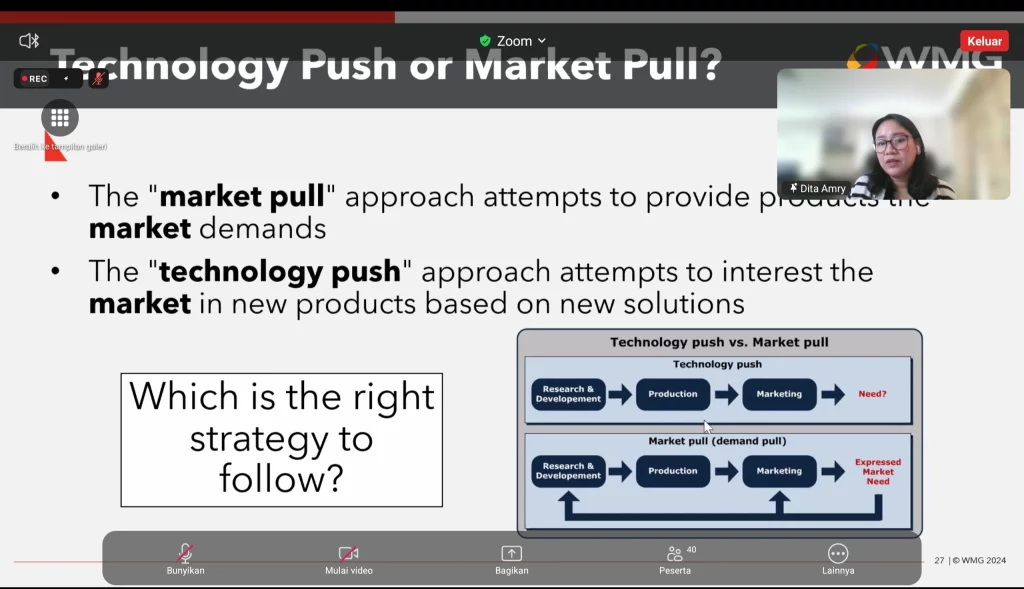
Conversely, the technology push model starts with technological breakthroughs or new solutions generated through R&D. “Here, companies develop a product based on new technology and then work to identify or create a market for it,” she noted.
Five categories of technology adopters
Dr. Amry categorized technology adopters into five distinct groups, ranging from innovators to the most reluctant users. She outlined the traits of each group. “The first group, innovators, represent about 2.5 percent. These individuals are highly skilled, open to risk, and motivated by the opportunity to be first to adopt new technologies,” she explained.
The next group, early adopters, comprises roughly 13.5 percent. “They are quick to embrace innovation in pursuit of a competitive edge or operational improvements,” she added.
Following them is the initial majority, making up approximately 34 percent. This group tends to wait until a new technology has been proven effective by innovators and early adopters.
Then comes the late majority, also representing about 34 percent. These adopters usually wait until the technology is well established and more affordable before committing to it. The final group, known as laggards, accounts for roughly 16 percent. “They are the most resistant to change and typically adopt new technologies only when older systems become obsolete,” Dr. Amry concluded.
She stressed that digital transformation is not merely about streamlining existing operations. Instead, it involves reimagining the business model itself through the use of innovative digital tools. Dr. Amry explained that this process integrates a variety of technologies and workflows with the ultimate aim of achieving strategic business goals. “This integration often leads to the creation of substantial new value for both customers and the organization,” she said.
Author: Arifatun Nazilah
Editor: Yulia Rohmawati