

UNAIR NEWS — Universitas Airlangga (UNAIR) students have once again earned national recognition, this time for their success in a prominent business plan competition. The achievement comes from three students in UNAIR’s Faculty of Economics and Business (FEB).
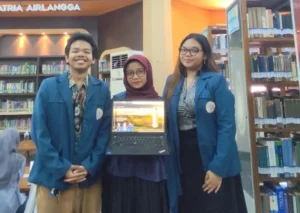
Team OK—comprised of Islamic Economics majors Desty Ika Anggraini, Lintang Ayu Rengganis Permata A, and Fatimah Azzahra Sakinah Assagung—took home the Best Design award at the KOMIKA Business Plan Competition. Organized by Universitas Sebelas Maret (UNS), the event carried the theme “Fostering Innovation, Driving Growth, and Building the Future of Business Through Creative and Strategic Planning.” The final round was held in person on Sunday, June 15, 2025.
The team’s award-winning edge came from their product’s strong visual presentation. According to Assagung, who represented the team, the judging criteria extended beyond the Business Model Canvas (BMC) and proposal; product design clarity and detail played a crucial role.
Their innovation was notable for seamlessly integrating mobile app features with smart clothing design, making the concept clear and engaging to both judges and attendees. “Visual clarity and effective concept delivery were key strengths that made our team stand out,” she said.
Smart Outfit innovation
Team OK presented Smart Outfit, an Internet of Things (IoT)-based smart apparel system. The clothing is embedded with sensors and automatically syncs with a mobile app, allowing users to monitor real-time health data and body conditions.
“Our project was inspired by the widespread sedentary habits in Indonesia. Roughly 26.27% of the population report health concerns, and the average Indonesian spends about 8.3 hours a day sitting,” Assagung noted.
That problem is further highlighted by data indicating that 74% of Indonesians intend to adopt healthier lifestyles by 2025, while 51% of wearable tech users already rely on such devices for personal health tracking. Responding to this trend, the team developed Smart Outfit, a garment enhanced with Phase Change Material (PCM) capable of automatically regulating body temperature.
That problem is further highlighted by data indicating that 74% of Indonesians intend to adopt healthier lifestyles by 2025, while 51% of wearable tech users already rely on such devices for personal health tracking. Responding to this trend, the team developed Smart Outfit, a garment enhanced with Phase Change Material (PCM) capable of automatically regulating body temperature.
Advice for future business plan competitors
She shared that the team largely prepared on their own, referencing past competitions and conducting product surveys. She also credited support from their department and faculty through coaching programs like Kejar BP—an initiative from the Association of Sharia Economics Studies (ACSES)—and Al-Fatih, a program by the Islamic Economics Student Association (HIMA EKIS).
“In our opinion, the most critical step is to thoroughly research your idea. You have to evaluate whether the concept is realistic. Sometimes we’re drawn to grand ideas that aren’t feasible. So while innovation is important, ideas must also be practical,” she explained.
Assagung added that online business plan courses were especially helpful, particularly for learning how to build a compelling and effective BMC. The team prioritized simplicity and readability in their design—using clear fonts and providing concise, well-structured explanations. Most importantly, they supported their canvas with accurate data and relevant facts to enhance the proposal’s credibility and gain the judges’ trust.
Author: Dalliyah Iftitah Arbi
Editor : Khefti Al Mawalia