


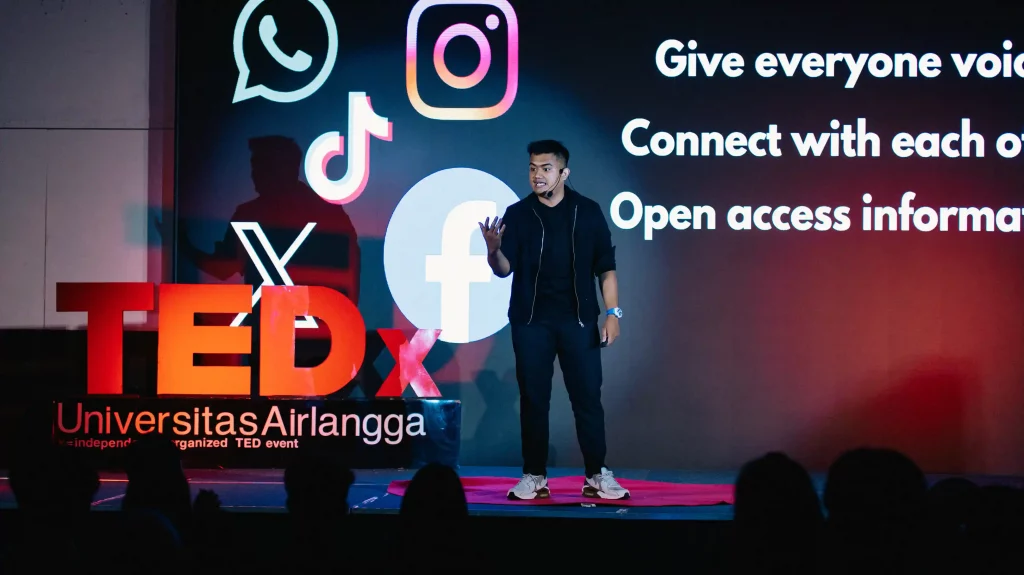
UNAIR NEWS – TEDxUniversitasAirlangga returned once again as a vibrant forum for ideas, creativity, and innovation. Held on Saturday (Nov 22, 2025) at the Pala Ballroom of the Surabaya Suites Hotel, this year’s main event carried the theme Within the Shadeline. Through this theme, the program offered a series of reflective and forward-looking discussions designed to broaden perspectives.
The event showcased six core topics: Synthetic Selves, Through the Borrowed Mirror, The Weight of Giving Hearts, Long Walks and Understanding, World Without AI, and Voice Manipulation. Each session delivered a distinct point of view that engaged and intrigued the audience.
Understanding overgiving phenomenon
Among the most attention-grabbing speakers was Bilal Faranov, podcaster and host of Suara Berkelas. In his talk, The Weight of Giving Hearts, he explored the pattern of overgiving, a behavior in which individuals give excessively to gain approval or social acceptance.
“Psychologists describe this as overgiving, when someone goes too far in trying to gain validation, avoid conflict, or win acceptance. Dr. Harriet Braiker, a prominent scholar on people-pleasing, called it The Disease to Please, a tendency to satisfy everyone but oneself,” he explained.

Faranov stressed the need to recognize emotional cues, set healthy boundaries, and cultivate internal confidence to avoid falling into self-sacrificing habits. “When you say ‘yes’ to everything, you create inner turmoil. When you say ‘no,’ you face conflict from others,” he said.
AI and roots of human curiosity
Another highlight of the event was Thor Atari, who presented Voice Manipulation, a talk examining the relationship between humans, technology, and innate curiosity, particularly surrounding Artificial Intelligence (AI). Atari argued that human curiosity, especially the urge to understand how the world works, is what ultimately gave rise to AI.
“AI comes from simple, curious questions. What if machines could help us think? What if computers could learn and perform tasks that once only humans could do?” the UNAIR student said.
Atari referenced an MIT study showing notable differences in brain connectivity between individuals who frequently rely on AI and those who do not. According to him, heavy AI users display thinner, weaker neural communication across different brain regions.
“Over time, our thinking muscles can soften. We remember less because we feel there’s no need to remember. We know the answer, but not the reasoning. Our creativity becomes more like a template. Our minds default to patterns rather than personality,” he said.
With its compelling topics, artistic elements, and deeply introspective theme, TEDxUniversitasAirlangga reaffirmed its role as a space where new ideas can take root amid rapid change. Through Within the Shadeline, participants were encouraged not only to listen, but also to reflect on overlooked aspects of themselves and the world around them.
Author: Rizma Elyza
Editor: Yulia Rohmawati