



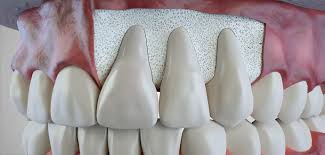
Recovery of bone defects in the oral cavity is one of the main challenges for dental services. Bone defects can occur in the alveolar bone as a result of various factors, such as tooth extraction, periodontal disease, trauma, cysts, tumors, and infections. Bone defects can also occur in endodontic surgical procedures such as hemisection and apex resection which can cause damage and alveolar bone loss. The physiological response to post-surgical damage is socket healing which leads to alveolar ridge resorption and re-building.
The healing process of the alveolar bone socket consists of 4 phases which are hemostasis phase, inflammatory phase, proliferation phase, and bone remodeling phase. Accelerating the healing process is needed to restore normal function of the affected body part, relieve discomfort, and minimize the possibility of further complications. By giving bone graft in alveolar socket after surgical procedur can accelerate the process of bone formation or osteogenesis which in turn can also improve the prognosis of the tooth.
Bovine teeth have become the most widely used substitute for human teeth because they have a similar structure or composition to human teeth and are easily obtained in large quantities in good condition. Bovine teeth also have a relatively large flat surface of the enamel. Compare to the human teeth, bovine teeth are stronger because they are not easily porous and not easily formed lesions. Processing of bovine teeth into bone graft is very promising because of the abundant availability of materials, which can help reduce waste and reduce dependence on imported bone graft materials.
Osteoconductive materials can serve as the medium for stem cells to attach, live and develop or differentiate into osteoblasts. In bone defects, osteoblasts will produce collagen, especially collagen type 1 which serves to support the mineralization of the bone matrix and organize the bone matrix to induce the osteogenesis process can occur properly. Collagen density measurement is an important aspect of bone tissue engineering because collagen is one of the markers of osteogenesis activity. Collagen is an important factor of the alveolar bone healing process because it provides integrity and strength to connective tissue, especially during the proliferation and remodeling phases. Matrix Metalloproteinases-8 (MMP-8) and type 1 collagen were strongly expressed in infected dentin of primary teeth at baseline and after cavity sealing with glass ionomer cement. During the osteogenesis process, the role of bone sialoprotein (BSP) is absolutely needed for functioning the osteoclast, especially for the integrity binding of bone cells and bone minerals. The full expression of osteopontin (OPN) or bone sialoprotein (BSP) is absolutely required, and OPN may compensate for the lack of BSP for osteogenesis.
This study was conducted on Rattus norvegicus strain Wistar. Twenty-eight Wistar rats were randomly divided into two groups (treatment and control with 14 rats in each group), and every group was divided into 2 sub-groups of 14 days and 28 days of evaluation. Materials used were hydroxyapatite bovine tooth graft (HAp-BTG) powder (size 3,5 micron), the HAp-BTG powder (0,5 gram) was mixed with combination of 19,6 grams PEG 400 (liquid) and 4,9 grams of PEG 4000 (powder) as a carrier. Histopathological examination was conducted with Masson’s Trichrome (MT) to identify the collagen fiber and immunohistochemistry stain (IHC) for identification of type 1 collagen (Col1A), BSP, and MMP-8. Collagen density was observed using a light microscope. The area being assessed was around the edge of the socket or socket healing center (HC). Collagen that was observed microscopically will appear in the form of blue-colored fibers.
The scoring of the density of collagen in microscopic visualization, magnification of 400x. The Col1A, BSP, and MMP-8 were examined in light microscopic with 1000x magnification and oil immersion to identify the cell with brown color that showed the expression of Col1A, BSP, MMP-8. The number of the expressed cell were counted for 20 microscopic fields. The enumeration of collagen fibers per microscopic field was used as the evaluation score of the collagen fibers.
The result showed that there was no significant difference between the treatment and control group in day-14 and day-28. The collagen density was significantly increased by the time (day 28 vs day-14), in both of treatment group and the control group. The observation of Col1A, BSP, and MMP-8 per microscopic field in the treatment vs control group on day-14 and day-28 showed a significant difference in Col1A, BSP, and MMP-8 between the treatment and control groups (p
Collagen is an important factor for the alveolar bone healing process because it provides integrity and strength to connective tissue. The collagen density of alveolar bone socket healing after tooth extraction was significantly increased on day-28 compared to day-14 but there was no significantly different in collagen density between the treatment groups against the control group. On the other hand, there was a significant difference between the type I collagen expressed cell (Col1A) and BSP between the treatment and control group. The study about bone healing, collagen produced by fibroblast was reached peak on 7th to 14th day and continued to increase accumulation until the 21st day 27 and other studies showed mature collagen in alveolar rats, increased substantially for up to 28 days after tooth extraction.
Type I collagen has a pivotal role in the integrity of the tissue itself, rather than the collagen in general. Thus the higher type I collagen expressed due to the application of HAp-BTG has a positive impact on dental socket recovery and maturation after dental extraction. Type I collagen forms more than 90% of the organic mass of bone and the major collagen of skin, tendon, and ligaments. The expression of bone sialoprotein (BSP) also has a similar effect with type I collagen in bone regeneration. The BSP expressed cell in the treatment group was significantly higher than the control group on both of day-14 and day-28.
The socket recovery after tooth extraction is followed by the process of bone formation, collagen metabolism, and inflammation. Matrix metalloproteinase 8 (MMP-8 = collagenase-2) is an enzyme capable of degrading almost all extracellular matrix and basement membrane protein components both in physiologic repair and pathologic destruction of tissues, such as a breakdown of extracellular matrix in embryonic development, wound healing, and tissue remodeling, is produced in bone marrow and store in polymorphonuclear leukocyte and odontoblast.
Our study showed that on the day-14and day-28, MMP-8 is significantly higher in control group of rat compared to the treatment group. It means that after 14 days and 28 days, the maturation of osteogenesis reached good progress that was indicated by decreasing MMP-8 and increasing type I collagen formation. This study also showed that HAp-BTG has a positive impact in accelerating the healing process matrix recovery of the dental socket after tooth extraction.
Authors: Nanik Zubaidah, Yosefin Adventa, Dian Dwi Pratiwi, Latief Mooduto, Ernie Maduratna Setiawati, Sri Kunarti
Title: The Pattern of Collagen, Col1A, BSP and MMP-8 in Alveolar Bone Socket Post Tooth Extraction of Rattus Norvegicus Strain Wistar After Induced with Hydroxyapatite Bovine Tooth Graft
Journal of International Dental and Medical Research ISSN 1309-100X The Pattern of Collagen, Col1A, BSP and MMP-8 in Alveolar Bone Socket Post Tooth Extraction of Rattus Norvegicus Strain Wistar After Induced with Hydroxyapatite Bovine Tooth Graft http://www.jidmr.com Alveolar Bone Socket Nanik Zubaidah and et al