

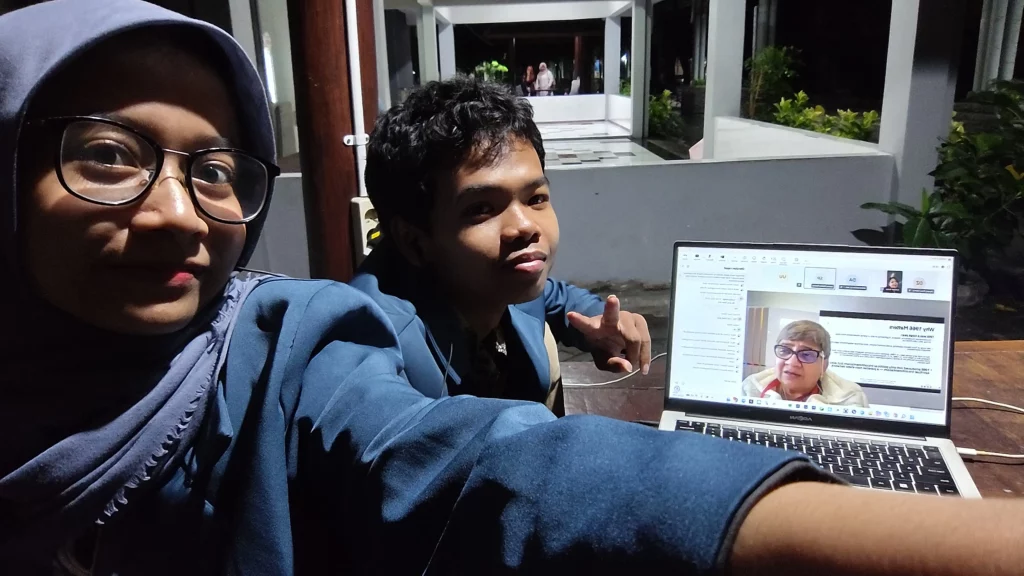
UNAIR NEWS – Universitas Airlangga (UNAIR) has once again marked an achievement on the global stage. Muhammad Irsyad Syafiudin and Kesya Azka Najhan successfully presented their ideas at the International and Interdisciplinary Conference The Rise of Asia 60 Years After Havana. The event took place on Friday, February 20, 2026, and was held online through Microsoft Teams.
Researchers from various universities around the world participated in the international conference, including participants from India, the United States, Italy, France, the United Kingdom, South Africa, and China. The organizing committee recorded a total of 91 abstracts with 99 presenters involved in the event.
“The conference was conducted in a hybrid format, both online and offline. The offline sessions were held at University Paris 1 Panthéon-Sorbonne and Le Havre Normandy University. Due to several limitations, we decided to participate online,” said Syafiudin.
Raising the issue of the 1926–1927 PKI from a deconstruction perspective
During the academic forum, Syafiudin and Najhan presented a study on the historical discourse surrounding the Indonesian Communist Party (PKI) in 1926–1927. Their research examined how colonial narratives labeled the movement as a rebellion, while in the context of Indonesia, which had not yet gained independence at that time, the term requires further reconsideration.
“We used Jacques Derrida’s deconstruction theory, Edward Said’s Orientalism, and Ann Laura Stoler’s archival perspective to analyze the narrative surrounding the deconstruction of the 1926–1927 PKI in Indonesian National History,” Syafiudin explained.
The research also applied an interdisciplinary approach, incorporating philosophical theory, anthropology, and postcolonial studies. As a result, the study does not only operate within the scope of history but also enriches the discussion through broader social theories.
“We examined Dutch-language archives and contemporary newspapers. We compared who referred to it as a rebellion, who described it as resistance, and who remained neutral. All of these sources must be verified through source criticism,” they explained.
Challenges of international conferences
Najhan also revealed that one of the biggest challenges in international conferences is language barriers. As a student from Asia, she admitted feeling nervous when presenting research before a global audience. Nevertheless, the experience became a valuable learning opportunity.
“We observed differences in research culture between Indonesia and other countries. Issues considered sensitive domestically, such as the PKI, actually receive more open academic discussion in international forums. We believe that as long as we stay confident and dare to ask questions, everything can go smoothly. They are also very inclusive and appreciate differences,” she said.
On the other hand, they had the opportunity to build connections with participants from China and India, exchange contacts, and expand their international network. More importantly, the experience became a moment for them to go beyond their personal boundaries.
“This conference opens our mental perspective. It encourages us to step outside the comfort zone of our academic discipline. History can interact with philosophy, anthropology, and even literary theory. We cannot be limited only by the label of our major,” Najhan stated.
Their participation demonstrates that UNAIR students are capable of contributing to global academic discourse while bringing Indonesia’s critical perspectives to the international stage.
Author: Putri Andini
Editor: Khefti Al Mawalia