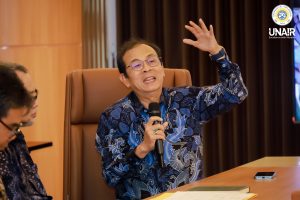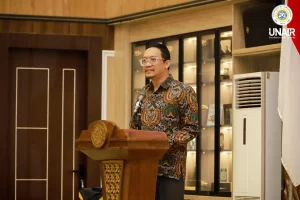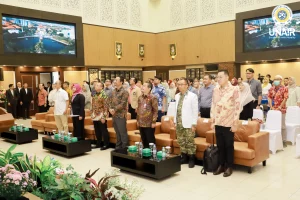


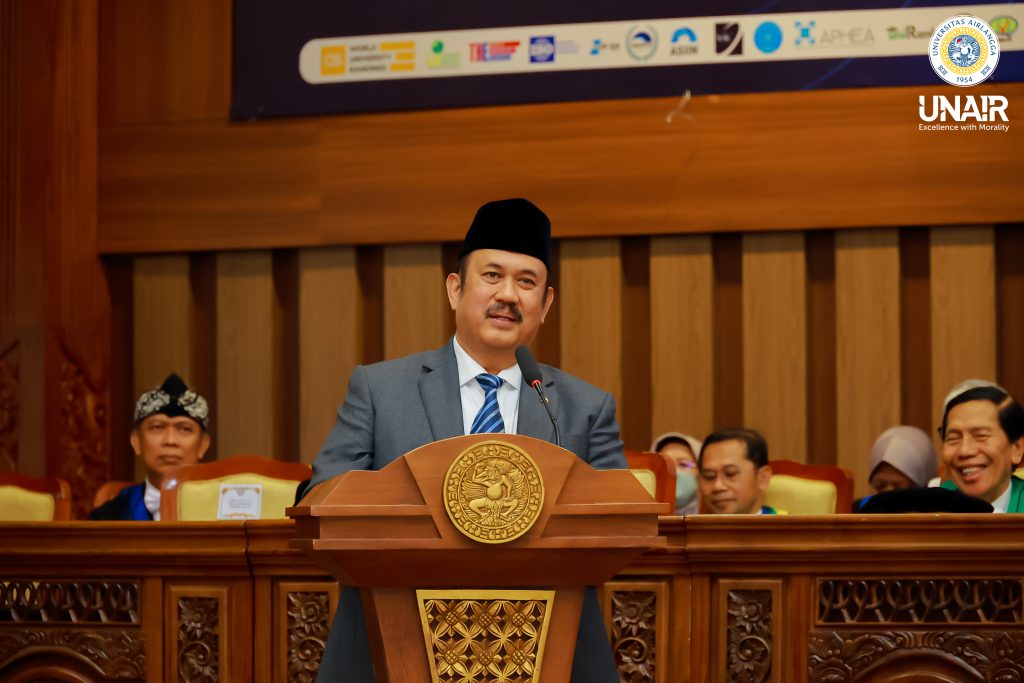
UNAIR NEWS – Minister of National Development Planning (PPN) and Head of Bappenas Prof. Dr. Ir. Rachmat Pambudy, M.S. attended Universitas Airlangga’s (UNAIR) 71st Anniversary Assembly on Tuesday (November 11, 2025) at the Garuda Mukti Hall, Management Office, MERR-C Campus. In his keynote address, he encouraged the academic community to reevaluate the role of higher education in national development and explore how universities can expand their contributions through research, innovation, and character building.
Higher education in the National Development Plan
Prof. Pambudy underscored that universities serve not only as centers for generating knowledge but also as vital institutions for shaping values. He noted that the journey of higher education is inseparable from the broader story of national progress. “When we talk about the future of higher education, we are essentially discussing the future of our nation,” he said.
He went on to outline the place of higher education within Indonesia’s national development priorities. The 2025–2029 National Medium-Term Development Plan (RPJMN) focuses on expanding access, ensuring curriculum relevance, improving the quality of learning, and strengthening research and innovation. Still, he pointed out that there are ongoing challenges that must be addressed collectively.
“Indonesia holds tremendous potential, with over 320,000 lecturers, 8,000 researchers, and 9 million students who produce research and innovations each year. The challenge lies in how we can coordinate this vast potential so that knowledge and innovation truly meet the nation’s development needs,” he explained.
UNAIR growing contribution
Prof. Pambudy also highlighted UNAIR’s achievements in various strategic areas, particularly in health research. He praised the university’s collaborations with Dr. Soetomo General Hospital and the East Java Provincial Government, noting significant breakthroughs such as early stunting detection, vaccine development, and clinical innovations that deliver tangible social benefits.
In addition, UNAIR has been active in advancing the blue economy, developing IoT-based aquaculture technologies, and strengthening its research startup ecosystem. These milestones, he noted, illustrate how universities can extend their impact by ensuring that research outcomes translate into real-world solutions rather than remaining within academic circles.
“UNAIR exemplifies how research can transform into practical benefits. This is not just an academic success, it’s a direct contribution to national development,” he affirmed.
Prof. Pambudy concluded by expressing his confidence in UNAIR’s ability to continue serving as a beacon of knowledge and humanity. With its growing research capacity, strong global reputation, and vibrant academic culture, he expressed hope that UNAIR will remain at the forefront of efforts to achieve the vision of Indonesia Emas 2045.
Author: Fania Tiara Berliana M
Editor: Khefti Al Mawalia