

UNAIR NEWS – Universitas Airlangga (UNAIR) reaffirmed its dedication to community empowerment through the Airlangga Community Development Hub (ACDH) initiative. The program, held on Saturday and Sunday (October 18–19, 2025) in Wringinputih and Kalipait Villages, Banyuwangi Regency, focused on strengthening local potential, particularly in coastal areas. The initiative featured a series of training sessions and mentoring activities involving multiple faculties and research centers across UNAIR.
This effort represents a concrete application of the Tri Dharma of Higher Education, where UNAIR’s academic community actively collaborates with local residents to create long-term, positive change. The successful execution of this initiative is expected to bring real benefits to the local population while reinforcing UNAIR’s role as a driver of sustainable transformation.
According to program coordinator Dr. Almando Geraldi, ACDH Banyuwangi was designed to develop the economic and environmental capacity of coastal communities, with a focus on the blue economy, conservation, and sustainable tourism. The program also supports the United Nations Sustainable Development Goals (SDGs), contributing specifically to SDG 1 (No Poverty), SDG 2 (Zero Hunger), SDG 14 (Life Below Water), SDG 15 (Life on Land), and SDG 17 (Partnerships for the Goals).
Strengthening agrarian and marine potentials in Wringinputih Village
In Wringinputih Village, known for its agricultural and coastal resources, UNAIR’s team concentrated on two primary sectors. Members from the Faculty of Science and Technology (FST), the Faculty of Advanced Technology and Multidiscipline (FTMM), and the Center of Excellence for Molecular Biosciences (BIOME), represented by Prof. Ni’matuzahroh and Dr. Fatimah, conducted intensive biofertilizer training. The program aimed to promote sustainable agricultural practices, reduce dependence on chemical fertilizers, and improve long-term productivity.

At the same time, the Faculty of Fisheries and Marine Sciences (FPK) provided hands-on assistance in seafood processing and packaging. “We not only train participants to process marine products with higher market value but also to package them in modern, hygienic ways so they can reach wider markets,” said Dr. Eng. Sapto Andriyono, a mentor from FPK. The initiative seeks to strengthen household income and empower local fishing communities.
Developing ecotourism potential in Kalipait Village
Unlike Wringinputih, Kalipait Village’s program emphasized sustainable tourism development. A team from the Faculty of Vocational Studies (FV) offered comprehensive training covering tour-guiding techniques, the creation of attractive tourism packages, and safety protocols for trekking activities.
“Kalipait has remarkable natural potential, especially as it borders Alas Purwo National Park. Through this training, we hope local youth can become skilled tour guides who not only showcase the area’s natural beauty but also ensure visitor safety,” explained Dr. Yuniawan Heru Santoso, coordinator from the Faculty of Vocational Studies.
The initiative was further supported by a team from Faculty of Science and Technology led by Dr. Moch Affandi, in collaboration with the Biology Student Association (HIMBIO) and the PEKSIA Study Group. They focused on environmental education and conservation by helping residents develop learning materials on the ecological importance of avifauna (bird species) in the area. This aligns with UNAIR’s mission to promote education-based ecotourism.
Building synergy through cross-sector collaboration
The success of ACDH Banyuwangi was driven by collaboration among multiple partners, including the Ijen Geopark Information Center (PIGGI) and BISA Indonesia. The program also received strong support from local leaders, village officials, and active participation from residents of Wringinputih and Kalipait Villages.
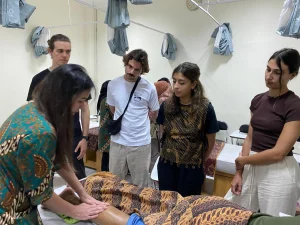
The program involved exchange students from Universiti Teknologi Malaysia (UTM), providing opportunities for cultural interaction and mutual learning between the students and local residents.
Abdillah Baraas, General Manager of Ijen Geopark, expressed his appreciation to UNAIR for conducting the ACDH program. He noted that the initiative supports the core pillars of UNESCO Geopark—conservation, education, and community empowerment—and hoped that similar collaborations will continue.
Local farmers and women’s cooperatives from Wringinputih Village also expressed enthusiasm for the program’s continuation, particularly in advancing agricultural automation and product marketing. The ACDH initiative stands as a powerful example of how collaboration between universities, government, industry, and local communities can accelerate regional growth and foster sustainable development.
Author: ACDH contributor
Editor: Yulia Rohmawati