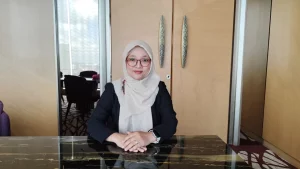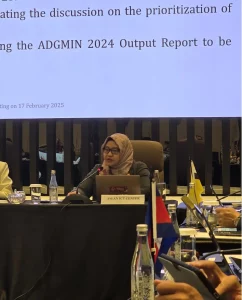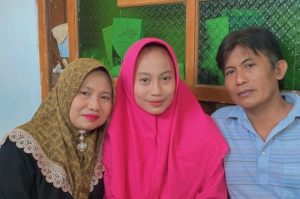


UNAIR NEWS – A graduate of Universitas Airlangga (UNAIR) continues to make her mark on the global stage. Anisa Farida, an alumna of the English Language and Literature Study Program, Faculty of Humanities (FIB) UNAIR, has built a long career at the Ministry of Foreign Affairs of the Republic of Indonesia. To date, she has served for nearly 16 years in various diplomatic assignments, both in Indonesia and at several Indonesian missions abroad.
After graduating from UNAIR in 2007, Farida did not immediately imagine pursuing a career in diplomacy. Her literature background was more commonly associated with professions such as teaching, translation, or tour guiding. However, in 2008, encouraged by her colleagues, Farida tried her luck by applying for the diplomat candidate selection at the Ministry of Foreign Affairs. Without high expectations, she successfully passed the selection process and officially joined the ministry at the end of that year.
Pursuing a diplomatic career
After joining the Ministry of Foreign Affairs of the Republic of Indonesia in early 2009, Farida began her career through the Diplomatic Training Program at the Indonesian Foreign Service School (Sekdilu). Entering the program without a background in international relations, Farida admitted that she had to learn many things from the beginning. “When I first joined, it truly started from zero. I did not come from an international relations or law background, so the theories and ways of thinking in diplomacy were all new to me. Fortunately, there was a structured training program, so the process gradually shaped my understanding,” Farida said.

Farida’s first overseas assignment took her to Toronto, Canada. During the internship period, she was involved in various consular and humanitarian activities, including fundraising initiatives with the Indonesian community and international supporters. Through this experience, she began engaging directly with cross-border humanitarian issues.
Focusing on global humanitarian issues
After returning to Indonesia, Farida joined the Directorate of Human Rights and Humanitarian Affairs at the Ministry of Foreign Affairs of the Republic of Indonesia. From this unit, her interest in human rights issues continued to grow, particularly those related to the protection of Indonesian citizens abroad (WNI). Her assignment in London, United Kingdom, later became an important phase in her career journey.
There, Farida handled various consular matters, including cases involving Indonesian migrant workers who experienced violence, exploitation, and even forced labor. “In London, the pressure was very real because we dealt directly with people, not just documents. Calls could come in at any time, and we had to think immediately about what to do and how the situation would affect the person involved,” Farida said.
One of the most memorable experiences for her was being involved in the repatriation process of a female migrant worker who had not returned to Indonesia for 18 years after being confined by her employer. According to Farida, the experience strengthened her understanding of the importance of the state’s presence for its citizens. “That was the moment when I truly realized the role of the state. When someone is in their most vulnerable position, the state must be present,” Farida said.
Learning and adapting in multilateral forums
After completing her assignment in London, Farida returned to Jakarta and served at the Directorate of International Security and Disarmament, which still intersected with human rights issues. In 2022, Farida was assigned to Geneva, Switzerland, with a role different from her previous postings. This time, she handled international trade issues in multilateral forums, a field that required her to start learning again from the beginning.
“At first, I felt like I was stepping outside the path I had built. But it turned out that trade issues are very interesting because the outcomes of the negotiations are binding and have enforcement mechanisms. The impact can be felt directly,” Farida said.
The experience changed her perspective on diplomacy. If previously she had focused largely on norms and values, she now viewed diplomacy as a strategic instrument with concrete consequences for countries. “In trade forums, if we negotiate poorly, the impact is real. There are real effects. That is what eventually made me interested. Life is a lifelong learning process. If we stop learning, we will be stuck. When we are pushed to learn something new, that is when we grow,” Farida concluded.
Author: Fania Tiara Berliana M
Editor: Yulia Rohmawati