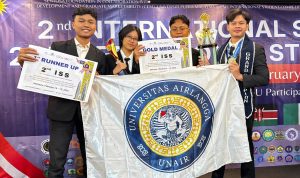


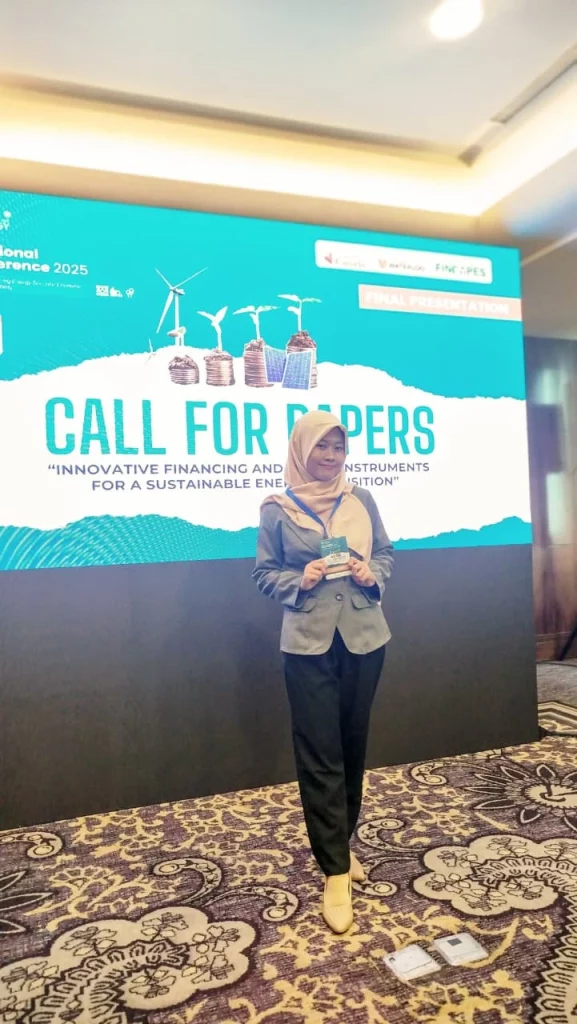
UNAIR NEWS – An alumna of Universitas Airlangga’s Faculty of Humanities (FIB) has once again brought pride to the university on the international stage. Aidatul Fitriyah, a graduate of the English Language and Literature Program, won first place for Best Paper in the International Journal of Oil Palm (IJOP) Paper Competition 2025. The event was organized by the Palm Oil Plantation Fund Management Agency (BPDP Sawit) in collaboration with the Indonesian Palm Oil Community (MAKSI).
The hybrid competition, hosted at IPB, drew more than 115 participants from several countries, including Indonesia, Sri Lanka, and countries in East African regions. Out of all submissions, only nine papers were shortlisted for presentation at the international conference held on Saturday, October 25, 2025. Among these, Fitriyah’s research earned the top position, securing the first-place Best Paper award.
Advancing Indonesia’s net-zero emission goals
Fitriyah’s study, titled Zero-Waste Palm Oil Biorefinery System for Sustainable Aviation Fuel (SAF) Production, focused on designing and assessing the technical, economic, and environmental feasibility of an integrated zero-waste palm oil biorefinery system. The model not only produces sustainable aviation fuel (SAF) but also generates high-value by-products such as biochar, bioplastic, and biofertilizer.
“The main objective is to convert palm oil industry waste into clean energy while cutting greenhouse gas emissions by up to 72.4 percent. This aligns with Indonesia’s net-zero emission goals and international standards like CORSIA and RED II,” Fitriyah explained.
Her research was carried out through a systematic, multi-stage process. It began with collecting secondary data from organizations such as the IEA, IRENA, BPS, the Ministry of Energy and Mineral Resources (ESDM), and the World Bank. The next phase involved process modeling using Aspen Plus V14 to simulate the conversion of palm oil waste into SAF and its by-products. Environmental impact was analyzed using the Life Cycle Assessment (LCA) approach, while financial viability was measured through Net Present Value (NPV), Internal Rate of Return (IRR), and Payback Period calculations.
“The key takeaway from this research is the importance of methodological discipline and systemic accuracy. Integrating process engineering, economics, and public policy within a single model taught me that science must extend beyond the laboratory. It must respond to industrial and policy realities,” she said.
Reflection of consistency and dedication in research
Fitriyah hopes her research will serve as a national blueprint for transforming the palm oil industry toward a green energy and circular economy ecosystem. She also envisions the model being used to guide the development of biorefinery pilot plants in Sumatra and Kalimantan, supporting the implementation of the Sustainable Aviation Fuel (SAF) blending mandate within the aviation industry.
She emphasized that her achievement represents more than academic recognition, it is a validation of persistence and dedication in multidisciplinary research.
“This accomplishment proves that data-driven and system-based research from Indonesia can compete on the global stage. More importantly, research should translate into tangible solutions that drive energy transition and industrial sustainability,” Fitriyah concluded.
Author: Nur Khovivatul Mukorrobah
Editor: Ragil Kukuh Imanto