

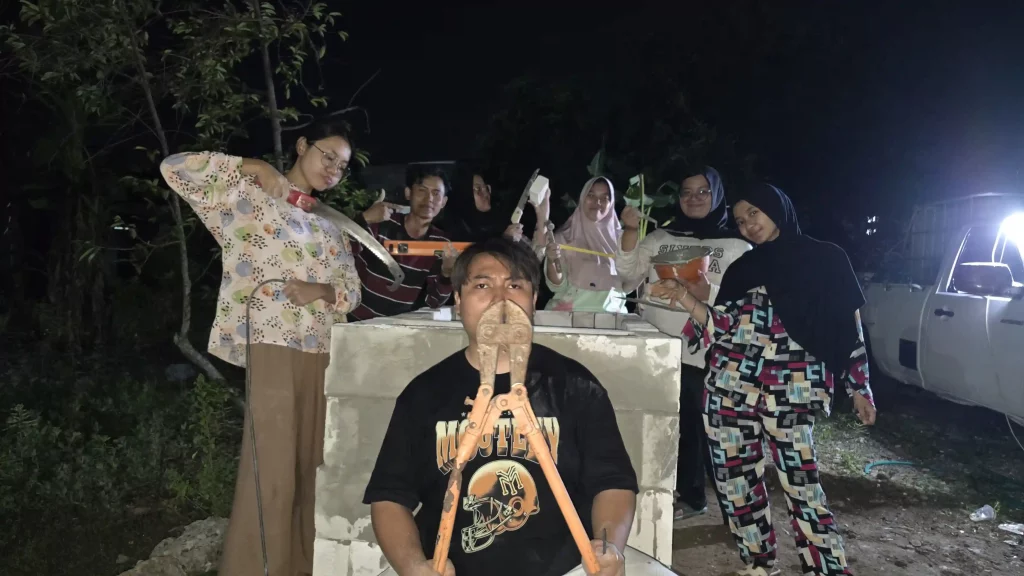
UNAIR NEWS – Students from Universitas Airlangga’s Community Service Program – Learning with Community (KKN-BBK) 6 have introduced an eco-friendly waste management innovation through a project titled Sapu Asap Desa with Rocket Stove. The event was held on Tuesday evening, August 29, 2025, in the plantation area of Gedangan Village, Sidayu District, Gresik Regency.
The initiative aims to provide an alternative to the common practice of burning household waste, which often produces heavy smoke and contributes to air pollution. Using appropriate technology, the UNAIR student team constructed and demonstrated a Rocket Stove—a combustion device built from lightweight bricks and iron, designed to reduce smoke output during the burning process.
“The Rocket Stove is specifically engineered to improve combustion efficiency while minimizing smoke. Our goal is to introduce a healthier, more sustainable method of waste disposal,” said Vidi Wilujeng Oktaviany, a member of the KKN-BBK 6 team stationed in Gedangan Village.
Educating community
The event began with an educational session for local residents, explaining the harmful effects of open waste burning and the benefits of the Rocket Stove. This was followed by a live demonstration, during which villagers actively participated in assembling the stove using lightweight bricks, mixing specialized adhesive, and testing it by burning dry waste such as leaves and non-toxic plastic. The hands-on nature of the program sparked enthusiasm among residents, particularly homemakers and heads of households.
“We usually burn our trash behind the house, and the smoke often makes it hard to breathe. But this stove works well and produces far less smoke. I’m interested in trying to build one at home,” said Bu Rini, a resident who took part in the workshop.
The program also served as a space for meaningful dialogue between students and residents. Several participants expressed interest in independently producing Rocket Stoves. In response, the student team prepared easy-to-follow technical guides so the stoves could be replicated using affordable, locally available materials.
Field Supervisor Dr. Yulis Setiya Dewi, S.Kep., Ns., MSc., praised the students’ approach for being both informative and practical. “This program directly addresses environmental challenges with actionable solutions. It’s not just theory—there’s real application and measurable benefit for the community,” she stated.
The introduction of the Rocket Stove is expected to increase public awareness around the importance of sustainable waste management. As a tangible example of science applied to daily life, the innovation reflects Universitas Airlangga’s continued commitment to supporting cleaner, healthier rural communities.
Author: Vidi Wilujeng Oktaviany
Editor: Yulia Rohmawati