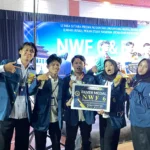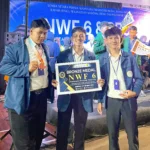
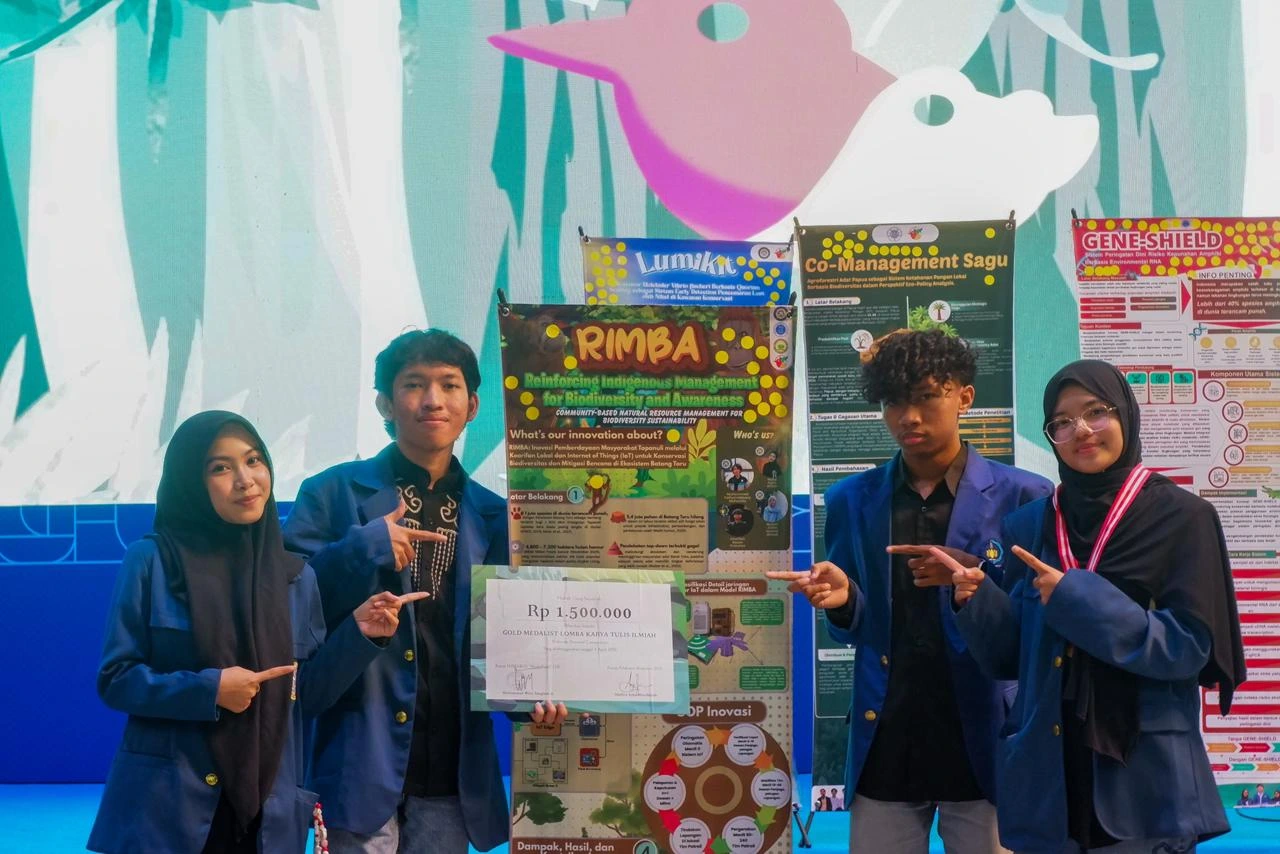
UNAIR NEWS – Students from Universitas Airlangga (UNAIR) have once again secured a significant international achievement. A team named Bismillah Juara Satu Aamiin won a Gold Medal at the Biolexion 2.0, Research and Innovation Idea Competition, hosted by the Biology Student Association of SITH ITB in Bandung on Saturday, April 4, 2026.
The team comprises four students: Naila Fatin Afifah (Faculty of Vocational Studies), Nailah Jelita Husnul Walad (Faculty of Science and Technology), Muhammad Fathurrabbany Muhasiby (Faculty of Science and Technology), and Khalifah Razan Prasetyo (Institut Teknologi Sepuluh November). They presented their project under the theme Empowering Innovation for Biodiversity Crisis Solutions.
Tackling the Batang Toru biodiversity crisis
The team highlighted the Batang Toru Ecosystem in North Sumatra, a tropical rainforest that represents the last known habitat of the critically endangered Tapanuli orangutan, whose population has declined to fewer than 800 individuals.
“We selected this issue because of growing concerns over deforestation, mining activities, and palm oil expansion that continue to threaten the region. Our goal was to propose a solution that combines technological innovation with community involvement,” said Afifah, the team leader.
RIMBA: Blending local wisdom with IoT technology
Through their innovation, RIMBA, the team developed an integrated sensor system designed to monitor forest conditions in a sustainable manner. The system incorporates camera traps, bioacoustic sensors, and microclimate sensors to track wildlife activity, detect temperature fluctuations, and capture environmental sounds.
“These sensors enable real-time monitoring of forest areas, allowing potential threats to be identified more quickly. The data collected are then integrated into a website and application that we developed,” Prasetyo explained.
In addition to technological components, RIMBA also emphasizes community empowerment by establishing a local group known as the Forest Guardian Council. This group is responsible for overseeing forest areas while acting as a bridge between technological systems and local communities.
Walad highlighted the importance of integrating local wisdom into the innovation. “We aim to deliver a solution that is both sustainable and community-centered. By positioning indigenous communities at the forefront, the innovation is expected to be more effective and impactful,” she said.
Overcoming challenges during the competition
The team acknowledged several challenges throughout the competition process. “Coming from diverse academic backgrounds made it difficult to coordinate our schedules for discussions. However, we managed to overcome this through strong commitment, effective time management, and clear communication,” said Muhasiby.
“Focus on developing innovations that directly address the urgency of the issue. In biodiversity, the most meaningful innovations are those that generate real, simultaneous impact for both the environment and the communities that depend on it. The process is challenging, so stay committed and don’t give up. Most importantly, don’t hesitate to seize every opportunity,” he concluded.
Author: Maulya Afifah Zahra
Editor: Khefti Al Mawalia