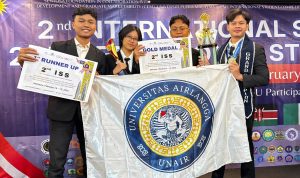


UNAIR NEWS – Students from Universitas Airlangga (UNAIR) have once again achieved national recognition. A trio from UNAIR’s Faculty of Dental Medicine (FKG) earned third place in a National Literature Review Competition hosted by the Dental Student Association of Sam Ratulangi University’s Faculty of Medicine (Unsrat) in Manado. The competition was part of a series of events under the theme Dental Awareness Matters: Addressing the Knowledge Gap in Dental Health, held from May 2–4, 2025.
The team, composed of Bayu Cahyo Bintoro and Michelle Ellen Kimberly (Class of 2024), along with Akmal Umara Adli (Class of 2023), advanced to the final stage after passing three rounds of selection: abstract submission, full paper evaluation, and an in-person presentation at Unsrat.
Highlighting Nano-CT innovation in root canal therapy
Their research, titled Evaluating Nano-CT to Improve Root Canal Morphology Accuracy for Endodontic Treatment: A Systematic Review, focused on the significance of diagnostic precision in root canal therapy. It examined Nano-CT imaging as a modern, more accurate alternative to conventional methods such as 2D radiography, CBCT, and Micro-CT.
“Through our review of six recent academic papers, we found that Nano-CT outperforms existing technologies in identifying microporosities, assessing residual debris, and analyzing root canal filling and deformation,” Bintoro explained.
The study also concluded that Nano-CT can significantly reduce the risk of treatment failure stemming from diagnostic inaccuracies, aligning well with the growing emphasis on precision-based dental care.
Systematic approach and challenges in literature review
The team adopted a systematic review approach, retrieving data from five leading databases: ScienceDirect, Scopus, PubMed, SpringerLink, and BMC Oral Health. Out of 360 initially identified articles, only six met the inclusion criteria for qualitative analysis.
Inclusion standards required that articles be relevant to the topic, published within the last five years, written in English, and available in full-text format. One of the primary challenges, the team noted, was the limited number of studies directly exploring Nano-CT’s role in endodontics.
“As a relatively new technology, Nano-CT is still underrepresented in the literature, which meant we had to be particularly selective and adapt to various research methodologies,” Bintoro said.
Aiming for international publication
Beyond their competition success, the team plans to refine their review for submission to an international journal in the dental field. They hope their findings will help broaden understanding and encourage clinical application of Nano-CT technology in dentistry. “Our goal is to support the advancement of more precise, technology-driven endodontic care,” Bintoro concluded.
Author: Ameyliarti Bunga Lestari
Editor: Yulia Rohmawati