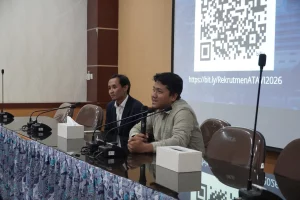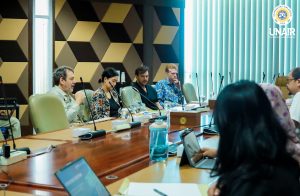


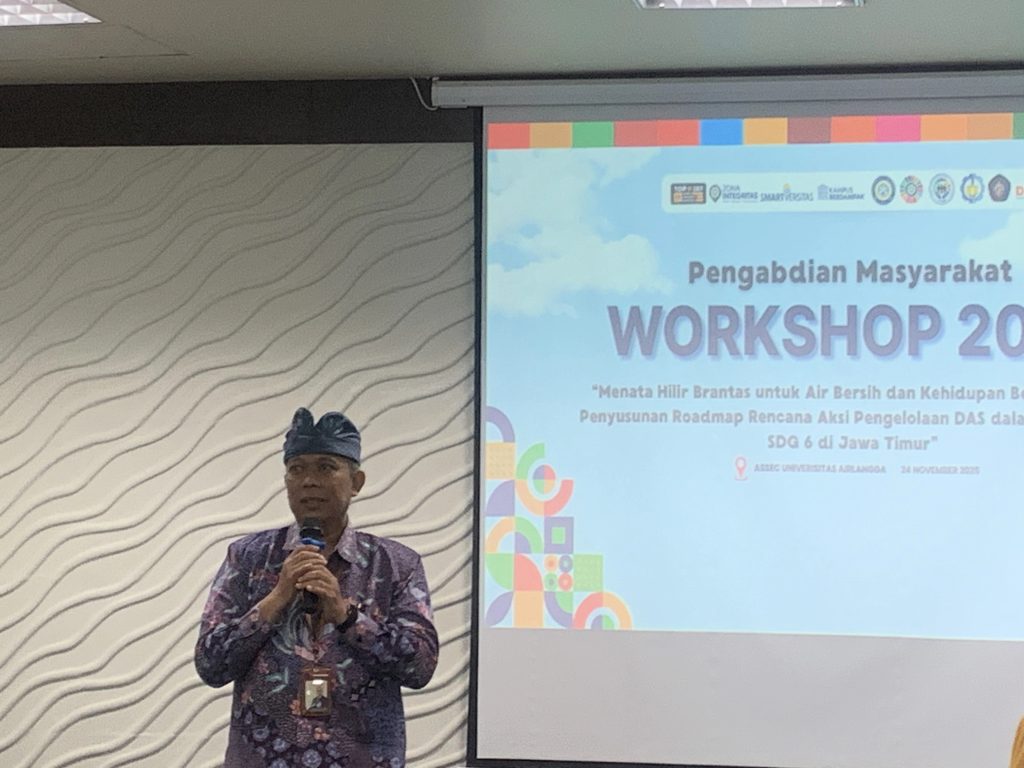
UNAIR NEWS – Universitas Airlangga (UNAIR), through its Sustainable Community Service Institute (LPMB), hosted a workshop titled “Organizing the Lower Brantas: Developing Roadmap and Action Plan for Brantas Watershed Management in Support of SDG 6.” The forum, held Monday (Nov. 24, 2025) in the Dayak Room, Dharmawangsa–B Campus, brought together academics, local officials, and environmental organizations to address the increasingly complex conditions of the lower Brantas River and outline strategic management measures.
The workshop featured extensive discussions on issue mapping, aligning stakeholder perspectives, and identifying collaborative policy priorities. The resulting roadmap is expected to provide a framework for stronger environmental governance, particularly in support of SDG 6 targets for clean water and sanitation.
LPMB highlights the need for collaboration
Prof. Purnobasuki emphasized that stewarding the Brantas Watershed requires viewing the system as a single continuum from upstream to downstream. He noted that pressures stemming from land-use changes and expanding settlements in the lower watershed cannot be managed by one party alone, underscoring the need for coordinated and deliberate planning. “Even the smallest action is more meaningful than standing still,” he remarked.
Prof. Purnobasuki expressed hope that the forum would yield policy directions grounded in cross-sector synergy. He stressed that aligning ideas among stakeholders is essential to improving the effectiveness of Brantas Watershed management. With integrated efforts, he said, sustaining the river ecosystem could generate tangible benefits for communities along its course.
Environmental agency underscores strategic value
A representative from the East Java Environmental Agency (DLH) underscored the Brantas River Basin’s strategic role in supporting the social and economic well-being of East Java residents. However, significant challenges, including industrial pollution and pressures from human activity along the riverbanks, continue to threaten environmental resilience and demand heightened attention from all stakeholders. “Through this forum, we are examining the issues facing the Lower Brantas. I am confident we can restore environmental quality and preserve a healthy environment for future generations,” the representative said.
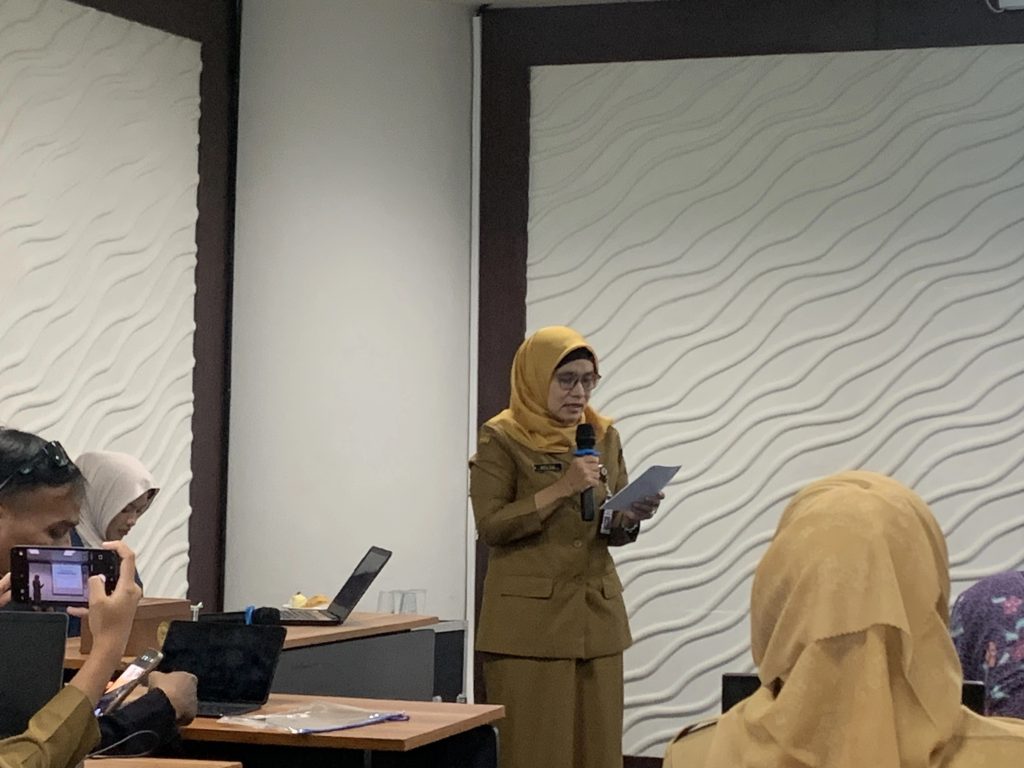
In its remarks, DLH East Java affirmed that the workshop reflects the provincial government’s commitment to improving environmental quality. The agency emphasized the forum’s importance in shaping concrete actions to address the ecological pressures affecting the Lower Brantas region.
DLH further highlighted the need for strong, cross-sector collaboration, spanning government, academia, and environmental organizations, so that policy strategies can be both practical and aligned with field conditions. The representative added that building a unified perspective among stakeholders is essential for developing sustainable recovery strategies that deliver real benefits to communities along the Brantas River.
Author: Era Fazira
Editor: Ragil Kukuh Imanto