

UNAIR NEWS – Universitas Airlangga (UNAIR), through its Halal Center, has once again demonstrated its commitment to advancing Indonesia’s national halal ecosystem. This commitment was reflected in the recent Airlangga KHAIR 2025: National Conference on Halal and Research Innovation, held on Wednesday (June 25, 2025) at the Ternate Auditorium, ASEEC Tower, First Floor. The conference carried the theme “Regulatory Harmonization in the Upstream Halal Certification Process and Innovation for the Sustainability of the Halal Ecosystem.”
The event was opened by Prof. Dr. Bambang Sektiari Lukiswanto, DEA, Drh, UNAIR Vice Rector for Academic, Student, and Alumni Affairs (AMA). In his address, he highlighted the ongoing challenges in halal literacy and oversight on the ground. “We still face significant issues at animal slaughterhouses. For this reason, UNAIR continues to strengthen its innovations and halal-related research, which also supports the UN Sustainable Development Goals and enhances UNAIR’s global standing,” he stated.
Strong commitment to halal certification
Echoing Prof. Lukiswanto’s statement, Dr. Abdul Rahem, MKes, Apt, Head of UNAIR’s Halal Center, emphasized the university’s active role in promoting national halal certification since the center’s establishment in 2017. “From the beginning, we created LP3H and a halal laboratory, and we’ve provided assistance to small businesses in West Nusa Tenggara, South Kalimantan, and East Java. We’ve also worked with investment offices to help expedite the issuance of business permits,” he said.

Dr. Abdul Rahem also shared that all food and beverage vendors at UNAIR canteens are now halal-certified. “Alhamdulillah, all 62 vendors at UNAIR canteens are now 100 percent halal-certified, thanks to our partnership with MPOPM-MUI,” he added. He also noted UNAIR’s key contribution to the development of Indonesia’s first halal vaccine, produced through faculty-led research.
Call for firm regulations in upstream halal sectors
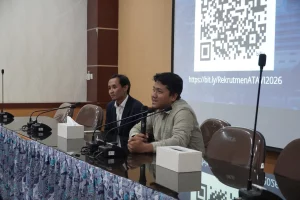
The conference gathered stakeholders and experts in halal product assurance to address strategies for accelerating halal certification in Indonesia. One of the speakers, Dr. H. Muhammad Aqil Irham, MSi, Secretary General of BPJPH, expressed concern over Indonesia’s drop in the global halal index. “We once ranked first in the Global Muslim Travel Index (GMTI). We’re now fifth. That should serve as a serious warning,” he said.
He pointed to upstream sectors—such as slaughterhouses and traditional markets—as areas of weakness. “Many business operators are still unaware of halal requirements. In Australia, for example, slaughterers must comply with Islamic law, including offering prayers. Failure to do so can lead to dismissal. That level of discipline is a model for a strong halal ecosystem,” he concluded.
Author: Samudra Luhur
Editor: Yulia Rohmawati