


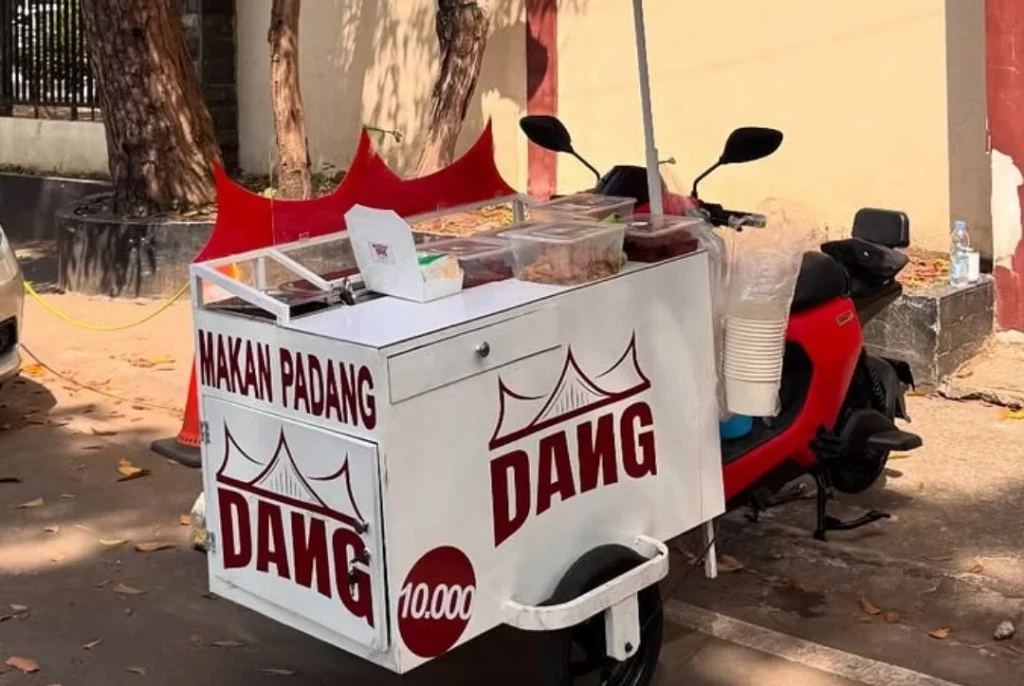
UNAIR NEWS – Mobile culinary concepts are increasingly popular in Indonesia, especially in major cities such as Surabaya. Most recently, social media has spotlighted mobile Padang rice vendors, following the earlier surge of traveling coffee sellers. While many see this as something new, the practice has historical roots. Mobile food vendors once served workers in remote areas with limited dining options. Beyond convenience, the trend also reflects cultural expression.
Professor of Communication at Universitas Airlangga’s Faculty of Social and Political Sciences, Prof. Dra. Rachmah Ida, M.Com., Ph.D., explained that mobile culinary services—commonly known today as food trucks—first emerged as a way to reach workers who lacked access to nearby eateries.
“This concept, in my view, is about reaching their target market. Vendors understand there are people who cannot easily leave their workplaces, where no food stalls exist. Now, food trucks have expanded widely and can be found everywhere,” she said.
Not new phenomenon
Prof. Ida stressed that food trucks are not an entirely new development. She compared them to traditional street vendors who have long circulated through Indonesian neighborhoods.

“What food trucks or mobile vendors are doing today is essentially the same as local bakso or tofu sellers who move from place to place. There is nothing truly new here—only now they use cars or more modern vehicles,” she noted.
Still, she added, the model offers distinct advantages. Food trucks are less costly to operate and more efficient than conventional restaurants, providing clear benefits for business owners.
“For entrepreneurs, running a food truck is far cheaper. Operational costs are low. If they operate a fixed stall, they are subject to building taxes. Food trucks avoid those taxes while generating direct income. That is a real advantage,” she explained.
Power of social media
The rapid growth of mobile dining is tied closely to social media’s ability to create instant waves of consumer interest. Prof. Ida also highlighted the role of content creators, whose viral posts can draw large crowds within hours.
“Social media triggers people to look for something new. It has helped spark what feels like a revival of food trucks. It’s extraordinary how social media can shape new subcultures within Indonesia’s consumer society,” she concluded.
Author: Mohammad Adif Albarado
Editor: Yulia Rohmawati