

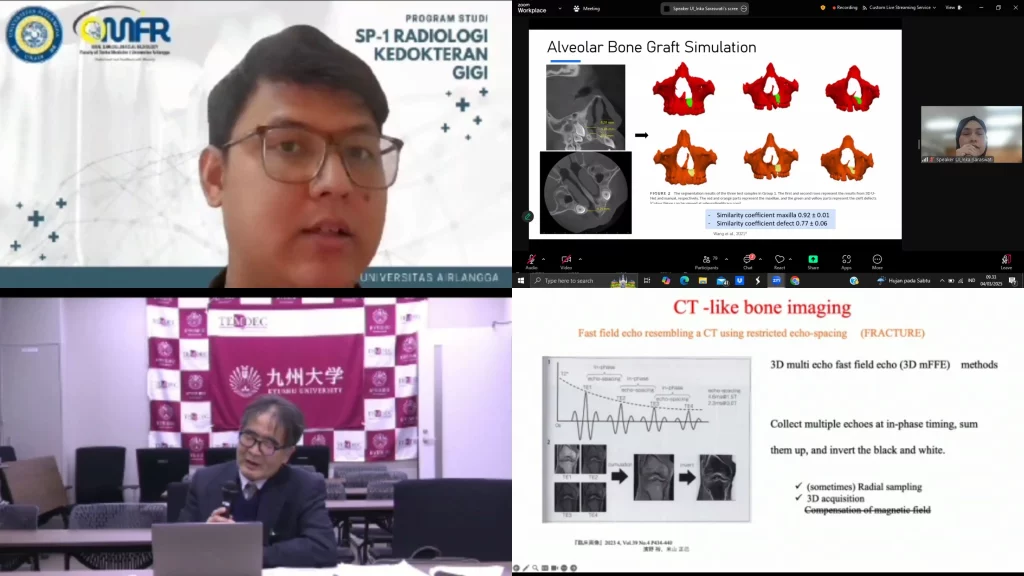
UNAIR NEWS – The Faculty of Dental Medicine Universitas Airlangga (UNAIR) hosted the 59th Asia-Pacific Advanced Network (APAN) conference in collaboration with the Telemedicine Development Center of Asia (TEMDEC) on Tuesday, March 4, 2025. Conducted virtually via Zoom, the webinar featured leading researchers in Dental Radiology. APAN 59 focused on telemedicine in dentistry, presenting the theme “Recent Advances in Dental Radiology,” including discussions on the role of Artificial Intelligence (AI) in the field.
The event featured distinguished speakers, including drg. Ramadhan Hardani Putra, M.Kes., Ph.D. (Universitas Airlangga), drg. Inka Saraswati, M.Sc. (Universitas Indonesia), and Prof. Toru Chikui, Ph.D. (Kyushu University). In the first session, drg. Putra discussed the latest applications of deep learning for pathology identification in panoramic radiography. He explained how AI has seamlessly integrated into human life, particularly in healthcare, significantly improving quality of life.
“There is a fundamental distinction between machine learning and deep learning in image recognition. Machine learning still requires human intervention during the process, whereas deep learning autonomously extracts key features from images and directly identifies whether an object is accurate or not,” drg. Putra elaborated.
Potential of deep learning
Drg. Putra emphasized that deep learning surpasses machine learning due to the availability of vast datasets for panoramic radiology. The system processes big data into valuable resources, enhancing computational capabilities. Consequently, deep learning holds significant potential in radiographic analysis and diagnostic recommendations by automatically generating chart records to minimize human error. Currently, deep learning is capable of identifying dental caries and periodontal bone loss with remarkable accuracy.
In his conclusion, drg. Putra highlighted the immense potential of deep learning in enhancing the accuracy and efficiency of diagnosing dental pathologies through panoramic radiography. To fully harness this potential, AI development requires a multidisciplinary approach to ensure effective integration into dental healthcare systems. The benefits of AI in healthcare for clinicians include reducing human error, streamlining workflows, and enabling fast and reliable assessments.
AI in cleft treatment
Following Drg. Putra’s presentation, drg. Inka Saraswati and Prof. Toru Chikui expanded the discussion. Drg. Inka explored AI-driven innovations in cleft treatment, emphasizing its role in detection, diagnosis, prediction, and treatment planning. AI enables advanced 3D simulations and predicts ideal bone structure dimensions. However, she cautioned that AI has inherent limitations, such as its inability to perform independent tasks beyond its programmed capabilities and its dependency on training data. Therefore, she stressed that clinical decision-making and responsibility must remain with dental professionals.
Meanwhile, Prof. Toru Chikui addressed three key challenges in modern maxillofacial MRI diagnostics: unintentional and uncoordinated jaw movements, anatomical complexity, and magnetic field inhomogeneity caused by metal prosthetics and air-filled cavities. As a solution, he introduced advanced corrective techniques, including radial sampling for motion correction, 3D acquisition, magnetic field adjustments, and specialized applications to minimize metal-induced artifacts.
Author: Dalliyah Iftitah Arbi
Editor : Edwin Fatahuddin