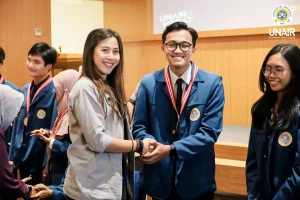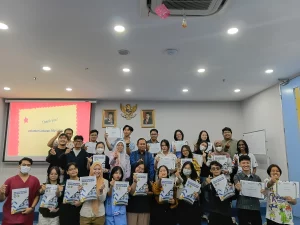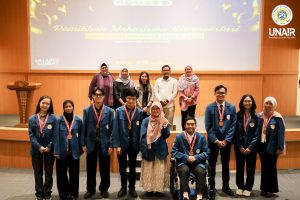


UNAIR NEWS – The Faculty of Law (FH) Universitas Airlangga (UNAIR) hosted an engaging seminar titled “More Than Just a Quota: Women’s Politics That Transforms, Not Adorns” on Saturday, October 25, 2025. The event featured two influential speakers, Sri Wahyuni, Deputy IV of the East Java Regional House of Representatives (DPRD), and Hosiana Rugun Anggraini, Governance/WPS Programme Analyst at UN Women Indonesia. The discussion explored the evolving role of women in Indonesia’s political landscape and the ongoing challenges in fostering a more inclusive and equitable system of governance.
Representation and women’s participation in politics
In her address, Sri Wahyuni emphasized that politics is no longer a male-dominated arena. She noted that increasing numbers of women are entering the political sphere and using their voices to advocate for change, though the journey toward real influence remains ongoing. “Politics is no longer an exclusive space for men. Today, more women are stepping forward and speaking out, but the struggle to move from mere presence to real influence is far from over,” she stated.
Wahyuni highlighted that the values often associated with women, empathy, compassion, and integrity, are essential in reshaping politics. “In politics, the values that women bring are deeply needed. Women are the forefront of a new political vision built on empathy, social justice, and care,” she explained.
She also underscored that an inclusive political system must be grounded in both moral courage and a genuine commitment to equality. Indonesia, she added, has ratified numerous international conventions upholding gender equality both morally and constitutionally.
Effectiveness of gender quotas and real challenges in the field
Addressing the 30 percent gender quota policy in Indonesia’s political framework, Sri Wahyuni said that while it marks important progress, it represents only the beginning of deeper systemic reform. Women who win office, she noted, often face the greater challenge of proving their capability, navigating a male-dominated political environment, and upholding their integrity and ideals.
“Politics is not about who speaks the loudest. It’s about who works with the most sincerity,” she affirmed. “Women are not mere accessories to democracy; they are its moral conscience.”
She also pointed out that women’s active participation in politics significantly shapes public policy, particularly in areas such as child and women’s protection, inclusive access to healthcare and education, and community economic empowerment through MSMEs.
Women as drivers of change, not decoration
Concluding her presentation, Sri Wahyuni urged young women to remain courageous and active in political life. “Women may not change the world overnight, but every small step, every act of courage, leadership, and advocacy, contributes to meaningful transformation,” she said.
She emphasized that a more compassionate, equitable, and human-centered politics will emerge from the genuine contributions of women who engage not as symbols, but as changemakers. “Let’s prove that women can not only participate but lead. Not only speak, but inspire action,” she concluded.
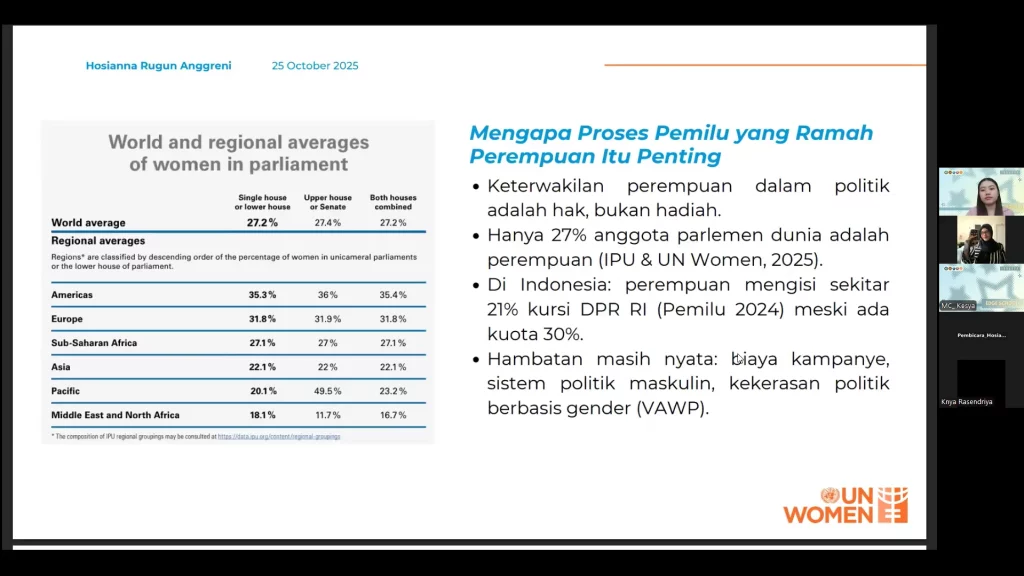
Echoing her message, Hosiana Rugun Anggraini of UN Women Indonesia reiterated that women’s representation in politics is a right, not a privilege. According to 2025 data from the Inter-Parliamentary Union (IPU) and UN Women, women currently make up only 27 percent of the world’s parliamentarians. In Indonesia, despite the 30 percent quota policy, the 2024 election saw women occupying just about 21 percent of seats in the national parliament (DPR RI).
Anggraini noted that the barriers to women’s political participation remain both structural and cultural, from high campaign costs and entrenched masculine political systems to gender-based political violence (VAWP), which often silences women candidates. She added that UN Women Indonesia continues to strengthen women’s leadership capacity, confidence, and networks to help them compete on equal terms in political spaces.
“With continued synergy between inspiration and institutional support, Indonesia’s vision of a more inclusive, empathetic, and gender-equitable political landscape is steadily becoming a reality,” Anggraini concluded.
Author: Muhammad Afriza Atarizki
Editor: Yulia Rohmawati