


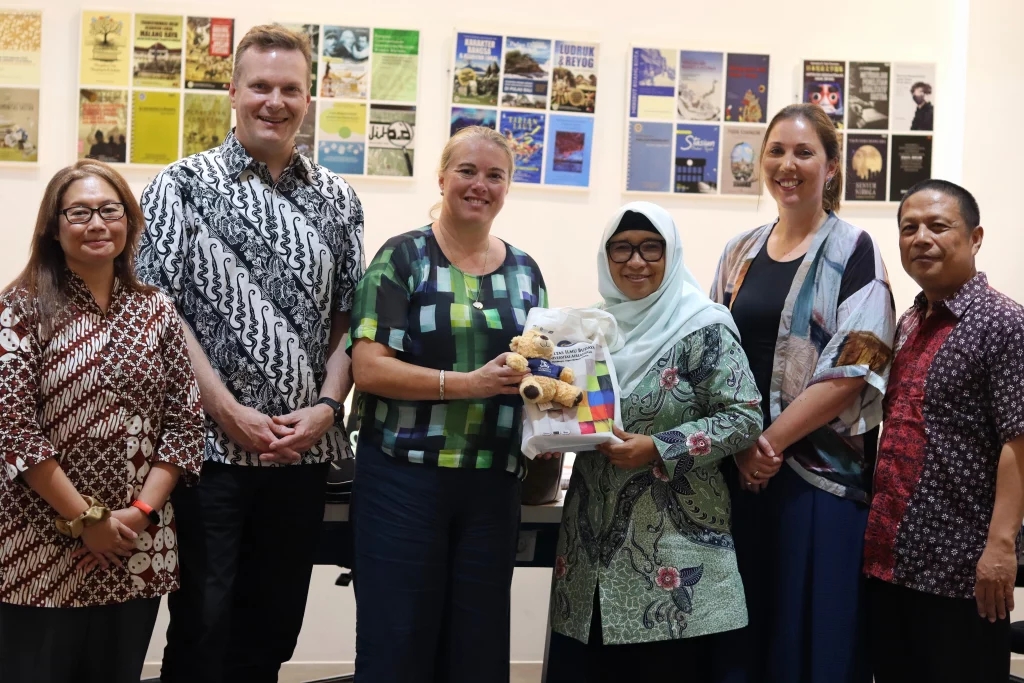
UNAIR NEWS – The English Language and Literature Program at the Faculty of Humanities (FIB), Universitas Airlangga (UNAIR), held a guest lecture titled Bridging Gaps in Communication Development Within Global Health Care. The event took place on Tuesday (April 29, 2025) in the Prapanca Room at the FIB Building, Dharmawangsa-B Campus.
The lecture featured three scholars from The University of Melbourne who presented findings from a four-year research project examining how classroom design affects children’s reading abilities. Nearly 200 students from six schools participated in the study. Also in attendance was Lina Puryanti, SS, M.Hum., Ph.D., Vice Dean for Research, Innovation, and Community Development (RICD).
Impact of classroom design on learning
One of the key speakers, Prof. Dani Tomlin, noted that open-plan classrooms—where many students share a single, large space—often result in excessive noise, which hinders effective learning. “Children tend to learn better in quieter environments. In noisy open classrooms, their reading performance tends to decline,” she stated.
The research showed that not all students are equally able to cope with noise. Children with shorter attention spans or who struggle to process speech in loud settings often show notable declines in literacy. “Some children can still thrive in open classrooms, but others need a quiet environment to maintain focus and absorb lessons,” she added.
The discussion also highlighted commonly ignored issues such as childhood hearing loss. Associate Prof. Kelley Graydon and Dr. Christopher Waterworth warned that certain everyday habits—like using cotton swabs—can actually damage the ear canal. “Many people don’t realize that ears are self-cleaning. Using cotton swabs often pushes earwax deeper, causing harm,” said Graydon.
They also pointed out that hearing problems can begin as early as in the womb, often caused by medication exposure. Other contributing factors include ear infections, birth complications, and genetics. “Gentamicin, a medication available over the counter, is one example that can seriously impair a child’s hearing,” Waterworth explained.
Family crucial role
In an interview with UNAIR News following the event, Prof. Tomlin emphasized that early hearing loss can delay—or in severe cases, prevent—language development in children. “A child may lose the ability to hear certain sounds or may never develop speech. If not treated early, this can significantly set back their communication skills,” she explained.
She noted that interventions vary from hearing aids and cochlear implants to switching to visual forms of communication such as sign language. The most important factor, she said, is that the child maintains access to language in some form to ensure continued development.
Author: Fania Tiara Berliana Marsyanda
Editor: Edwin Fatahuddin Ariyadi Putra