

UNAIR NEWS – Universitas Airlangga (UNAIR) continues to solidify its position in shaping the trajectory of higher education across ASEAN. The university demonstrated this commitment through its active involvement in the 2025 Programme for Leadership in University Management (PLUM), hosted by the National University of Singapore (NUS) from Tuesday to Thursday (Nov. 18–20, 2025).
Themed The Evolving University Ecosystem, the high-level forum brought together university presidents and senior leaders from across ASEAN to craft adaptive strategies for navigating technological disruption, particularly global developments in Artificial Intelligence (AI), while safeguarding the future of Quality Education (SDG 4). UNAIR’s delegation, which contributed to discussions and presentations, included Vice Rector for Resources Prof. Dr. Ardianto, SE, MSi, Ak, CMA, CA; University Secretary Prof. Dr. Dwi Setyawan, SSi, MSi, Apt; and Airlangga Global Engagement Deputy Director Tofan Agung Eka Prasetya, PhD.
AI in Education: Prioritizing pedagogy and essential human skills
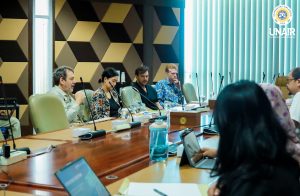
Over the course of three days, UNAIR delegates engaged in substantive dialogue with leaders from ASEAN universities, offering UNAIR’s strategic views on the future of higher education and technology. During the session AI in Teaching, Learning & Research, the delegation stressed that integrating Generative AI (GenAI) should be understood as a fundamental pedagogical transformation rather than a simple adoption of digital tools.
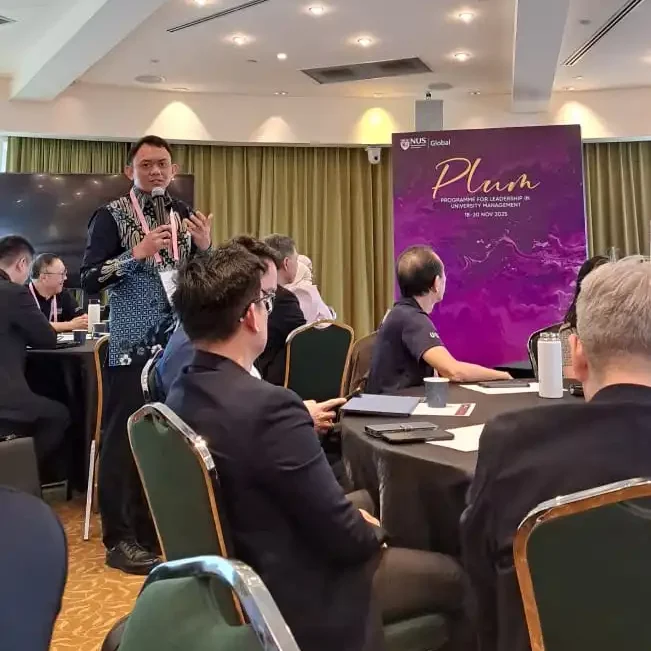
Prof. Dr. Dwi Setyawan, SSi, MSi, Apt noted that UNAIR sees GenAI as a means to enhance critical human competencies, such as ethics, sound judgment, and interpersonal skills, that technology cannot replace. “UNAIR promotes the X + AI approach, deep disciplinary transformation, and the use of Large Language Models (LLMs) to create realistic learning simulations. In fields such as health sciences tied to SDG 3, these tools can significantly strengthen students’ practical abilities,” he said.
Advocating for responsible AI Governance in higher education
In the session on AI Governance and Anticipatory Leadership, UNAIR’s delegation emphasized the crucial role of ASEAN universities in developing ethical, inclusive, and context-sensitive frameworks for AI governance (aligned with SDG 16). Prof. Dr. Ardianto, SE, MSi, Ak, CMA, CA underscored that universities must proactively prepare for the future by implementing ethical AI governance supported by strong data infrastructure and institutional resources.
UNAIR voiced its full support for the ASEAN Guide on AI Governance and Ethics, which prioritizes transparency, fairness, and security. Delegates also discussed promising areas of AI research with direct relevance to the region, such as credit-risk modeling for micro, small, and medium enterprises (MSMEs) with limited financial records (Thin-File Credit Risk). “This approach reflects UNAIR’s commitment to advancing AI research that is not only technologically innovative but also economically impactful and equitable for communities,” he said.
Vision for future-ready and sustainable campuses
During the roundtable on Future-Ready Campus and Technology Infrastructure, Dr. Tofan Agung Eka Prasetya highlighted the importance of robust data architecture and adequate computing capacity to support AI-based research.
“UNAIR emphasizes campus planning that is not only digitally advanced but also environmentally sustainable, aligning with SDG 11 and SDG 13,” Dr. Prasetya explained.
The delegation also took part in a strategic simulation on Future Governance of Neurotechnology, a session designed to assess leaders’ ability to anticipate the ethical and social challenges of emerging technologies. UNAIR’s active participation throughout PLUM 2025 reaffirms its commitment to strengthening strategic leadership and cross-border collaboration (SDG 17) in ethical technology governance. It also highlights the university’s dedication to preparing its institutional framework for AI integration, ensuring its competitiveness and relevance in the global higher education landscape.
Author: AGE UNAIR
Editor: Yulia Rohmawati