

UNAIR NEWS – Organic waste management remains a challenge for residents of Warugunung Village, located in Pacet District, Mojokerto Regency. In response, students from Universitas Airlangga‘s Community Service Program – Learning with Community (KKN-BBK 6) launched an initiative to help transform household organic waste into compost.
Cantika Thania Karina, a student from the Faculty of Public Health and a member of the KKN-BBK 6 team, explained that this program addresses both environmental and agricultural needs, as most villagers are farmers. The compost produced will enrich the soil and support sustainable farming practices.
“We hope the compost can be immediately tested on local crops. This initiative aims to reduce waste while creating something useful,” Karina said on Wednesday (July 16, 2025).
Composting in practice
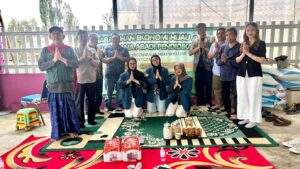
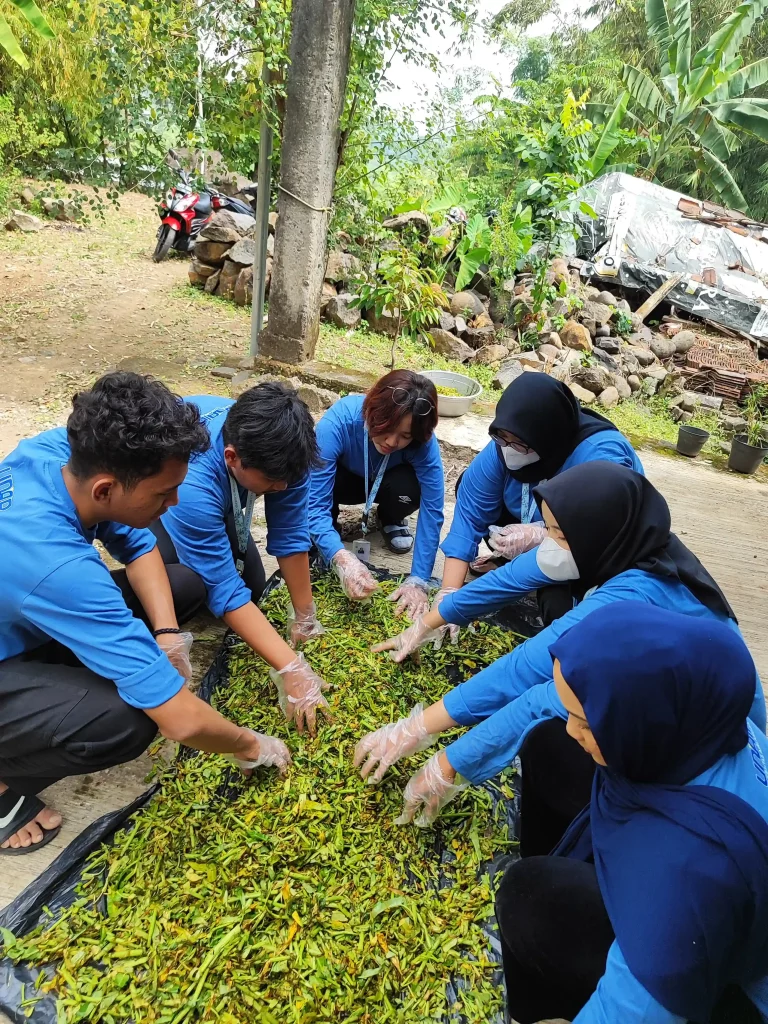
As part of the program, villagers were invited to take part in a hands-on composting workshop using the Takakura method, a technique that employs Effective Microorganisms (EM4) for waste breakdown.
“The Takakura composting method requires a starter culture, EM4 solution, clean water, and organic waste such as vegetable scraps or food leftovers,” she said.
Before beginning the composting process, participants received a short educational session to help them understand the technique. “We also administered pre- and post-tests during the session to assess how much they learned,” she added.
Karina explained that the composting process takes 14 days. It starts with cutting organic waste into small pieces and sun-drying it to reduce moisture. Meanwhile, an EM4 solution is prepared by mixing 50 ml of EM4 with 250 ml of water.
The composting setup uses a Takakura basket, made from a plastic basket lined with cardboard. A layer of rice husks is placed at the bottom, followed by 2 kg of compost starter material.
“Before adding the waste to the basket, it should be sprayed with the EM4 solution. Then, 6 kg of organic waste is added and mixed evenly,” she explained.
The final step involves adding another layer of rice husks and sealing the basket. The compost bin must be kept in a dry, shaded area with good airflow and protected from pests and rain.
Karina noted that if managed well, the compost could become a source of income for the villagers. She and her team hope the program becomes a long-term solution to reduce organic waste independently.
“We also hope this initiative will continue and eventually become a standard practice in the village to foster a cleaner and healthier environment,” Karina concluded.
Author: Septy Dwi Bahari Putri
Editor: Khefti Al Mawalia