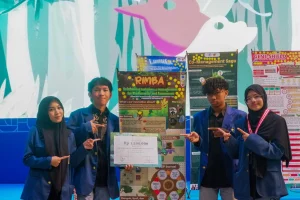


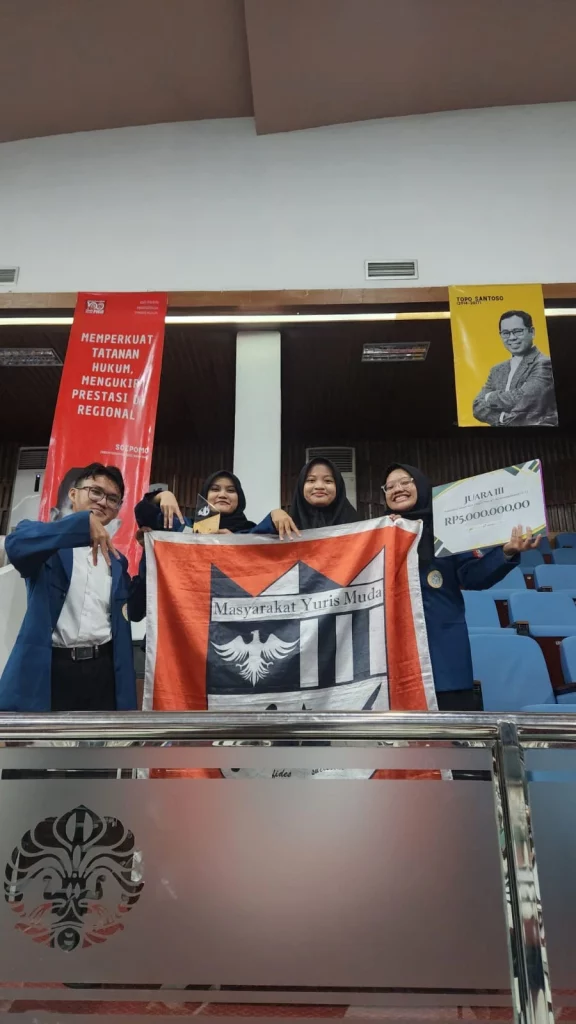
UNAIR NEWS – A delegation from the Faculty of Law (FH) Universitas Airlangga (UNAIR) has secured another notable national achievement. The Sudikno Mertokusumo Team won third place in the Scientific Writing Competition at 12th Sciencesational, held for the Prof. Erman Rajagukguk Cup. The event was hosted by the Faculty of Law at Universitas Indonesia (FH UI) on Saturday (Nov. 29, 2025).
Led by Nadila Amelia, the team included members Laela Ayu Dewanti and Alya Azzahra Armandi, with Anindhito Gading Rasunajati serving as the official delegate advisor. Their accomplishment reinforces the academic strength of UNAIR law students in advancing progressive and responsive legal discussions on national issues.
Strategic issue in Indonesia’s energy transition
In the competition, the team presented a paper titled The Urgency of Regulating Triple Bottom Line–Based Green Jobs Following the Early Retirement of Coal-Fired Power Plants as a Strategy for Achieving a Just Energy Transition. The paper addressed the pressing implications of Indonesia’s early retirement policy for coal plants, which may affect an estimated 32,000 workers.
Amelia explained that their idea stemmed from both academic concerns and the reality that national regulations are not yet prepared for an accelerated energy transition. “We found a clear legal gap. Indonesia is committed to retiring coal plants early, yet the legal framework to protect workers and foster green jobs is still incomplete,” she said.
Using a normative juridical method, combining statute, conceptual, and comparative approaches, the team analyzed laws, doctrines, and international practices, including the Philippines’ Green Jobs Act and Japan’s labor framework. “If the energy transition prioritizes environmental goals while ignoring the social dimension, substantive justice will inevitably be overlooked,” she added.
Triple bottom line framework
Through their research, the students proposed revising provisions in Presidential Regulation No. 112 of 2022 to ensure that the energy transition includes worker protection mechanisms, such as reskilling, upskilling, and social security measures. This framework, they argued, would help prevent new social vulnerabilities during the decarbonization process.
“The triple bottom line approach is crucial because it balances people, planet, and profit. We want to show that environmental justice must be aligned with social justice, not treated separately,” Amelia said.
Their findings revealed inconsistencies across regulations and a lack of operational guidelines for implementing green jobs policies. These gaps, they warned, could create legal uncertainty and leave affected workers without adequate protections as coal plants are phased out.
Amelia also emphasized that the energy transition is not solely an environmental challenge, but a societal one that requires critical and forward-thinking perspectives. “This kind of academic work demonstrates the vital role law plays in ensuring equitable change. Intellectual courage is key for the next generation of legal scholars,” she concluded.
Author: Muhammad Afriza Atarizki
Editor: Yulia Rohmawati