
UNAIR NEWS – Histology, a sub-discipline of biology focused on the microscopic study of tissues in living organisms, has seen significant advancements in recent years. These technological developments have notably enhanced the efficiency, accuracy, and breadth of tissue analysis.
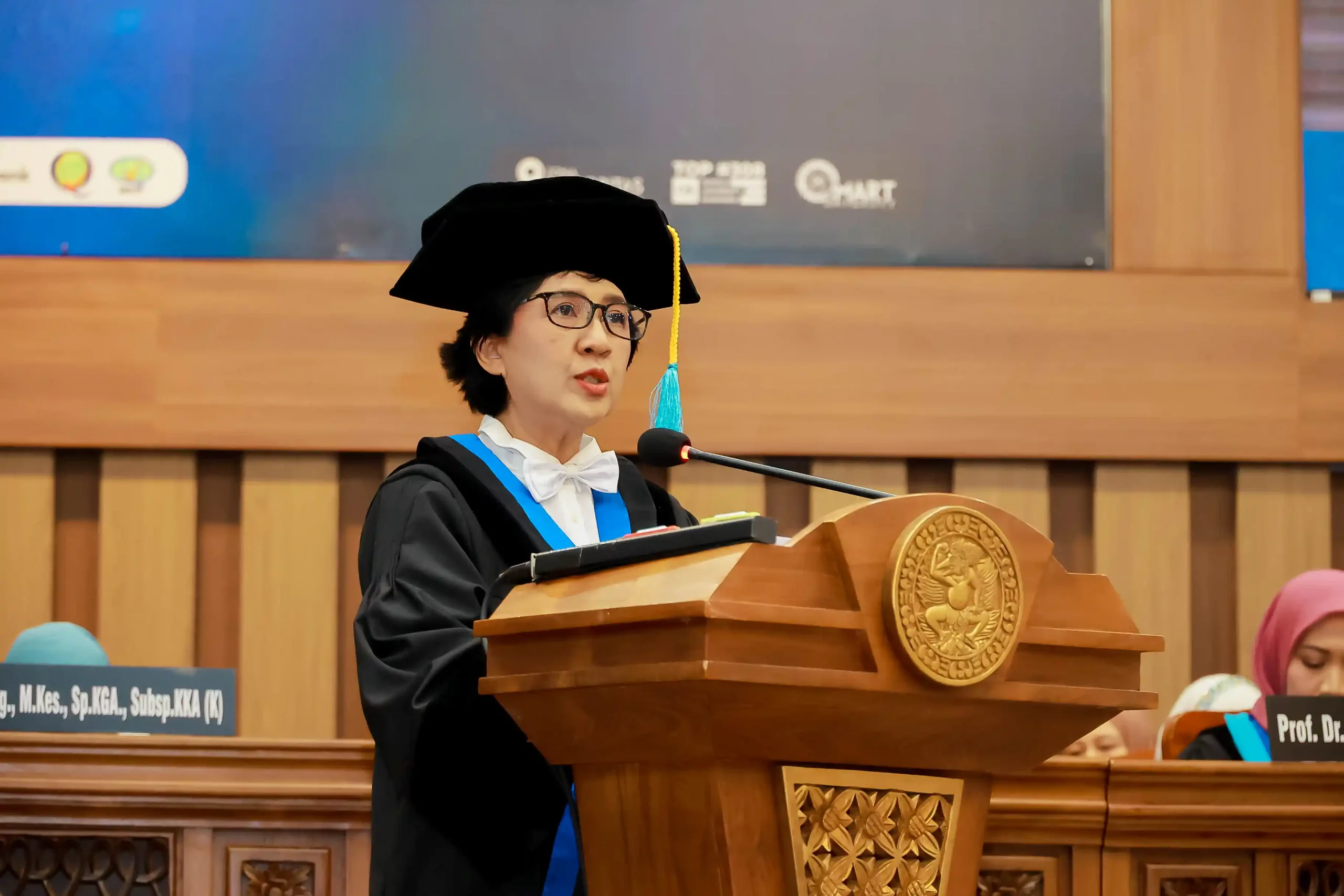
This was the central theme of Prof. Dr. Dwi Winarni, M.Si’s scientific oration during her inauguration as a professor at Universitas Airlangga (UNAIR) on Thursday (April 24, 2025) at the Garuda Mukti Hall, UNAIR Management Building, MERR-C Campus. “Tissue structure directly influences its biological function, and conversely, we can often deduce its function by examining its structure,” she stated.
Prof. Winarni explained that the observation and analysis of animal tissues employ various techniques to uncover the relationship between structure and function. Technological innovations, she noted, have played a critical role in automating tissue processing and minimizing human error in laboratories.
“Advances in microscopy now allow for high-resolution, three-dimensional imaging. Digital technology enables tissue slices to be archived and analyzed electronically. Moreover, molecular and genetic tools have introduced immunohistochemical staining and in situ hybridization techniques, which allow scientists to detect specific proteins or DNA/RNA sequences within tissue samples,” she elaborated.
Value of sea cucumber collagen
Reflecting on her research career, Prof. Winarni emphasized how technological support in histology has been essential, especially in studying the anatomical structures of local sea cucumbers from the Madura Strait. Through histological methods, she identified the sea cucumber’s potential as a source of pharmacologically beneficial compounds.
“The sea cucumber’s body wall is known to be rich in collagen—comprising up to 70% of its total protein content. This collagen, like that found in other echinoderms, forms a unique structure known as mutable collagenous tissue (MCT),” she noted.
Prof. Winarni further explained that the collagen in sea cucumbers is predominantly Type I collagen—the same type found in about 90% of human collagen. This similarity grants sea cucumber-derived collagen significant commercial value, particularly for products aimed at skin, hair, nail, and joint health.
“One of the key advantages of marine collagen, including that extracted from sea cucumbers, is its lower molecular weight, which enhances its solubility and absorption. Additionally, it poses no risk of zoonotic disease transmission or religious concerns, has low immunogenicity, reduced risk of inflammatory reactions, and is easier to extract,” she added.
Advancing research of sea cucumber species
Prof. Winarni also highlighted the pivotal role of histology in facilitating the exploration of underutilized sea cucumber species. Since 2019, several sea cucumber species have been listed under the Convention on International Trade in Endangered Species (CITES) due to overexploitation.
“This has encouraged researchers to investigate lesser-known local species that have not yet gained commercial prominence. Such efforts are critical to ensuring the sustainable use of sea cucumbers. As an animal histologist, I have been involved from the early stages of exploration to the product-testing phase for collagen-based applications,” she concluded.
Author: Febriana Putri Nur Aziizah
Editor : Edwin Fatahuddin