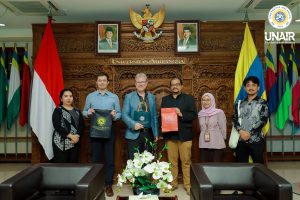


UNAIR NEWS – A delegation from Universitas Airlangga (UNAIR) carried out a series of strategic activities in Islamabad, Pakistan, including participation in the International Symposium on “Halal Science and Wellness,” an official meeting with the Rector of Bahria University, and discussions with an international NGO focused on community development. The delegation was led by Vice Rector for Research, Innovation, and Community Development Prof. Dr. Muhammad Miftahussurur, SpPD-KGEH, PhD; Executive Secretary of WUACD Prof. Dr. Ni Nyoman Tri Puspaningsih, MSi; Chair of LPJPHKI Prof. Ferry Efendi, S.Kep., Ns., MSc., PhD; and Dr. Muhammad Saud, who collectively advanced UNAIR’s academic diplomacy and international research initiatives.
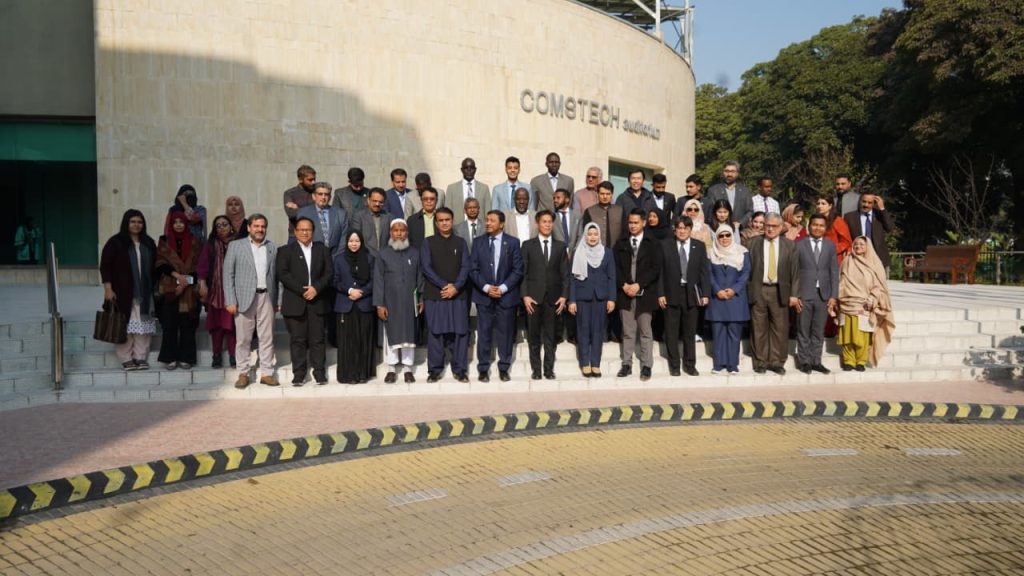
At the halal symposium hosted by the OIC-COMSTECH Secretariat, Prof. Puspaningsih took part in technical sessions focused on harmonizing halal testing laboratories, accreditation frameworks, and prospects for international research cooperation in halal science. She stressed that standardizing halal laboratories is essential to ensuring product safety, integrity, and transparency worldwide, while also opening opportunities for UNAIR to contribute to the development of a science-driven global halal ecosystem.
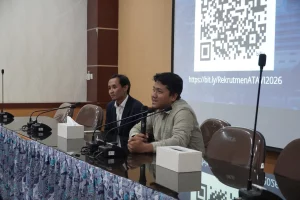
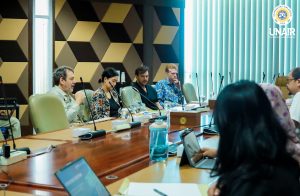
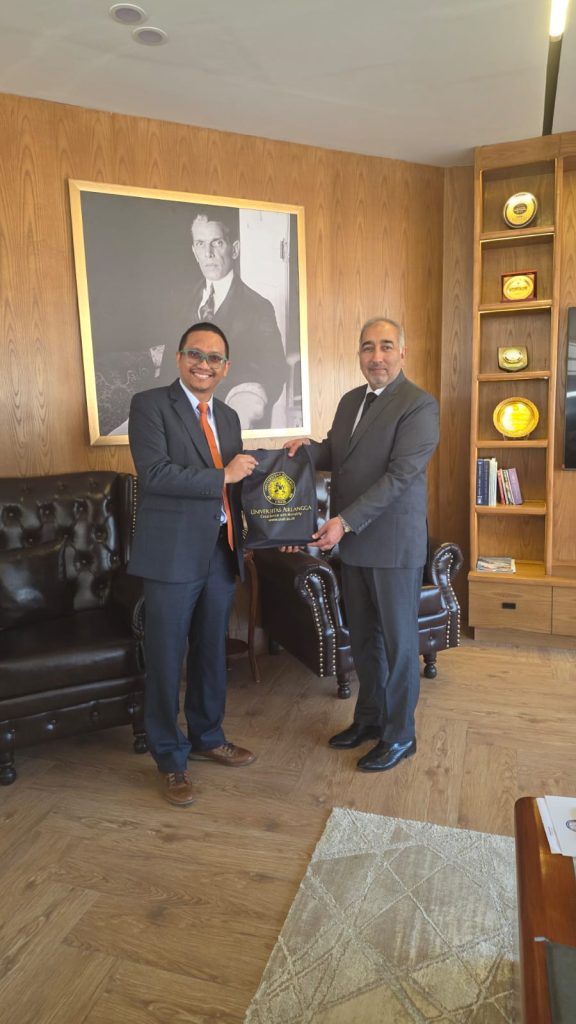
One of the key events was an official meeting between Prof. Muhammad Miftahussurur and Bahria University Rector Vice Admiral Abid Hameed HI(M). Founded by the Pakistan Navy in 2000, Bahria University is a semi-government public institution led by a Rector and overseen by the President of Pakistan, who serves as Chancellor under its charter. During bilateral talks, both leaders explored ways to strengthen higher education through joint research, innovations, scholarly publications, matched grants, and collaborative studies in infectious diseases, climate change, and public health. Rector Abid Hameed conveyed strong support for partnering with UNAIR, noting that global collaborations are crucial to improving graduate competencies in health and scientific disciplines.
After the meeting, Prof. Miftahussurur delivered a guest lecture for Bahria University medical students, both in person and online. His lecture, “Gastric Dysbiosis and H. pylori Bacteria,” highlighted recent findings in gastrointestinal microbiome research and its implications for clinical practice and global health. Students showed high engagement throughout the session, signaling promising potential for future academic partnerships.
Outside the academic agenda, Prof. Puspaningshih held an afternoon meeting with the Human Development Foundation (HDF) in Islamabad, a prominent NGO in community advancement. Accompanied by Dr. Muhammad Saud, BS., MS., she discussed the UNAIR WUACD program “Indoor Pollution Mitigation for Rural Communities in Pakistan, Bangladesh, and Indonesia.” The discussion covered initiatives such as clean cookstove deployment, training programs for community health workers, health-impact research in rural areas, and opportunities to secure international funding for broader implementation. Prof. Puspaningshih emphasized that the initiative positions UNAIR not only as a knowledge institution but also as a driver of real-world solutions for global communities.
UNAIR also deepened its international network through discussions with scholars from the International Islamic University Islamabad (IIUI) and researchers from the University of Karachi, two institutions that have longstanding partnerships with Long Island University (LIU) through the WUACD framework. The talks centered on comparative studies in medical education, evidence-based community development models, joint publications, and co-supervision of postgraduate students. All parties agreed to coordinate WUACD programs more systematically to generate sustainable, multi-country impact.
This series of engagements in Islamabad underscores UNAIR’s commitment to advancing academic diplomacy, expanding global research collaboration, and strengthening cross-border community development. “These partnerships lay the foundation for long-term innovation in education, health research, and sustainable development,” Prof. Miftahussurur concluded as the delegation wrapped up its visit to Pakistan.
Author: Prof Ferry Efendi SKep Ns MSc PhD
Editor: Yulia Rohmatillah