

UNAIR NEWS – It’s not every day that household waste like used cooking oil becomes the foundation for international innovation. Yet, Mochammad Afzal Iftikharus Sadat Ramadhan, an Information Systems student at Universitas Airlangga, has demonstrated just that.
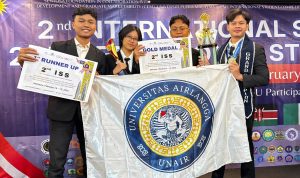
Afzal, as he is known, was chosen to represent at the Global Youth Innovation Summit held across Singapore and Malaysia. Alongside his team, he also secured second place in the SDGs Project Video category, focusing on environmental issues. Their entry, Oil Chemy, introduced a prototype for collecting used cooking oil equipped with a barcode-scanning system that tracks user points—an innovative response to the lack of national regulations for oil waste management.
“If the opportunity’s there, why not take it? We often overthink and fear failure, when taking that first step is already a step toward change,” Afzal said.
Turning waste into opportunity
The idea behind Oil Chemy stemmed from concern over the increasing volume of used cooking oil in major urban centers like Jakarta. According to Afzal, there has yet to be a reliable system to help communities recycle used oil in a structured and sustainable manner.
The team’s prototype goes beyond being just a collection tool. It integrates simple technology, such as a QR code, allowing users to accumulate reward points. The concept is framed within a Business Model Canvas, featuring plans to convert the collected oil into eco-friendly products like soap and air fresheners.
Bridging generations through collaboration
Afzal’s team, consisting of five members, included high school students unfamiliar with Sustainable Development Goals (SDGs). Instead of viewing this as a challenge, Afzal used it as a learning opportunity. “I had to reframe the concepts I’ve grown used to at university. It wasn’t just a competition—it became a two-way educational experience,” he explained.
He reflected on how the experience improved his ability to communicate across age groups and simplify complex ideas for diverse audiences.
In addition to earning the runner-up title, Afzal was also named one of the Top 10 Special Partially Funded Delegates, signaling international recognition for his innovative thinking. For Afzal, who was participating in his first international event, the real value went far beyond awards.
“I had to learn everything on the spot—public speaking, team coordination, presentation design. This experience wasn’t just about winning; it was about becoming the kind of person who’s ready to take on global challenges,” he concluded.
Author: Sintya Alfafa
Editor: Ragil Kukuh Imanto