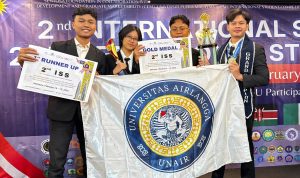


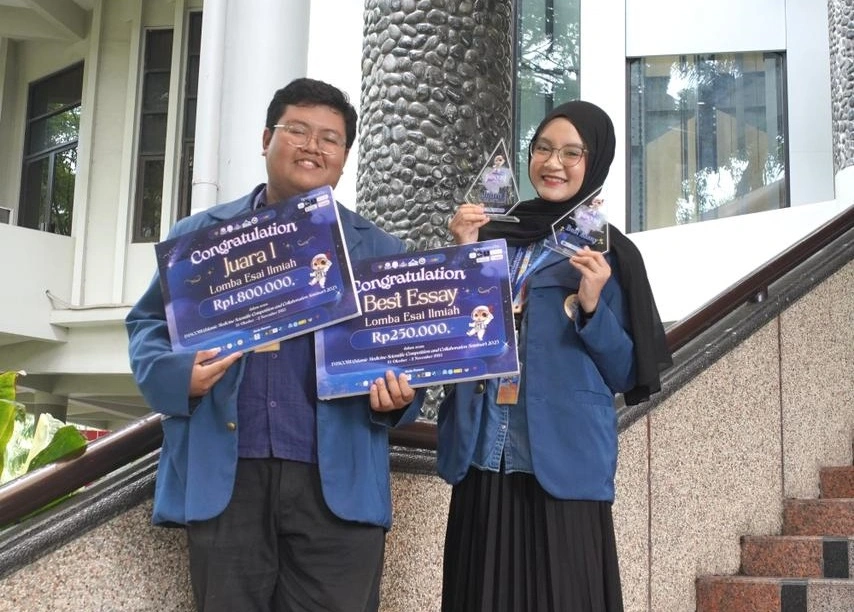
UNAIR NEWS – A new health innovation has been introduced by two students from different study programs at Universitas Airlangga (UNAIR). This initiative was developed by M. Ibaness Maula Ardinata (Medicine 2023) and Nabila Fariha Hanim (Pharmacy 2023), who presented their idea in a scientific essay for the 2025 Islamic Medical Scientific Competition and Collaboration Seminar Organized (IMSCOBI).
Their essay earned them first place along with the Best Essay distinction. The competition, hosted by the Islamic Spirituality Board of the Faculty of Medicine Universitas Brawijaya, took place from Friday (Oct. 31, 2025) to Sunday (Nov. 2, 2025).
Their winning essay, titled Optimizing the Survival of Pancreatic Islet CiPSC Transplants Through Layer-by-Layer Collagen Nanoencapsulation and Non-Systemic Immunosuppressant Particles as a Type 1 Diabetes Mellitus Therapy from an Islamic Perspective, was inspired by the need to find a new treatment option for Type 1 diabetes, a condition typically managed with lifelong insulin therapy.
Advancing Type 1 Diabetes treatment
Hanim explained that insulin therapy remains the sole standard treatment for Type 1 diabetes, intended to extend life expectancy rather than offer a cure. Through extensive research, the team learned that damage to pancreatic beta cells, the main cause of the disease, could potentially be repaired through stem cell transplantation, allowing natural insulin production to be restored.
“Stem cells are capable of addressing various genetically rooted diseases. But we faced challenges because stem cell transplants carry a high risk of rejection. That pushed us to explore ways to improve the success of stem cell grafting,” Ardinata said.
Their first approach to enhancing the transplant process involved using layer-by-layer collagen nanoencapsulation, a method of assembling collagen in protective layers around the transplanted cells.
“This technique helps extend the lifespan of donated stem cells, allowing them to survive longer in the body. This could greatly reduce how often patients need to rely on insulin,” Hanim noted.
Beyond that, Ardinata and Nabila also considered using non-systemic immunosuppressant particles to lessen post-transplant side effects. These particles are believed to reduce toxicity levels that are commonly seen with systemic immunosuppressant drugs.
Hope for future application
Stem cell transplantation as a substitute for pancreatic beta cells is still relatively rare in medical practice. This limited availability made it difficult for the team to find previous research to support their essay. They hope their work contributes to expanding scientific knowledge and future treatment possibilities for Type 1 diabetes.
They also hope to shift the view that Type 1 diabetes is incurable, believing that new biomedical approaches could eventually lead to complete recovery. “More importantly, I hope this innovation can be implemented in Indonesia, since biotechnology breakthroughs are still uncommon here. Stem cell research is still largely developed by scientists abroad,” Hanim concluded.
Author: Selly Imeldha
Editor: Khefti Al Mawalia