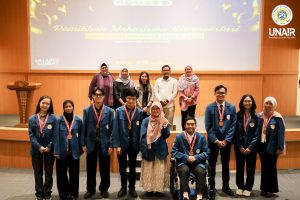


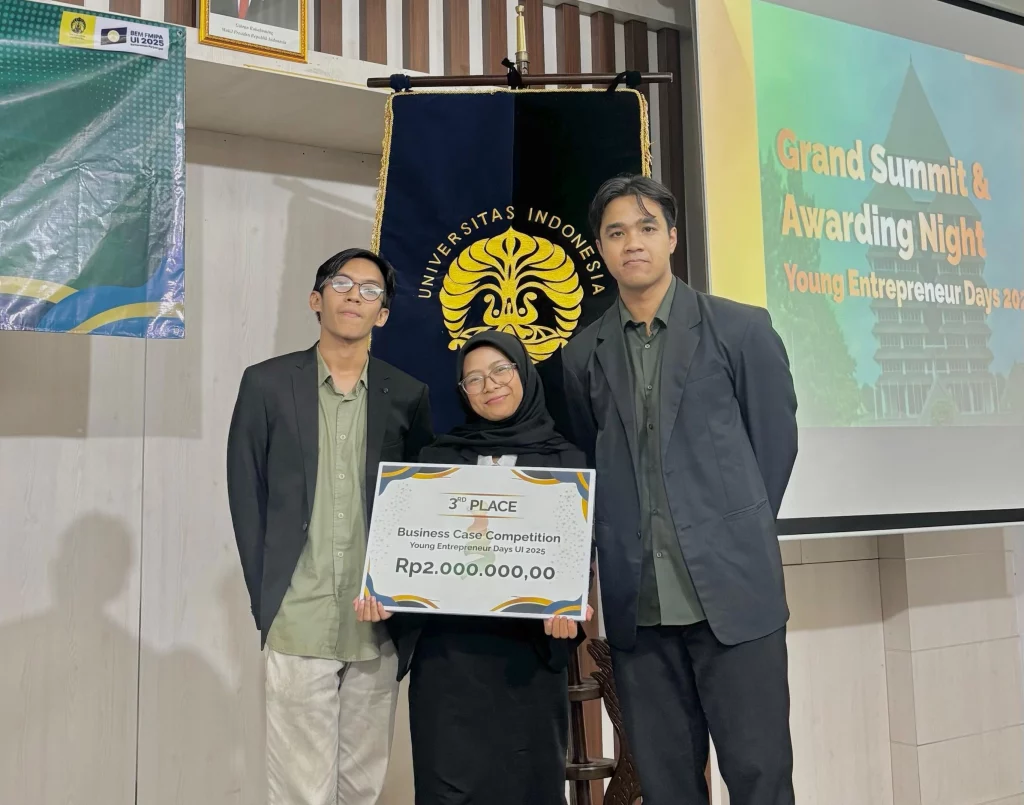
UNAIR NEWS – Students from Universitas Airlangga (UNAIR) once again proved their strong national competitiveness. Renaldi Setiawan, a Management student from the Faculty of Economics and Business, earned third place in the Business Case Competition at NBCC Young Entrepreneur Day (YED) UI 2025, teaming up with two students from the Sepuluh Nopember Institute of Technology (ITS).
The competition drew more than 150 teams from universities across Indonesia, creating an intense and highly competitive environment. The winners were officially announced on Saturday, December 20, 2025.
Tackling challenges in Indonesia’s forklift industry
For the competition, the team analyzed a case involving PT Bina Pertiwi, a subsidiary of Astra International and the official distributor of Komatsu Forklifts. The company is facing significant pressure from the influx of lower-priced Chinese forklifts, alongside shifting market demand toward electric and low-emission equipment.
To address these challenges, the team introduced a proposal called the 3S with Forklift Strategy. “This strategy combines energy source segmentation, flexible financing options, and a long-term energy transition plan. It is designed to respond to market pressures while remaining aligned with sustainability commitments and Net Zero Emission targets,” Setiawan said.
Flexible and context-aware approach
Setiawan explained that the central issue examined was the selection of forklift energy sources, ranging from lead-acid and lithium-ion batteries to hydrogen fuel cells, while weighing factors such as cost efficiency, infrastructure availability, safety, and Indonesia’s environmental regulations.
“Our approach does not force a single technology solution. Instead, it matches energy types with industry characteristics, total cost of ownership (TCO), and market readiness. This makes the strategy more realistic and applicable in Indonesia’s diverse industrial setting,” he noted.
The team carried out a thorough analysis, starting with problem mapping using the SCQ framework, followed by SWOT analysis, Porter’s Five Forces, the McKinsey 7S framework, and greenhouse gas (GHG) emission simulations. Their final proposal included a clear implementation roadmap and projections of potential business impacts.
Cross-campus collaboration and key takeaways
As a team drawn from different campuses, responsibilities were divided based on individual expertise. Setiawan focused on market analysis and business strategy, while his ITS teammates handled technology, energy systems, safety considerations, and emission assessments.
According to Setiawan, one of the most important lessons from the competition was the need to deliver business solutions that are data-driven, context-specific, and ready for implementation. “Sustainability and energy transition are no longer add-ons, they are now at the core of future business strategies,” he said.
Going forward, the team aims to further develop its capabilities in strategic business planning and energy transition, while continuing cross-campus collaboration to produce practical solutions for Indonesia’s industrial sector. (*)
Author: Nafiesa Zahra
Editor: Khefti Al Mawalia