


UNAIR NEWS – The Lower Brantas Watershed has long struggled with persistent hydrological challenges, most notably flooding and pollution. These issues stem largely from its flat topography, which slows water flow and increases the likelihood of sediment buildup and channel silting.
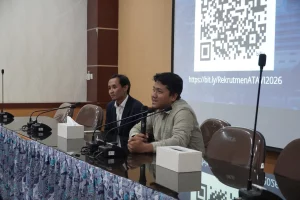
These watershed challenges and the need for integrated management were the focus of a workshop held by Universitas Airlangga’s Sustainable Community Service Institute (LPMB). The event, hosted on Tuesday (11/25/2025) in the Dayak Room of the ASEEC Tower at the Dharmawangsa-B Campus, aimed to shape an action plan roadmap for managing the lower Brantas watershed.
Challenges in Lower Brantas Watershed
Workshop presenter Dr. Ir. Runi Asmaranto ST MT IPM ASEAN Eng explained that the lower Brantas absorbs the cumulative impacts of activities occurring upstream. Declining water quality, he noted, is one of the most significant consequences. Runoff from the upper and middle watershed areas ultimately concentrates its pollutant load downstream.

“Flooding is another common issue. It’s widespread, both in Surabaya and Malang. One of the major causes is inefficiency in the irrigation system. Fluctuating water discharge disrupts distribution, and weak integration across the network further worsens the problem,” Dr. Asmaranto said on Monday (11/24/2025).
Integrated flood and drainage management
Given these downstream problems, Dr. Asmaranto stressed the urgent need for improved flood control and integrated drainage systems. Solutions must be implemented from upstream to downstream, as lower-basin issues often arise from unresolved upstream conditions. He outlined several strategies, including irrigation upgrades, improved drainage networks, nature-based solutions, and graduated land-use mitigation within spatial planning.
“We’ve also begun applying nature-based solutions, essentially green infrastructure. In Surabaya, for example, residents are increasingly open to these approaches. The transformation in Keputih is a standout case; it shows how much progress can be made when communities embrace new ideas,” he noted.
However, he emphasized that recent extended dry seasons have introduced additional challenges. Lower water discharge exposes vulnerabilities in inefficient watershed management. Poor network integration intensifies competition for water among agricultural, industrial, and domestic users.
“That is why integration cannot stop at building physical infrastructure. Oversight and control systems must also be strengthened. We need automated operations supported by real-time data to ensure water-gate management is truly effective,” he concluded.
Author: Dinnaya Mahashofia
Editor: Yulia Rohmawati