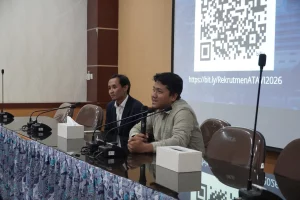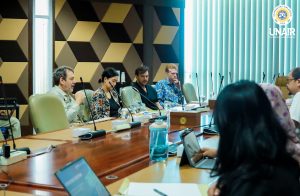


UNAIR NEWS – The History Program of the Faculty of Humanities (FIB) at Universitas Airlangga (UNAIR) successfully held an international seminar titled Critical Studies on Provenance, History, and Cultural Heritage on Monday (June 23, 2025). The event took place in the Majapahit Room, ASEEC Tower, Dharmawangsa-B Campus. It was organized in collaboration with Hasanuddin University (UNHAS), Andalas University (UNAND), the Indonesian Association of History Study Programs (PPSI), and the Association of Historical Profession Practitioners (P3K).
Prof. Dr. Purnawan Basundoro, SS, MHum, Dean of FIB UNAIR, delivered opening remarks, emphasizing that provenance is deeply tied to a nation’s historical journey.
“Provenance should be an essential area of expertise within the field of history. Therefore, this topic will be further explored by experts, including an overview of the government’s efforts,” he added.
Prof. Dr. Bambang Sektiari Lukiswanto, DEA, DVM, UNAIR Vice Rector for Academic, Student, and Alumni Affairs, also gave remarks during the opening ceremony. He expressed hope that the forum would make a meaningful contribution to national cultural development. “We hope this event benefits not only historians and cultural scholars, but also supports the advancement of a distinguished Indonesian civilization toward Golden Indonesia 2045,” he said.
Repatriation of cultural artifacts
Prof. Dr. Ismunandar, Chair of the Expert Panel on Indonesia’s Cultural Heritage Repatriation Team, opened the discussion by explaining that repatriation has long been a critical issue. “Since 1975, several cultural artifacts have been returned to Indonesia. For instance, in 2019, approximately 1,500 objects were repatriated after a museum in the Netherlands was closed. The process has continued in a more structured way between 2022 and 2023,” he noted.
He explained that the Dutch government currently has a repatriation policy that acknowledges colonialism as a historical injustice. If it’s proven that an artifact was taken without consent, it must be returned in principle. He stressed that provenance research plays a vital role in any repatriation claim. Without strong documentation of an object’s origin, it becomes difficult to justify its return.
“The Netherlands values dialogue and allows repatriation requests not only from governments, but also from Indigenous communities and royal descendants. However, these requests must still go through official ministry channels,” said the ITB Chemistry professor.
Provenance and cultural heritage interpretation
Prof. Mayumi Yamamoto of Miyagi University, Japan, shared her perspective as an anthropologist who has conducted extensive research on World War II in Indonesia. She noted that since the Meiji era, many Japanese cultural artifacts have changed hands and ended up abroad. However, Japan has not actively sought their return.
“For example, ukiyo-e prints by Utagawa Hiroshige, now widely acclaimed, are held in collections around the world. Some of the finest pieces are in Boston. If they had all remained in Japan, they might not have achieved global recognition. So we should ask ourselves: does having our heritage abroad increase its international value?” she questioned.
In response, Prof. Yamamoto urged a reassessment of how cultural heritage is valued, interpreted, and preserved. She emphasized that researchers must not only investigate provenance but also understand the historical context of cultural objects. Furthermore, a cross-disciplinary approach is necessary to avoid falling into colonial frameworks when interpreting provenance.
The seminar continued with a series of discussions led by prominent historians and academics, including Prof. William Bradley Horton, PhD (Akita University), Dr. Johny Alfian Khusyairi (UNAIR), Dr. Alicia F. Schrikker (Leiden University Institute for History), Prof. Dr. Agus Suwignyo, MA (Universitas Gadjah Mada), Dr. Muslimin AR Effendy, MA (UNHAS), and Dias Pradadimara, MA (UNHAS).
Author: Fania Tiara Berliana Marsyanda
Editor: Ragil Kukuh Imanto