


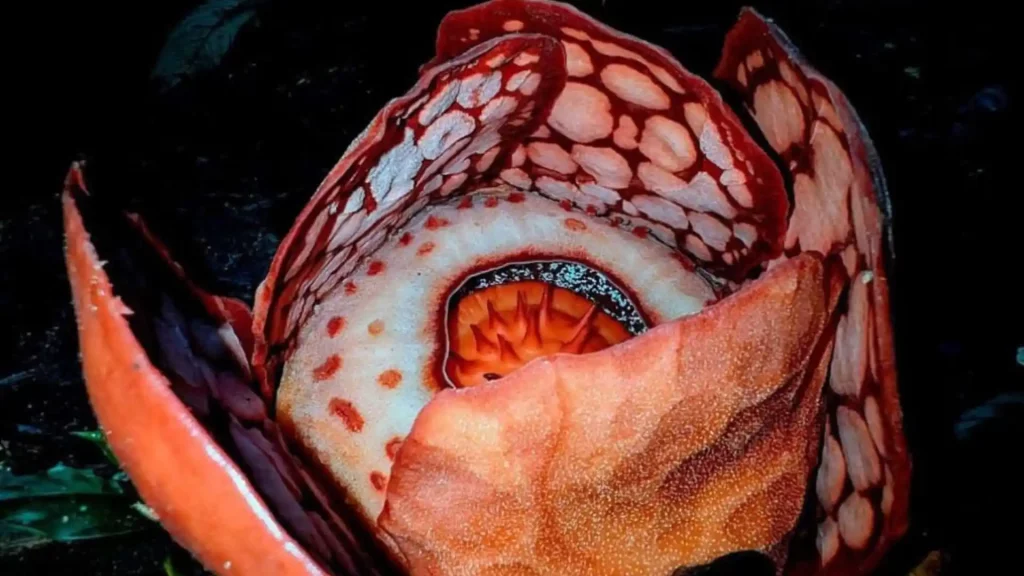
UNAIR NEWS – A recent discovery of Rafflesia hasseltii has revived public interest in one of Indonesia’s rare endemic plants. The widely shared discovery also reopened conversations about the species’ natural habitat and the need for scientific exploration of this parasitic organism.
Responding to the attention, UNAIR botanist Prof. Hery Purnobasuki, MSi, PhD, explained that Rafflesia is a true parasitic plant that relies entirely on its host. “This flower, this plant, is wholly parasitic and survives by attaching itself to another plant. Indonesia’s climate provides ideal conditions for its growth,” he said.
Origins and parasitic traits of Rafflesia
Prof. Purnobasuki noted that Rafflesia can grow only on specific types of climbing vines. As a parasitic plant, it lacks leaves and cannot photosynthesize. Instead, it absorbs all nutrients directly from its host’s tissues.

He added that Rafflesia thrives only in highly specific environments. “It survives in areas with very little pollution and minimal human disturbance. That’s why it is rarely encountered by the public,” said the Head of UNAIR’s Sustainable Community Service Institute.
Indonesia is currently home to around 13–14 Rafflesia species, although Rafflesia arnoldii remains the most familiar to the public. Prof. Purnobasuki believes that broader scientific exploration could lead to the identification of additional species.
Rafflesia reproduction
Addressing reports that described the recent appearance of Rafflesia hasseltii as a new discovery, Prof. Purnobasuki clarified that the species had previously been documented. “Morphologically, trained observers can identify Rafflesia buds from the start. Residents report sightings, and practitioners monitor the buds until they bloom. So it is not an abrupt, unexpected find,” he said.
Yet many aspects of Rafflesia reproduction and embryo dispersal remain unclear. Scientists still do not know exactly how the species spreads, though intermediaries are likely involved.
Unlike other plants with visible seed-dispersal mechanisms, Rafflesia remains puzzling. “Male and female flowers grow separately. Fertilization requires an intermediary. But how the embryo enters its host’s tissue remains a major question,” he explained.
Need for scientific exploration and risks of land conversion
As the world’s second most biodiverse nation after Brazil, Indonesia has significant potential for discovering more endemic species. However, habitat loss from land conversion continues to jeopardize rare plants like Rafflesia. “If this is considered a national treasure, it must be protected, not merely publicized. Protecting its habitat requires coordinated action from many parties,” stressed the Faculty of Science and Technology lecturer.
He also emphasized the need to develop cultivation techniques for Rafflesia. Successful propagation would allow the plant to be reintroduced into its native habitat as part of conservation efforts. In addition, the discovery of new species offers Indonesian researchers the opportunity to be formally credited in scientific nomenclature.
Author: Rizma Elyza
Editor: Yulia Rohmawati