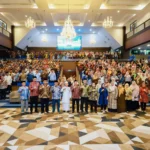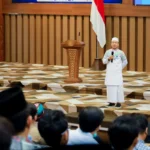
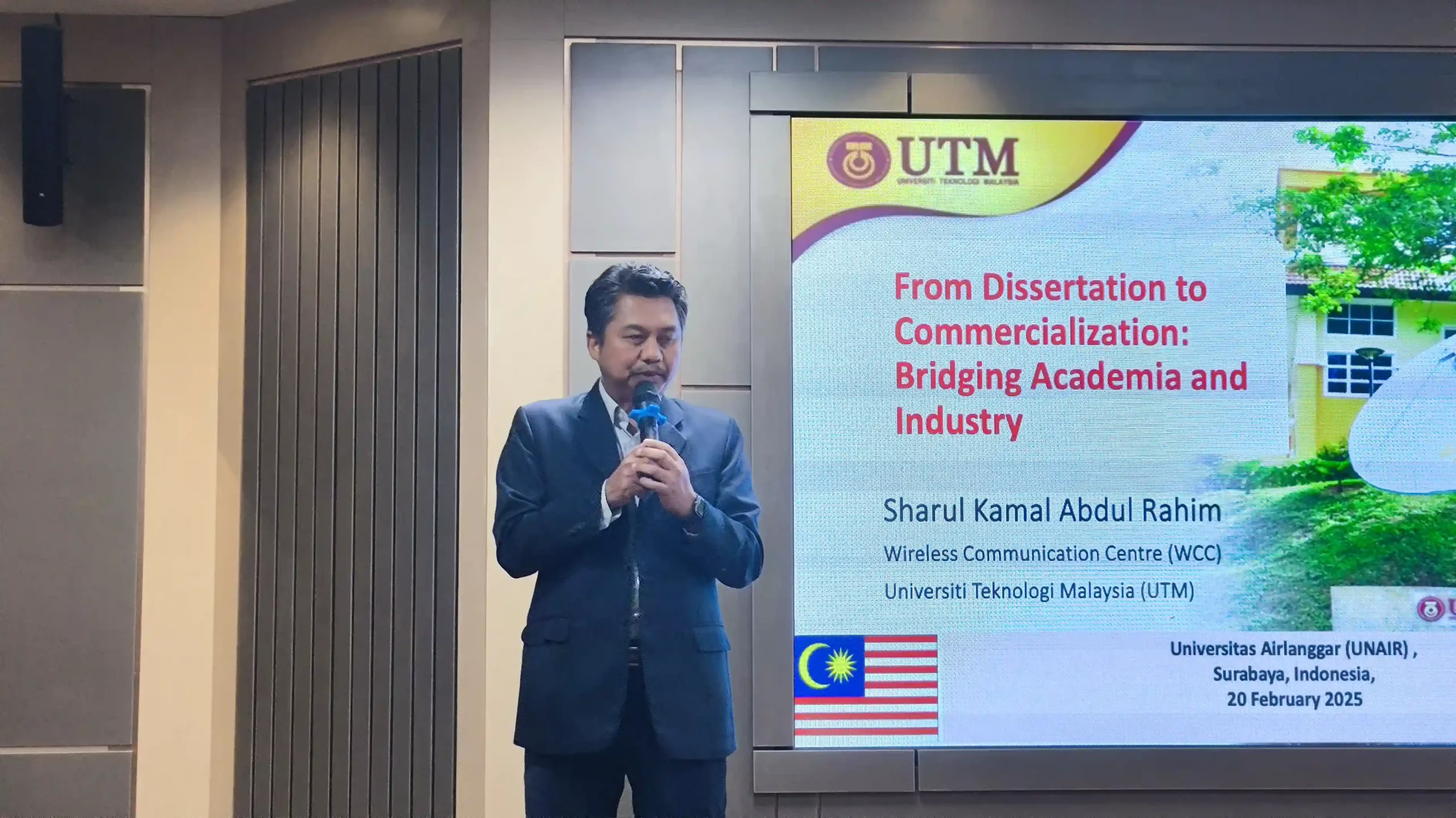
UNAIR NEWS – As industries continue to evolve at an accelerated pace, the World University Association for Community Development (WUACD) at Universitas Airlangga (UNAIR) hosted a guest lecture to address the growing intersection between academia and industry. The event was held at the Tarumanegara Room on the 10th floor of the ASEEC Tower, Dharmawangsa-B Campus, UNAIR, on Thursday (Feb. 20, 2025).
The lecture, titled Bridging Academia to Industry, featured Prof. Ir. TS Dr. Sharul Kamal Bin Abdul Rahim, Principal of Kolej Tuanku Conselor at Universiti Teknologi Malaysia, as the keynote speaker. Prof. Rahim, an expert in antenna design, discussed innovative solutions to bandwidth limitations, particularly in tropical countries like Indonesia.
“One of the key challenges in tropical regions is weak bandwidth capacity. To improve performance and enable higher frequencies, instead of relying on a single antenna, we can use multiple antennas. The more antenna elements we have, the greater the signal strength,” he explained.
Advancements in transparent antennas
Prof. Rahim highlighted the potential of transparent antennas, particularly in urban environments where traditional antenna signals often face interference. “In major cities like Kuala Lumpur, Jakarta, and across Europe, modern architecture is dominated by glass buildings. These structures disrupt conventional antennas, making transparent antennas an essential alternative,” he stated.
He also shared insights from his research, emphasizing that transparent antennas offer superior performance and have been developed through collaborative efforts with his students. “These antennas operate across a broad frequency spectrum, ranging from 3 GHz to 32 GHz, providing extensive coverage. We have also collaborated internationally, sending seven of my students to France for further development,” he added.
Public transportation innovation
Addressing public transportation challenges in Malaysia, Prof. Rahim noted that one of the primary obstacles is the reluctance of commuters to use buses due to difficulties in tracking their routes and stops.
“Although tracking systems exist, they are owned by private companies, requiring the government to invest heavily to implement them. To address this, they approached us to develop an alternative solution,” he explained.
To improve accessibility and efficiency, Prof. Rahim and his team designed a real-time bus tracking system that allows passengers to monitor routes more easily. “Our system integrates GPS technology, onboard WiFi for passengers, and RFID sensors at bus doors to accurately track passenger flow. This innovation ensures a more seamless and efficient public transportation experience,” he concluded.
Author: Mohammad Adif Albarado
Editor: Khefti Al Mawalia