

UNAIR NEWS –Japanese Literature program in Universitas Airlangga is considered to be one of the latest programs. Under the Faculty of Humanities (FIB), Japanese Literature program was established in 2006 and has developed a lot ever since.
When being met in his office, Dwi Anggoro Hadiutomo, M.Hum., Ph.D., as the Head of Japanese Literature program said that the program he is in charge of is provided with lecturers who have expertise in their own field.
“Our lecturers come with different backgrounds of expertise, some of them even pursue popular Japanese culture such as cosplay and anime,” Dwi said.
Moreover, to improve the students’ skills in speaking and writing kanji letters, Japanese Literature program regularly invites Japanese natives to give the students direct assistance.
As with the natives, Dwi explained that Japanese Literature program cooperates with several Japanese institutions, one of them is Ashinaga Foundation. The foundation itself frequently brings Japanese students into Indonesia to study or assist lecturers in teaching Japanese skills.
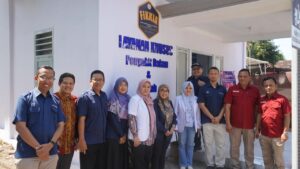
Furthermore, Japanese Literature program is also facilitated with an adequate Japanese language laboratory. In the established curriculum, Japanese Literature program not merely offers courses about literature and cultural studies, but also trains the students with translating skill, correspondence skill, and a course on teaching.
“Therefore Japanese Literature graduates must be excellent at Linguistics,” Dwi mentioned.
For the students’ activities, Japanese Literature program holds an annual event of “Japanese World” which is organized by UNAIR Japanese Literature Students Association (Niseikai). In this event there are a number of activities such as art festival, food bazaar, entertainment stage, and also competitions which all raise the Japanese nuance.
Every year, Japanese World is held at Campus B UNAIR and always swarmed by local visitors or them who come from out of town. Besides wanting to enjoy the event, the visitors also wish to feel the atmosphere of Sakura Country in Surabaya.
“Japan is rich in manner and popular culture, that’s what we want to bring here. So here (in Japanese Literature, -red), students don’t merely study the language or grammar but also learn Japanese culture like tea time, watch Japanese movies, or cook Japanese food together,” Dwi added.
According to a regular review by Japanese Literature program, 80% of Japanese Literature graduates work in various linier positions from the one in Japanese Banks, as translators, Japanese lecturers or teachers, staff in Japanese companies to Tour Guides.
Dwi also mentioned that people always think a program with the word “Literature” in it is identical with poems and rhymes; whereas in a literature program there are so many things to learn from the literature itself, the history to the culture.
“We have to change the paradigm about literature. Literature is about culture regarding human life. We need to start echoing this thought. Don’t get caught with a narrow definition of literature. This means a literature graduate is not only able to be a language editor, but also to have a job in any work environment,” Dwi concluded. (*)
Author: Faridah Hari
Editor: Nuri Hermawan