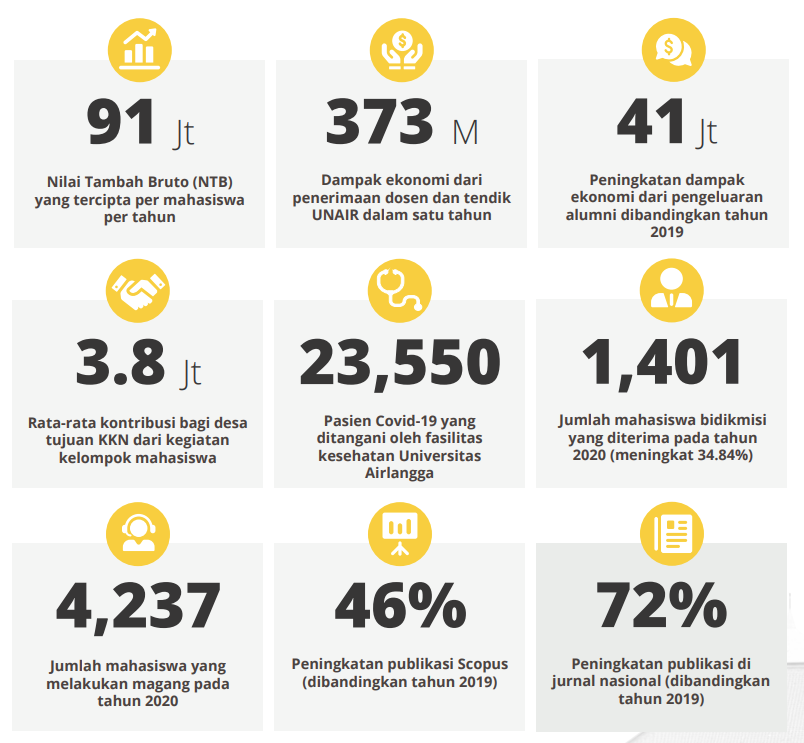
Universitas Airlangga has conducted a study to determine the economic and social impacts of Universitas Airlangga on the economy and society in 2020, as well as a portrait of Universitas Airlangga’s performance in various aspects. Through this study, Universitas Airlangga attempted to present evidence of its impact on the economy (of the society) and its social impact on the development of the university. Students, lecturers, education personnel, alumni, and other elements have contributed to the Indonesian economy both at the local and national levels. Several things revealed in this study are:
The above achievements show that the existence of Universitas Airlangga has had a positive impact on the community and shows the university’s determination to improve the quality of education and the quality of institutional development in order to become a university that is dignified, equitable, and beneficial to the community.
ECONOMIC IMPACT
CONTRIBUTION OF STUDENTS
The average student contribution to the economy or referred to as the ‘direct impact’ in one year was recorded at Rp189,640,235. This amount is 1.9 times greater than the total expenditure per student in one year, which is Rp91,350,627. The direct impact can be interpreted as a change in the economic level of the community due to direct expenditures made by students.
CONTRIBUTION OF STAFF
The economic impact of the education sector employment or the direct impact created was the absorption of 4,627 people. The estimate using the income multiplier for the government education service sector of 1.2 was Rp314,448,409,835. This figure shows that every rupiah earned can be spent in the economy again to produce something worth more than one rupiah.
CONTRIBUTION OF ALUMNI
The amount of alumni’s contribution to the economy varies depending on the sector. The average impact of alumni on the economy in one year was Rp122,705,116, which is Rp41,289,399 greater than the average annual income of alumni of Rp81,415,717. This amount is applicable to one person based on the first job salary for one year. The creation of further supply and demand will contribute to the economic growth and support people’s welfare.
SOCIAL IMPACT
STUDENT COMMUNITY SERVICE PROGRAM (KKN)
Students as agents of change play an important role at the forefront of the KKN implementation. For the smooth running of KKN activities, students contribute their resources. During the implementation of KKN, which is run for 26 days, each student spent Rp1,000,000. The amount spent by students in the villages in the 61st period was Rp1,248,485 per village while in the 62th period it was Rp6,519,428. These funds were distributed through expenses such as KKN-supporting activities, consumption, KKN facilities and infrastructure, travel costs, and other costs needed in the KKN destination villages.
BIDIKMISI STUDENTS
List of Bidikmisi Students’ Activities in 2020
In 2020 Universitas Airlangga admitted 1,401 Bidikmisi students, a significant increase (34.84%) compared to the previous year, which was 1,039 students. The proportion of Bidikmisi students to the total active students is 22.12%. Universitas Airlangga shows concern for the underprivileged not only through the large number of Bidikmisi students it admitted, but also by the provision of tuition fee waiver to students who have the KIP in the odd semester 2020/2021, totaling 1,718 students. This waiver also demonstrates Universitas Airlangga’s concern during the COVID-19 pandemic for all segments of the society, including the underprivileged.
One of AUBMO's community service activities, Bidikmisi Service Camp in 2020.
WORKFORCE
Voluntary student internship is one of Unair’s ways to contribute to the economy. Internship has a positive impact on the students, the companies/institutions, and the society. The positive impact for students is the hands-on work experience when faced with various cases and conditions. This encourages students to implement the knowledge gained in their coursework. For the companies or institutions, having student internships increases productivity with minimal expenses. The community also feels the positive impact, or termed “a positive externality”, especially the community around the internship place. This will be felt by the people who live around the school and health facility (hospitals, health centers, etc.) where student internships take place.
HEALTH IMPACT
Universitas Airlangga has contributed a lot to the prevention and control of Covid-19. Unair’s contribution in handling Covid-19 was its Universitas Airlangga Hospital (RSUA) being used as a referral hospital in handling Covid-19 and the university’s status as Covid-ready University.
COVID-19 HANDLING
Number of RSUA Covid-19 patients in 2020
9341
2425
1795
outpatients
emergency room patients
inpatients
239
surgeries
8443
RSUA swab test specimens
35943
ITD swab test specimens
UNAIR has also contributed in preventing the spread of Covid-19 by educating the public at large: the surrounding community in particular, and Surabaya population in general. The RSTKA (Ksatria Airlangga Floating Hospital) sailed to visit islets and outermost areas in the Sumenep islets in Madura to educate residents about Covid-19.
Fundraising was also carried out by UNAIR and stakeholders for Covid-19 related activities. These funds were donated to several public and private hospitals as well as communities affected by Covid-19.
COVID-19 PREVENTION
Universitas Airlangga also contributed to the prevention of Covid-19 through vaccination. A total of 21,234 vaccines have been given, both doses 1 and 2. The vaccines given were Sinovac, Astrazeneca, and Moderna.
Using the alumni network, Unair also mobilized the entire stakeholders by distributing a million masks which were part of the 66th Anniversary of Universitas Airlangga.
RESEARCH IMPACT
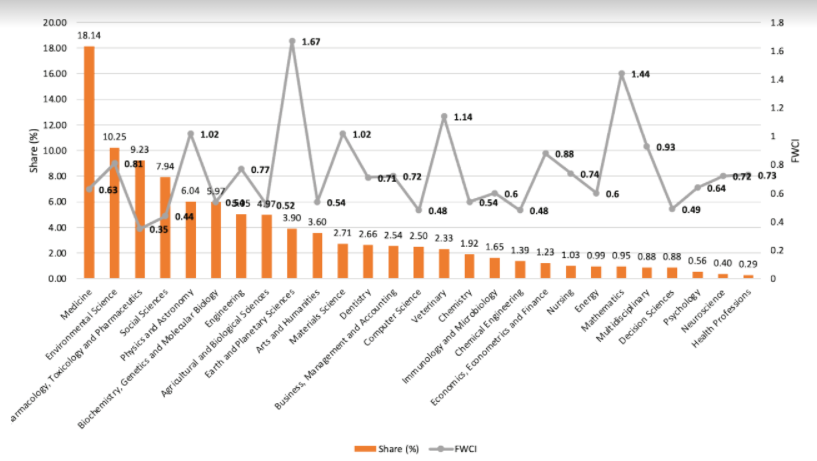
Publications, both at the national and international levels, have been done by the academic community of Universitas Airlangga to increase scholarly productivity as one of the important indicators of higher education performance. The following figure shows the classification of Universitas Airlangga publications based on the subject areas on Scopus-indexed journals. During the period of 2016 – 2020, Universitas Airlangga published 6,945 works, predominantly within the subject of Medicine, followed by Environmental Science, Pharmacology, Toxicology and Pharmaceutics.
Overall, Universitas Airlangga’s publications increased by 43% from 2,852 publications in 2019 to 4,075 publications in 2020. Publications on national journals and Scopus international journals have increased by 71% and 46%, respectively.
Read more about Universitas Airlangga’s social impact below:
UNAIR believes that collaboration and mutual cooperation with various parties, both domestic and abroad, will further deepen the impact. This is due to the fact that Indonesian people embrace the principles of mutual cooperation and unity. Strengthening collaboration does not only deepen the impact, but also facilitates the realization of the big vision to advance Indonesia.