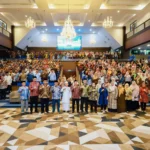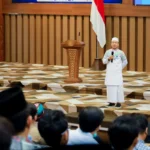
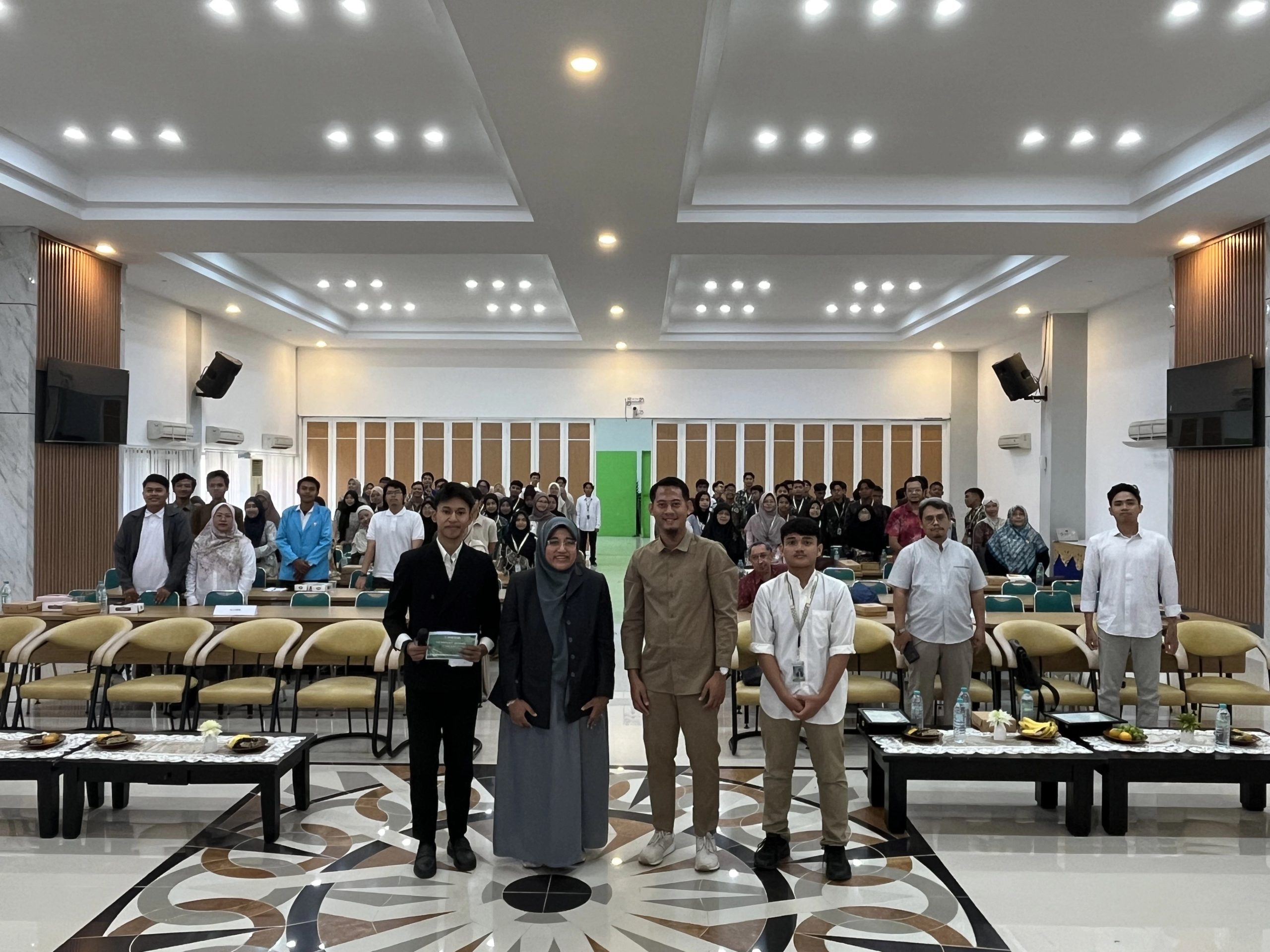
UNAIR NEWS – The Faculty of Economics and Business (FEB) Universitas Airlangga held an Islamic Business Seminar on Saturday (Sept 20, 2025). With the theme “Strengthening the Foundations of Islamic Economy as Strategic Driver for Business Transformation Towards Achieving the SDGs 2030,” the event featured Islamic Economics scholar Prof. Dr. Tika Widiastuti, S.E., M.Si., and Fadlkhera Official Founder, Wildan Salim, as keynote speakers.
Sharia entrepreneurship mindset
The first session highlighted the entrepreneurial journey of Wildan Salim, who began building his Muslim fashion brand in 2015. Despite starting with minimal capital, he remained committed to a long-term vision of educating the market while adapting to advancements in digital marketing.
“When you carry a big dream, you have an energy that never fades,” he said. Salim stressed that a powerful vision motivates ongoing innovation and perseverance. He channels this commitment by consistently upholding Sharia principles in his business practices, from interest-free contracts and transparent employment agreements to ensuring timely salary payments even during the pandemic.
Islamic Economics and the 2030 SDGs
In the second session, Prof. Dr. Tika Widiastuti, S.E., M.Si., emphasized that strengthening Islamic economic foundations is crucial for driving business transformation and achieving the Sustainable Development Goals (SDGs) 2030. She explained that the principles of maqashid shariah, protecting religion, life, intellect, lineage, wealth, and the environment, align closely with the 17 SDGs.
“Islamic economics is not merely about financial transactions; it is a framework that promotes sustainability and social justice. ZISWAF plays a significant role in reducing poverty and improving community welfare,” she said.
She also highlighted Evermos, a start-up that connects MSMEs with consumers through a Sharia-based distribution ecosystem. She noted that Evermos demonstrates how Islamic values can guide business transformation while making a tangible contribution to SDG progress.
Author: Era Fazira
Editor: Ragil Kukuh Imanto