UNAIR NEWS – Traditional livestock farming often struggles with slow economic turnover. Income from daily milk sales and inconsistent monthly carcass yields has yet to provide farmers with stable or optimal profit. However, livestock waste, typically overlooked, holds potential to be converted into additional products with economic value that farmers can process themselves.
Universitas Airlangga (UNAIR) is supporting this effort through a community service initiative titled Optimizing Sustainable Productivity of Sheep and Goats Through Integrated Finance, Feed, and Waste (KPI). The program is carried out with the Banyuwangi Goat Sheep Breeder group at Pak Tunggal Farm in Sumberagung Village, Pesanggaran District, Banyuwangi Regency.
Turning goat waste into biogas and vermicompost
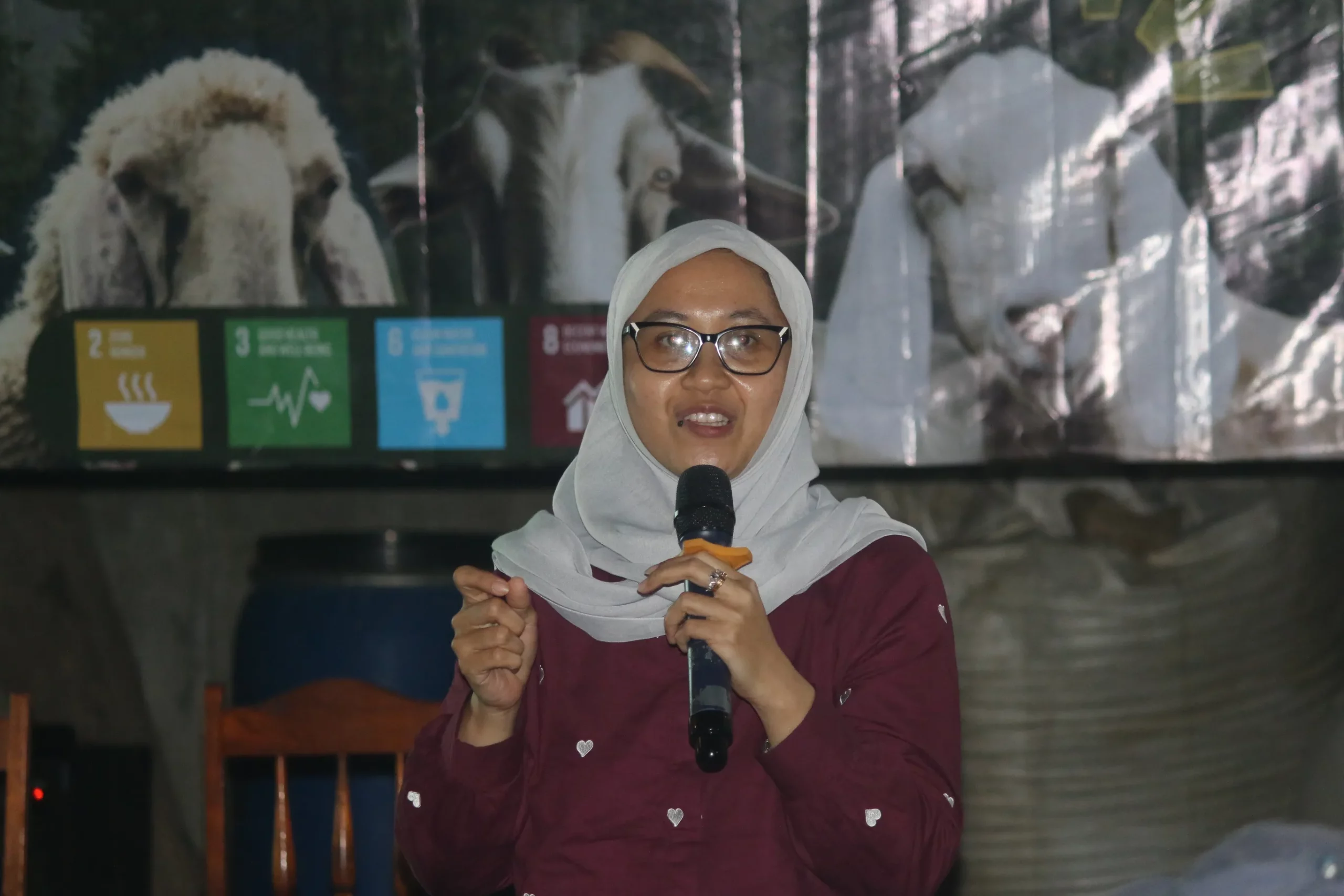
The first presenter, Dwi Ratri Mitha, S.T., M.T., explained that nearly all organic matter can serve as a biogas source. Data shows that the carbon-to-nitrogen ratio in goat manure is around 30, making it suitable for biogas production. Additionally, goats weighing between 30 and 100 kilograms produce manure amounting to roughly 3 percent of their body weight and urine totaling 1.5 percent.
“To produce biogas, goat manure must be placed inside an airtight digester, where anaerobic bacteria can break it down,” said the UNAIR Environmental Engineering lecturer during the session held on Saturday (Oct. 18, 2025), attended by 30 local residents.
Environmental Engineering lecturer Dr. Rizky Amaliyah Barakwan, S.T., noted that goat manure can also be processed into other useful products. Vermicomposting, she said, offers a simpler alternative. Using earthworms as decomposers, the process produces two outcomes: nutrient-rich organic fertilizer and worm biomass, which can serve as livestock feed or as a protein-rich raw material.

“In terms of equipment and cost, this is likely the most affordable method, farmers simply need to let the worms break down the manure into fertilizer or biomass,” she said.
Reaching wider markets
Development Economics lecturer Angga Erlando, S.E., MEc.Dev, explained that farmers must expand their business networks to maintain healthy financial flows. Currently, most locally produced dairy products are still sold to factories through middlemen.

He noted that fluctuating milk prices and inconsistent demand often leave farmers with unsold milk, particularly when storage facilities are insufficient. To address this, he encouraged farmers to adopt broader digital marketing strategies to connect with more customers.
“Farmers often use Facebook to communicate with potential buyers. But what they may not realize is that many of the audience members are actually other sellers,” he said.
Author: Azhar Burhanuddin
Editor: Yulia Rohmawati