

UNAIRNEWS – Long before he arrived in Poland, Kenny Simorangkir had already become familiar with disappointment. There were scholarship applications that did not work out. There was an opportunity to pursue a Bachelor’s degree in Music Business at New York University that ultimately proved financially out of reach. Like many students with international ambitions, Kenny learned that the path toward studying abroad is rarely straightforward. Then came an opportunity that changed everything.
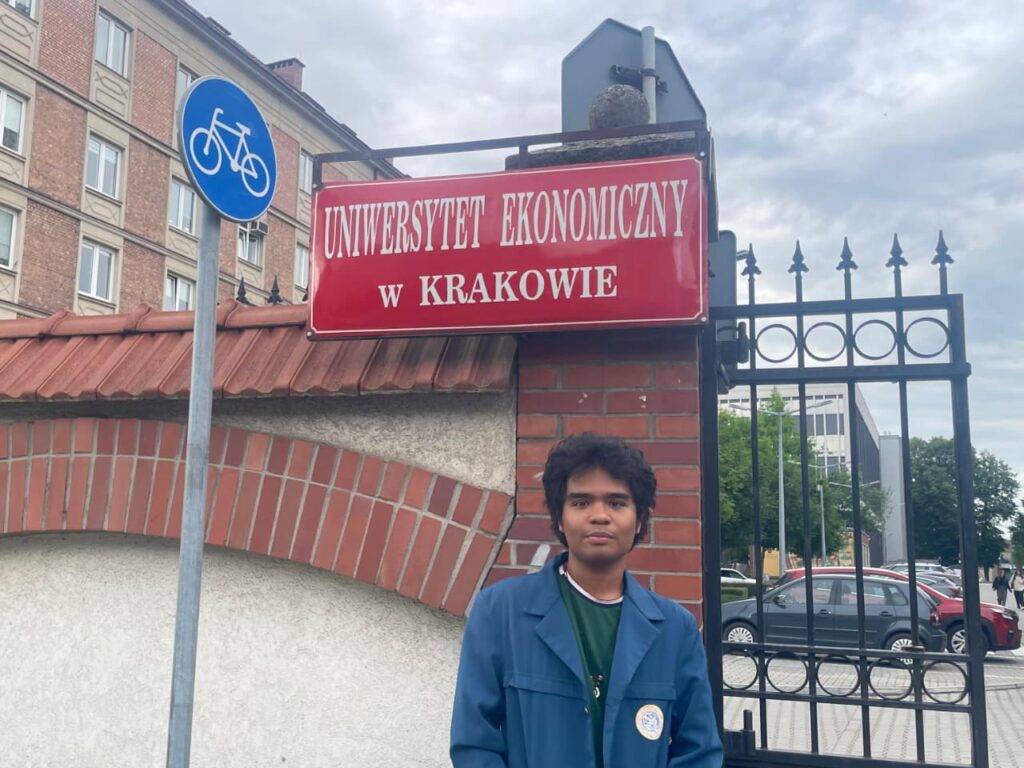
Through the Erasmus+ Student Mobility Program, the Universitas Airlangga student from the Faculty of Economics and Business spent a semester (February to June 2026) at the Kraków University of Economics (UEK) in Poland, a journey that would broaden not only his academic perspective, but also his understanding of culture, creativity, and himself.
“I’ve always been excited about trying new things, meeting new people, and starting fresh in a new place. When I discovered the Erasmus+ opportunity, it excited me more than anything,” Kenny said.
He first learned about the program while browsing the Airlangga Global Engagement website in search of study abroad opportunities. What began as curiosity soon became a turning point.
For Kenny, Erasmus+ represented more than an academic exchange. It was an opportunity to finally experience studying abroad while pursuing a long-standing interest in the global music industry.
“The mobility program gave me the chance to study abroad and build connections with professionals in the European music industry,” he explained.
At UEK, Kenny enrolled in courses from the Modern Business Management and International Business programs. One subject that left a lasting impression was International Market Research & Analysis, which introduced him to the ways culture shapes consumer behavior.
“Some people might rate a restaurant five out of five despite not being fully satisfied, while others might give it a four even though they enjoyed the experience,” he said.
The lesson extended beyond market research. It became a reminder that people often interpret the same experience differently, depending on cultural context.
Another course, Creativity Techniques in Project Management, resonated with him on a more personal level. As a musician, Kenny was fascinated by how creativity could be systematically integrated into project planning and execution.
“It helped me bridge creativity with technical execution,” he said.
The academic environment at UEK also felt different from what he had experienced at home. Courses were typically divided into lectures and workshops, allowing students to move between theory and practical application.
“This double approach helped me learn better,” he explained.
The flexibility of the learning system suited his independent learning style, while project-based assignments encouraged students to explore topics they genuinely cared about.
In one course, Kenny developed a policy paper on the Indonesia International Student Mobility Awards (IISMA), supported by professors whom he described as highly collaborative and responsive.
“They were wonderfully collaborative and always willing to help,” he recalled.
Yet some of the most valuable lessons happened outside the classroom. Adjusting to life in Kraków proved easier than he expected.
“By day three, I’d already made Kraków my home,” he said.
What initially felt unfamiliar gradually became an opportunity to rethink assumptions. Compared to Indonesia’s culture of murah senyum, warm smiles and outward friendliness, many Poles appeared more reserved.
Rather than viewing this as a barrier, Kenny learned to see it differently.“ I learned not to interpret neutrality as coldness,” he said. “It’s simply a different baseline of social expression.” That realization became one of the defining lessons of his exchange experience.
Through interactions with Polish classmates and fellow Erasmus students, he discovered that approaches to communication, teamwork, and problem-solving vary significantly across cultures.
Some people preferred direct and efficient communication. Others favored lengthy discussions and consensus-building.
“It made me realize that what we consider ‘normal’ is often cultural rather than universal,” he reflected.
Beyond Poland, Kenny took advantage of the opportunity to explore Europe, visiting six countries during his exchange semester.
One particularly memorable experience took him to Aarhus, Denmark, where he volunteered at a music conference. There, he gained firsthand exposure to the behind-the-scenes workings of the music industry, an area closely aligned with his career aspirations.
“What stood out most was how collaborative and open the environment was, despite everyone coming from different countries and professional backgrounds,” he said.
“What stood out most was how collaborative and open the environment was, despite everyone coming from different countries and professional backgrounds,” he said.
Kenny found himself navigating unfamiliar academic expectations, social norms, and moments of uncertainty. Building deeper connections in a culture that initially felt more reserved required patience and initiative. His solution was simple: stay curious.
“If something was unclear, I would directly ask, confirm, or experiment rather than hesitate,” he explained.
The approach helped him develop greater confidence in unfamiliar situations and strengthened his ability to adapt. Academically, the experience sparked a growing interest in international marketing and cultural strategy, particularly within creative industries such as music and events.
“It strengthened my interest in working in global environments where I can connect different audiences through storytelling and marketing,” he said.
Personally, the semester became a period of self-discovery. Unlike previous semesters filled with multiple commitments, Kenny chose to focus primarily on his studies and personal growth. He traveled alone, met people from around the world, and even performed his own song at an Erasmus event.
Each experience pushed him slightly beyond his comfort zone. “I’ve learned that I can handle challenges independently, even when things don’t go as planned,” he said.
Returning home, Kenny hopes to bring with him a more open and collaborative mindset, particularly when navigating cultural differences. Drawing from his own experience as a Bataknese student studying in Java, he believes intercultural understanding begins with a willingness to listen and adapt.
“The mobility program helped me navigate these differences with more awareness and adaptability,” he said.
For future Erasmus+ participants, his advice is straightforward. “Be open to discomfort and uncertainty, because that’s where most of the learning happens.”
The value of Erasmus+, he believes, is not simply the opportunity to study abroad. It is the chance to see the world, and yourself, from a different perspective.
Looking back, Kenny’s semester in Poland was not the journey he originally planned. But it became the journey he needed.
Sometimes, the opportunities that arrive after rejection turn out to be the ones that change us the most.
Author: Lintang AGE contributor
Editor: Duriati Asmawati, KheftiAl Mawalia