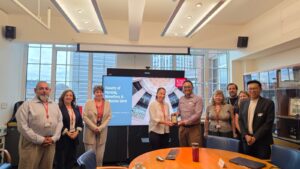


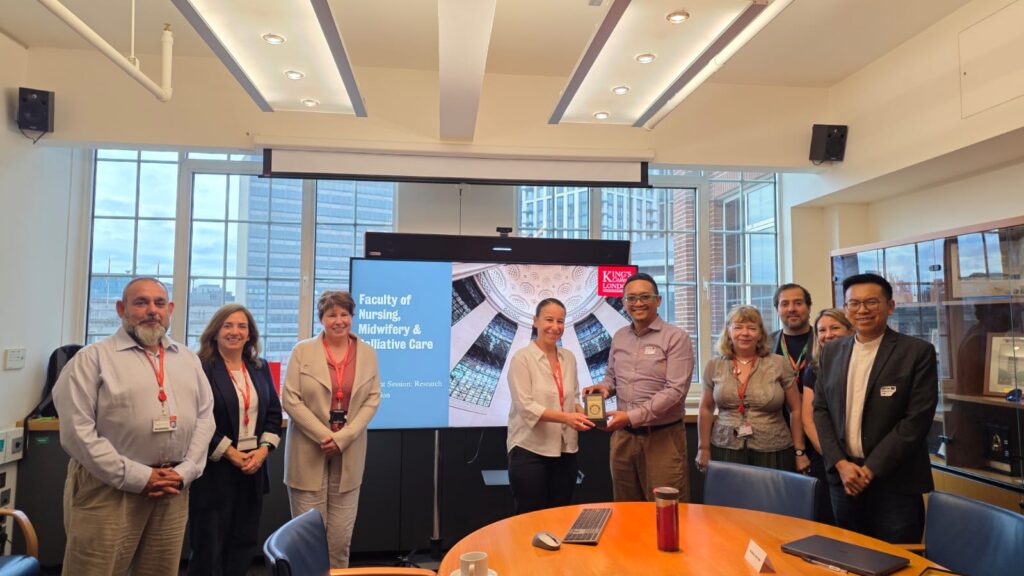
UNAIR NEWS – Universitas Airlangga (UNAIR) continues to expand its international research network in the health sciences. UNAIR Vice Rector for Research, Innovation, and Community Development (RICD), Prof Dr Muhammad Miftahussurur, dr MKes SpPD-KGEH PhD, led a UNAIR delegation in a meeting with King’s College London (KCL) on Monday, September 7, 2026, the James Clerk Maxwell Building, Waterloo Campus, London.
Prof Miftahussurur was joined by Prof Ferry Efendi, SKep Ns MSc PhD, Head of the Institute for Journal Development, Publication, and Intellectual Property (LPJPHKI) and a lecturer at UNAIR’s Faculty of Nursing (FKp). Representing KCL were Prof Richard Harding (Executive Dean), Dr Julia Philippou (Vice Dean International Engagement), Prof Glenn Robert (Vice Dean Research & Impact), Dr Maria Duaso, Dr Mary Leamy, and Dr Ehsan Khan, along with faculty teams overseeing research management, international partnerships, and digital learning.
UNAIR doctoral collaboration model
Prof Miftahussurur shared UNAIR’s experience in developing joint-supervision arrangements for doctoral programs with international partner universities. Under the model, doctoral students, particularly UNAIR faculty members, receive supervision from academic advisors at both institutions, with support from the Indonesia Endowment Fund for Education (LPDP), scholarships provided by partner governments, or UNAIR’s matching-grant schemes.
He said the model has created meaningful benefits for both sides. “Students gain access to international supervision and research facilities, while partner institutions gain opportunities for joint publications and stronger research networks,” said the UNAIR Faculty of Medicine (FK) lecturer. He proposed exploring a similar arrangement with KCL, while taking into account the needs and funding mechanisms of each institution.
UNAIR, he added, is also open to hosting KCL students in Indonesia for community service and clinical activities. These could include visits to community health centers (Puskesmas) and participation in community-based care programs, potentially linked to student mobility and credit-recognition arrangements at both universities.
Prof Efendi, meanwhile, outlined the UNAIR Faculty of Nursing’s research priorities, which include clinical and community nursing. He highlighted research on migration policies affecting Indonesian nurses, conducted in collaboration with the WHO, ILO, and IOM, as Indonesia prepares to become one of the region’s largest sources of nursing professionals.
AI-Based higher education innovation
The KCL team also demonstrated a digital learning platform designed to give nursing students access to virtual community-based clinical practice. Students can use the platform to review simulated patient medical records, interact with AI-powered patients, develop care plans, and receive reflective feedback on their work.
“The platform can be adapted to different languages and populations, creating an opportunity to tailor it to nursing education in Indonesia, particularly to help address differences in clinical learning infrastructure across institutions,” he explained.
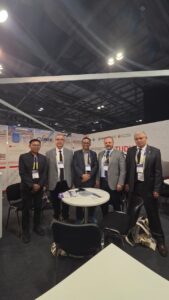
The two institutions also discussed regulatory considerations surrounding AI use and the protection of intellectual property arising from AI-based innovations. The meeting concluded with an agreement to identify shared priorities in research, education, and mobility, followed by further technical discussions through online meetings facilitated by Airlangga Global Engagement (AGE). The KCL meeting marked the first engagement of the UNAIR delegation’s working visit to the United Kingdom from September 7–12, 2026, which also includes participation in the European Association for International Education (EAIE) conference in Glasgow.
Author: Prof Ferry Efendi, SKep Ns MSc PhD
Editor: Khefti Al Mawalia