
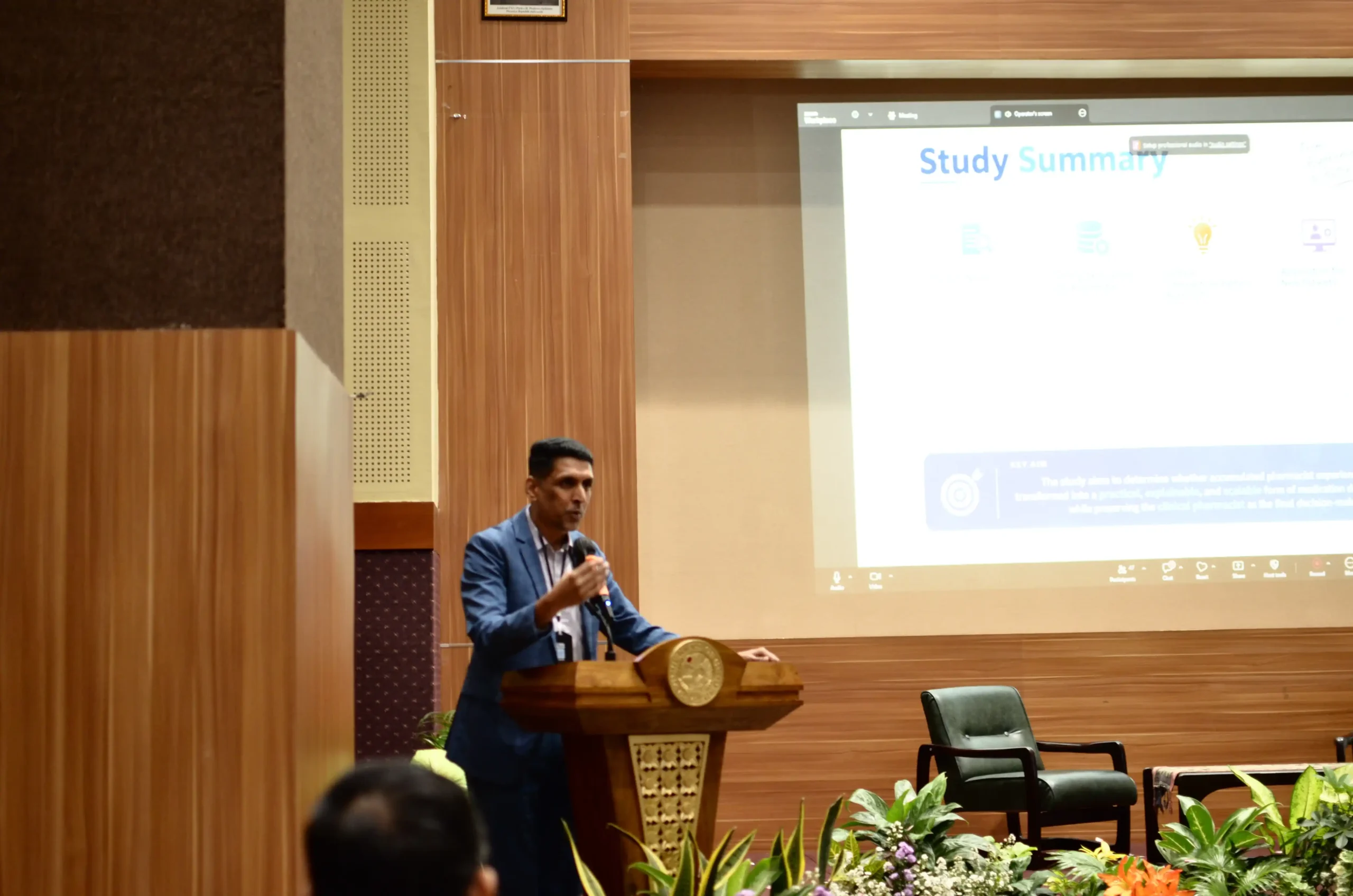
UNAIR NEWS – Faculty of Pharmacy (FF) Universitas Airlangga (UNAIR) conducted the International Graduate Student Conference on Pharmaceutical Sciences (IGSCPS) on Saturday, September 18, 2026. The event featured an international expert, Assoc Prof Baharuddin Ibrahim PhD, from Universiti Malaya, Malaysia.
In his presentation titled “Artificial Intelligence–Enabled Clinical Decision Support to Optimize Medication Therapy: Bridging Evidence and Practice”, Prof Ibrahim shared his team’s latest research result on the integration between Artificial Intelligence/AI and digital data technology in clinical pharmacy services.
Bridging gap in CPOE system adoption
Prof Ibrahim explained that the main focus of his team’s research is optimizing Computerized Physician Order Entry (CPOE), an electronic prescribing system which integrates with the Clinical Decision Support System (CDSS).
“The first project we undertook was to bridge the gap between adoption and success in the CPOE system. This is both an electronic prescribing system and a clinical decision support to help doctors in their decision-making,” he explained.
He added that hospitals in Malaysia already implemented the CDSS system, but its use has not yet been optimized. Therefore, his team is working to add more features and expand the database to help doctors make more precise clinical decisions.
The importance of understanding user perspectives
In designing the AI-based system, Prof Ibrahim emphasized the importance of involving medical workers from the primary stage. His research involved a Focus Group Discussion (FGD) with 14 doctors, 6 pharmacists, and 8 nurses at the Universiti Malaya’s teaching hospital, using thematic analysis model the Unified Theory of Acceptance and Use of Technology (UTAUT) and Information System Success Model.
“Before we develop the AI system, we need to understand the stakeholders first. The positive result, all of the medical workers liked this system because it gives a real benefit for the patients and directly integrates with their daily practical work,” he explained. Through this system, doctors are able to diagnose while automatically prescribing medication, supported by the CDSS recommendations.
Workflow challenges and alert fatigue
Although it offers significant benefits, the implementation of CDSS in the field is not without operational challenges. Prof Ibrahim highlighted two main issues, these are workflow interruption and excessive number of alerts/notifications.
“When a doctor prescribes medication, several issues arise due to CDSS. Clinical guidelines are updated annually, meanwhile the database system requires some time to synchronize. As a result, when a doctor uses the latest guidelines or specialized guidelines, the system will continue to issue alerts,” he explained.
In the closing segment, Prof Ibrahim reminded the researchers and pharmacy practitioners in attendance at UNAIR Faculty of Pharmacy to always prioritize the user’s perspectives in developing digital health systems.
“The main point I want to make today is when we develop a system, particularly an AI-based system, we must truly understand the perspectives of its user,” he concluded.
Author: Fauziah Laili Romadhon
Editor: Yulia Rohmawati