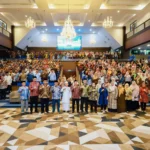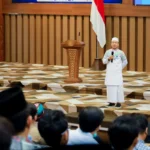
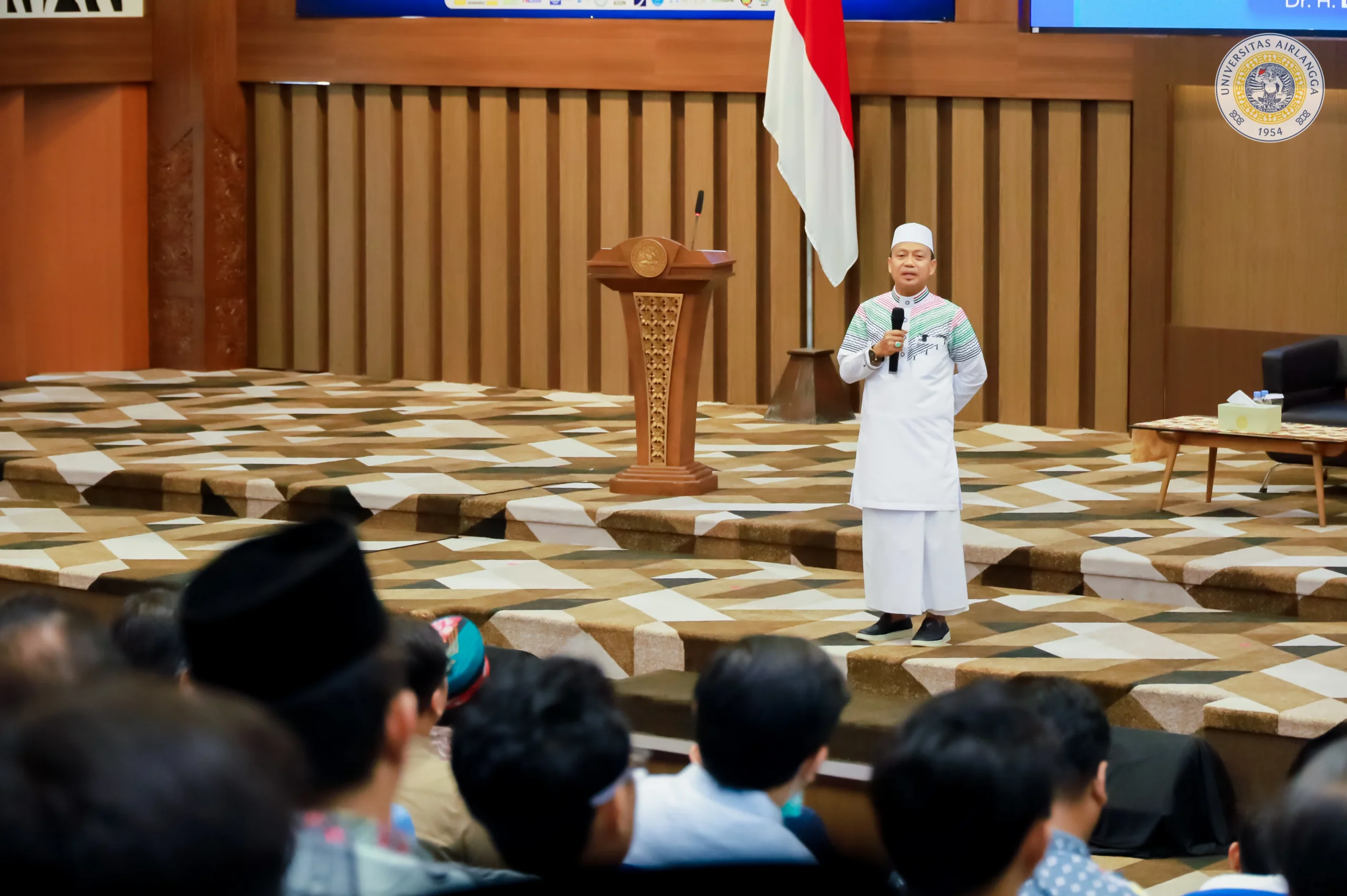
UNAIR NEWS – In celebration of its 72nd anniversary, Universitas Airlangga (UNAIR) held an Islamic study session with Dr H Das’ad Latif SSos SAg MSi PhD on Thursday (October 8, 2026), at Garuda Mukti Hall, Management Office, MERR-C Campus. The rector and university leadership, along with lecturers and administrative staff, filled the room.
In his lecture, Ustadz Latif emphasized that academic titles and positions are inevitably left behind. He described three deeds whose rewards continue to flow after a person’s death: righteous children, ongoing charity, and beneficial knowledge.
Students as ongoing deeds, manners above knowledge
Ustadz Latif said students are like children who will keep praying for their lecturers after they pass away. He urged lecturers not to stop at their academic teaching duties.
“We are not merely teaching students. What matters far more is teaching them to have good manners. Academic research completed without moral values will earn no reward in the hereafter,” he explained.
He also said that in teaching ethics and manners, lecturers need to lead by example. “As part of our teaching, we lecturers must also show students how to behave and what manners are expected, from modeling modest dress to how we communicate on social media,” he said.
Charity to ward off calamity, investment for the hereafter
He encouraged lecturers to give to charity diligently as a way to ward off calamity, stressing that people truly own only three things. “According to a saying of the Prophet, our wealth is only three things: the food we eat, the clothes we wear out, and the wealth we give away in charity,” he said.
He encouraged lecturers to help intelligent and virtuous students who struggle to pay for their education. He believed that the charity given would be what carries on the lecturers’ good deeds.
“No one ever becomes poor from giving to charity. What’s more, the knowledge students gain and share from our charity and educational support, will become an investment in our good deeds,” he concluded.
Beneficial knowledge stems from sincere intention
He explained that knowledge becomes beneficial when students put into practice what their lecturers have taught. “Teaching and sharing knowledge earns a reward, and that reward keeps growing when students pass it on,” he said.
Beneficial knowledge is not shared only in the classroom. Many other platforms can share it directly. “Nowadays there are many social media platforms, especially WhatsApp, which we use all the time. Through these, we can spread knowledge. If someone puts it into practice, we receive the reward too,” he said.
He added that beneficial knowledge begins with a sincere intention. “Start with small habits, such as performing wudu (ablution) before leaving home and maintain it, dressing appropriately as an educator, and sitting for a moment to pray before starting the day,” he said.
Author: Qurrota A’yuni Latifa
Editor: Khefti Al Mawalia