
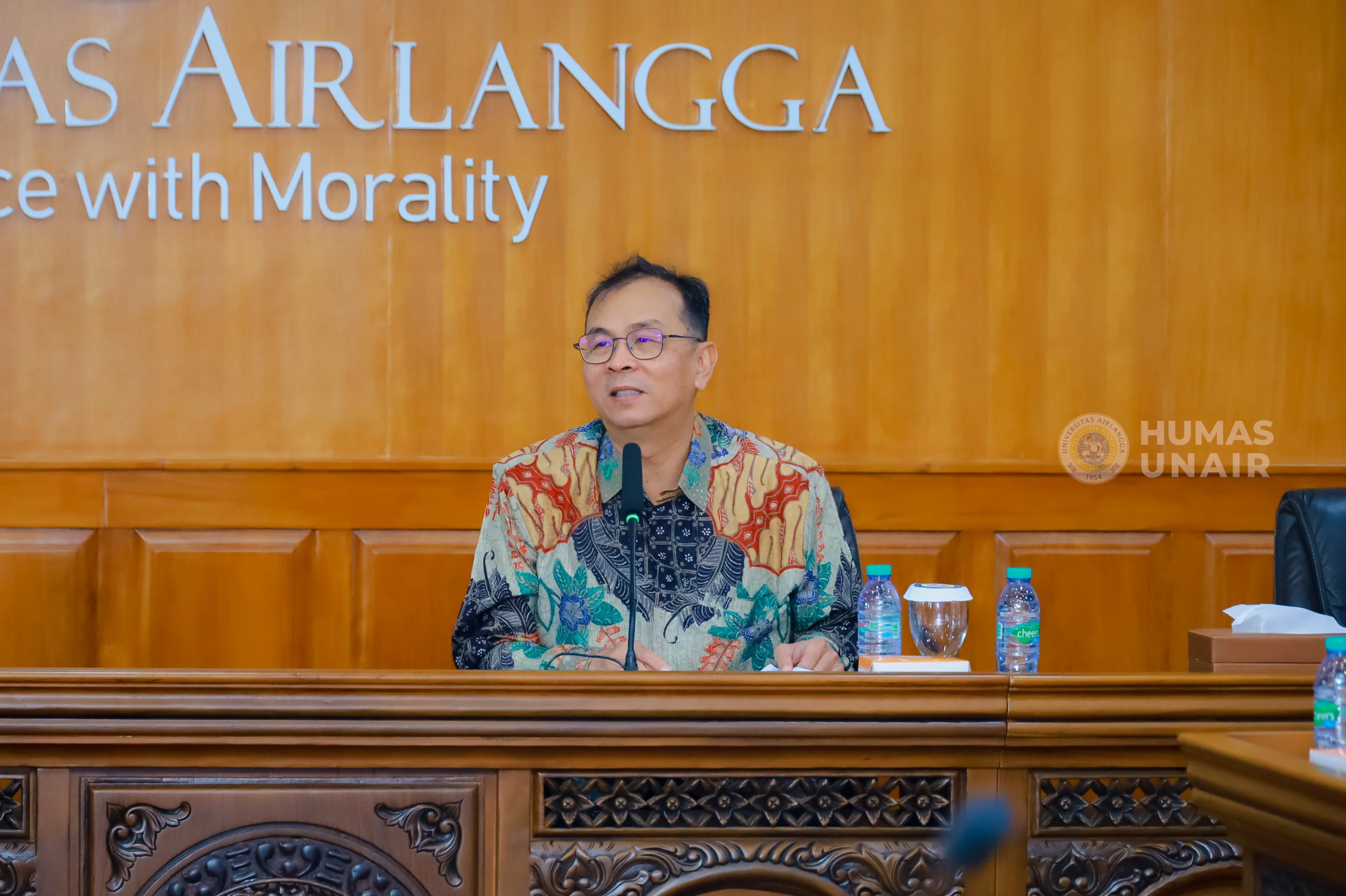
UNAIR NEWS – Universitas Airlangga (UNAIR) officially welcomed the assignment of the Evaluation of Improving Accessibility and Quality of Higher Education carried out by the East Java Province Representative Office of the Finance and Development Supervisory Agency (BPKP). The entry briefing forum took place at Balai Rua Room, 4th floor, Rectorate Building, MERR–C Campus UNAIR, on Thursday (November 5, 2026).
Commitment to no dropouts for economic reasons
UNAIR Rector Prof Dr Madyan SE MSi MFin affirmed that UNAIR always complies with the proportion of new student admission quotas under government regulations, from the SNBP track (National Selection Based on Achievement) at a minimum of twenty percent and the SNBT track (National University Entrance Exam) at a minimum of thirty percent, to the Independent Admission Track at a maximum of fifty percent. The setting of the Single Tuition Fee (UKT) is also managed fairly, rationally, and transparently through close coordination with faculties, by looking at comparisons from nearby universities and considering the economic capacity of the community.
Prof Madyan underlined UNAIR’s institutional commitment, which has consistently run for more than twelve years, namely guaranteeing the continuity of study for students who face financial barriers. UNAIR optimizes the Social Fund Management Center (PUSPAS) and UKT reduction and waiver schemes so economic problems do not stop students’ studies.
“We will not drop out (DO) students if the problem is economic. We will only DO students if the problem is related to academics. The presence of students at UNAIR is expected to be a real means of breaking the chain of poverty in society,” Prof Madyan stressed.
Furthermore, Prof Madyan said UNAIR also responds flexibly to fluctuations in students’ family economic conditions, which can change at any time during their studies. Fee adjustments are made based on proof of real conditions so students can finish their studies calmly.
“If out of five million they can only pay one million rupiah, we adjust the UKT. Even if proven unable to pay at all and supported by evidence, we waive that student’s UKT,” Prof Madyan added.
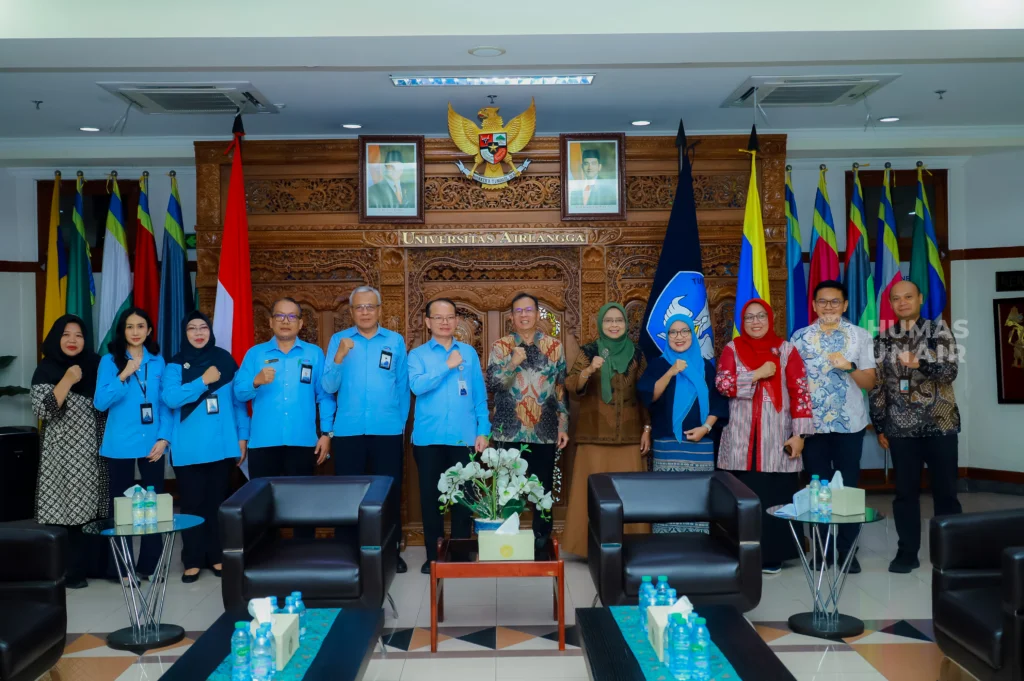
Evaluation of Legal Entity State University governance
Meanwhile, Head of the East Java Province BPKP Representative Office Hasoloan Manalu SE MM explained that the evaluation aims to assess the effectiveness of higher education policy and governance at Legal Entity State Universities (PTN-BH).
The evaluation covers the implementation of Fiscal Years 2025 and 2026. The main targets include the accuracy of Indonesia Smart Card for College (KIP-Kuliah) assistance and Higher Education Affirmation (ADik) Scholarships, UKT transparency, the efficiency of internal quality assurance, and graduate absorption into the workforce.
“Our main goal is to assess the effectiveness of higher education policy and governance in improving access to and quality of education. We hope for objective and real data support from UNAIR so this evaluation produces the best recommendations for shared progress,” Manalu said.
The series of activities ended with technical sharpening divided into two working groups. The first team, in charge of PTN-BH Governance, held discussions at Balai Rua Room involving the Legal Division of the Finance Directorate, DitSDMMTPO, DitPILAR (Directorate of Infrastructure, Environment and Operations Management), and the Directorate of Academic Affairs and PPMB. The second team, overseeing the UKT and KIP evaluation, held discussions in Room 305 involving the Directorate of Student Affairs and the Finance Directorate to ensure the evaluation process runs accountably and transparently.
Author: M Yasir Dharmawan Diniy
Editor: Khefti Al Mawalia