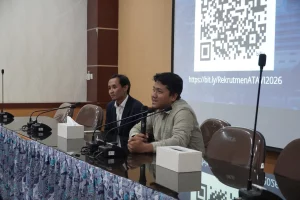


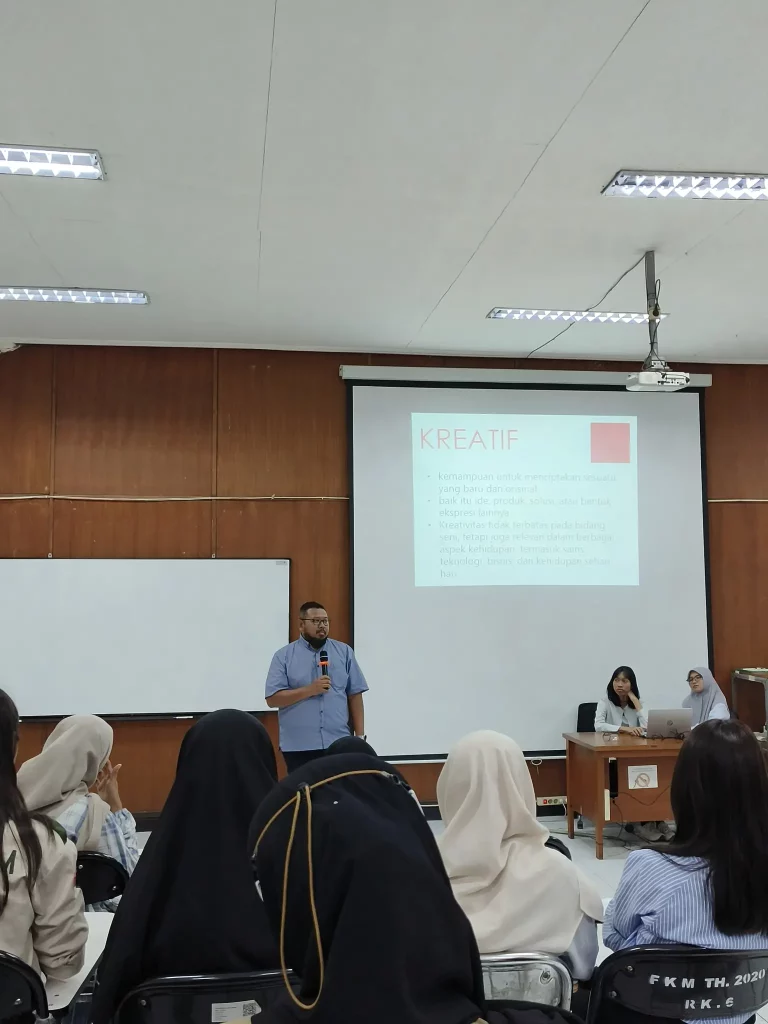
UNAIR NEWS – The Student Executive Board of Universitas Airlangga’s Faculty of Public Health (BEM FKM UNAIR) hosted the first session of the PKM On Training series on Tuesday, April 22, 2025. The event was designed to help students prepare for the Student Creativity Program (PKM), which serves as a gateway to the prestigious National Student Science Week (PIMNAS). The session featured expert speaker Dr. Pulung Siswantara, S.KM., M.Kes.
Spotlight on creativity
Siswantara emphasized that creativity is a central criterion in PKM evaluations. He advised students with purely commercial interests to consider other programs, such as P2MW, which are better suited to entrepreneurial endeavors.
“If your focus is simply selling a product, P2MW is the better fit. But if you’re offering something innovative with a creative twist, that’s where PKM comes in,” he said.
He also shared practical advice on how to foster creativity, encouraging students to step away from screens and engage with their immediate environment. “Put your phone down, shut your laptop, and log off social media. Take a moment to observe the world around you—that’s where real creativity comes from,” he urged.
He noted that digital content is often shaped by algorithms and external influences, which can limit original thinking. “Your phone mirrors your thoughts, so your creativity ends up stuck in the same loop,” he added. He encouraged students to listen to real-world problems and public concerns.
“That’s where you’ll find the seeds of new and impactful ideas,” he said.
Administrative accuracy emphasis
In addition to creativity, Siswantara underscored the importance of adhering strictly to administrative requirements. He pointed out that formatting and compliance with the official PKM handbook are often overlooked but essential.
“Keep in mind, there are over 10,000 PKM submissions. Each reviewer has to go through more than 2,000 proposals in just a month. The ones that don’t follow administrative guidelines are immediately disqualified,” he stressed.
He also warned students not to base their proposals on outdated examples from previous years, but to follow the most current guidelines. “Use the official template. Read the guidebook thoroughly. Don’t rely on hand-me-downs from older students. The guidelines are constantly updated,” he explained.
According to Siswantara, many proposals fail not because the ideas are weak, but because they don’t follow the proper structure.
“They’re rejected not due to lack of creativity, but because of formatting errors,” he concluded.
Author: Septy Dwi Bahari Putri
Editor: Khefti Al Mawalia