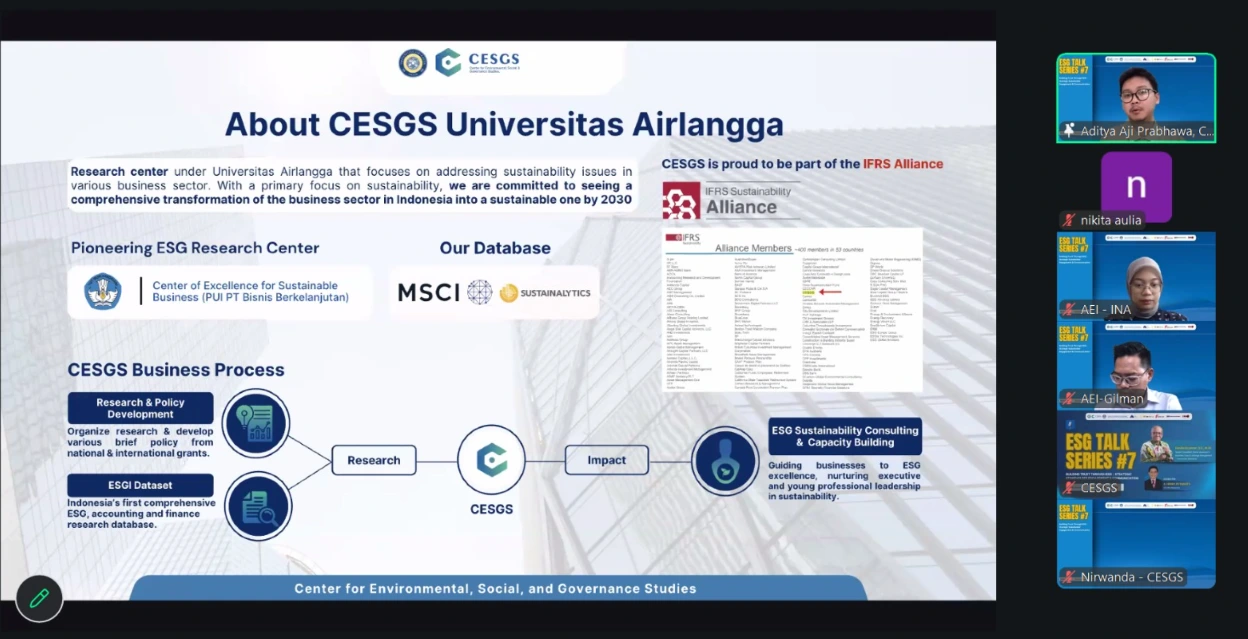
UNAIR NEWS – The Center for Environmental, Social, and Governance Studies (CESGS) at Universitas Airlangga (UNAIR) hosted ESG Talk Series #7 virtually on Thursday, April 9, 2026. The session featured Fandis Ekyawan, S.E., M.M., a Senior Consultant, Senior Assessor, and Business Coach at the Management Institute of Universitas Indonesia, with S. Herry Putranto, CEO of Biro Nusantara, moderating the discussion.
The event drew participants from diverse backgrounds, including academics and business practitioners interested in sustainability and ESG implementation. In his presentation, Ekyawan highlighted that ESG has become a central concern for investors, regulators, and the public. He noted that companies now face challenges not only in producing ESG reports, but also in fostering meaningful stakeholder engagement, as real-world implementation is often more complex than documented frameworks suggest.
ESG and the challenge of Greenwashing
Ekyawan opened his remarks by discussing greenwashing, a practice in which companies project an environmentally responsible image that does not fully align with their actual practices. He pointed out that this issue remains prevalent, even among major corporations across industries. Data presented during the session indicated that greenwashing is still widespread in Europe and the United States and is increasingly emerging in Asia, particularly in sectors such as oil and gas and finance.
He emphasized that the primary issue is not a lack of commitment, but rather a disconnect between stated commitments and their execution at the strategic level. “Many companies already have ESG policies and reports, but these have not yet been fully embedded in decision-making processes,” he said.
The gap between communication and implementation
Ekyawan further explained that the core challenge lies in the misalignment between communication and execution across organizational units. While many companies have established ESG frameworks, these are often not reflected in day-to-day operational decisions.
This misalignment creates a gap between external communication and internal implementation. Tools such as stakeholder engagement, materiality assessments, and sustainability reporting are frequently treated as procedural requirements rather than as strategic decision-making instruments. Drawing from global cases in industries such as automotive and aviation, he noted that major failures often stem from early warning signs that are overlooked, highlighting the importance of management in ensuring comprehensive ESG integration.
Advancing ESG integration in corporate strategy
In his closing remarks, Ekyawan highlighted that ESG should be positioned as a core element of business strategy rather than a supplementary component. He stressed that the success of ESG implementation should be measured not by the thoroughness of reporting, but by how deeply ESG values are embedded within corporate strategy and culture. He also observed that many companies remain at the compliance stage, where reporting becomes increasingly complex without corresponding shifts in business priorities or cross-functional collaboration.
Through this session, participants gained a deeper understanding of the importance of adopting a strategic and integrated ESG approach, ensuring that ESG serves as a driver of meaningful and sustainable business impact rather than merely a formal requirement.
Author: Nikita Aulia Editor: Ragil Kukuh Imanto